


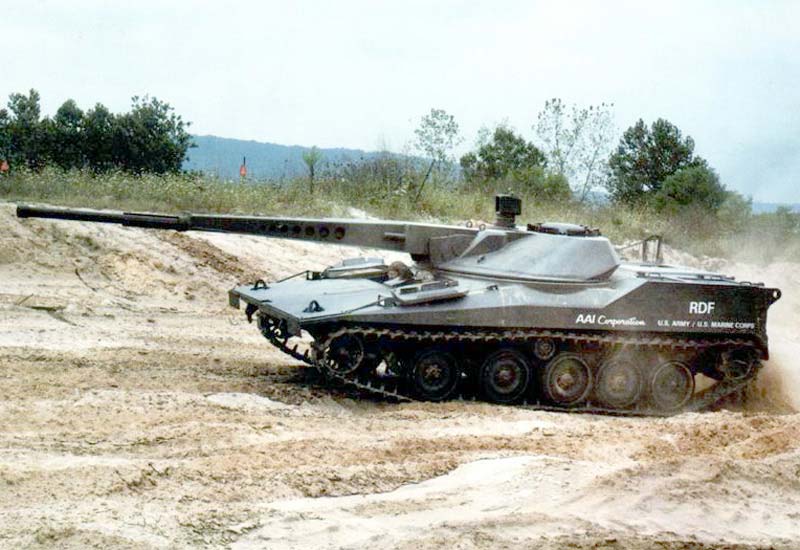
History of AAI Rapid Deployment Force/Light Tank (RDF/LT)
In 1980, the Soviet Empire remained the enemy of the United States and its allies. Thus, World War III is likely to be Europe-centric and, like World War II, will rely heavily on massive armoured forces fighting for control of key positions. Despite the advent of nuclear weapons, it is likely to remain a conventional war, fought using conventional equipment and using the latest technology.
A key component of such a conflict will be rapid response and the flexibility of forward combat forces, for which the U.S. Army is trying to use a light tank that can be airlifted and ready within minutes of disembarking.
This led to the 1980 Rapid Deployment Force/Light Tank (RDF/LT) specification requirement.
In response, AAI began privately developing a light tank, hoping to attract interest from the U.S. Army.
The original 14.5 ton (short) pilot vehicle had a 76mm main gun mounted in a two-man turret with a crew of three - the driver in the forward fuselage and the commander and gunner in the compact turret assembly. The main gun was equipped with a muzzle brake with two deflectors, while the 76mm shell was mounted on the lower right side of the fuselage.
The engine is usually located at the rear of the design. AAI has also developed a modular power pack arrangement that allows repairs/replacements to be performed quickly by using pull-out rails on the engine bay that provide the required access.
This prototype is the first of several related prototype vehicles for RDF/LT requirements.
Subsequent prototypes featured an all-new, in-house developed high-speed M32 75mm cannon using "casingless" ammunition and burst fire. The caseless aspect allows for the use of one-piece ammunition, and the spent case can be ejected from the hull to avoid buildup. The burst quality came from the consideration that the gun would ensure proper penetration of all existing Soviet armor by firing five 75mm shells (in succession) in an area.
The AAI also upgraded the M32 to be a dual-purpose gun, as the system could be used against low-flying aircraft when raised, as in self-propelled air defense (AA) systems.
It was this second pilot vehicle, which was subsequently developed further, in three different forms, centered on a rapid-firing 75mm gun. The first ship was piloted by a two-person turret with a crew of three, while the second ship departed from this design initiative and was completed with an unmanned turret with a two-person (now reduced) crew living side by side in the aircraft body. Each location is granted an entry hatch with visual blocks attached.
Not only does this allow for a lower profile and a compact design, but it also enables a certain amount of weight reduction. The third proposed company is similar to the second in most respects, except for the dual quad-shot Stinger short-range surface-to-air missile systems, which are added to the sides of the main guns to further strengthen tank defenses.
The plane rolls.
AAI designed its RDF/LT to compete with the latest light tank offerings, with improved ability to fire while moving, high maneuverability (low profile), some amphibious capabilities, and a fin stabilized main gun with high velocity projectiles. In addition, portability is key to the vehicle, and two units can be stowed (in tandem) in the fuselage of a single Lockheed C-130H Hercules transport aircraft.
From the looks of it, RDF/LT had a very clean, somewhat futuristic design profile at the time. Glacis panels slope well and lead to two crew hatches on top of the fuselage. As usual, the engine is housed in the rear compartment, and the turret manages the main armament, placed in the center of the design and rotating on a circular platform. The main gun towers above the hull and gains a 360-degree unobstructed firing angle. The landing gear consists of five twin-tire wheels on one side of the track, with the drive sprocket at the rear and the track idler at the front - the track attachment system itself is borrowed from the M113 armoured personnel carrier.
A hinged support assembly was added to the front of the fuselage to lock the main gun in the drive configuration.
Internally, both the commander and gunner received M32 sights, while the gunner's position also included a laser rangefinder for increased accuracy. A thermal imaging sight assembly is suggested as an optional component, along with a digital fire control system (FCS) using the AN/VSG-2 series of sights, the AN/GVS-5 laser rangefinder, and a digital ballistic computer.
On-board communication is via an AN/VRC 43 unit, while power is provided by six coupled 12 volt 24 VDC batteries.
Power will be provided by a 350-horsepower Detroit Diesel 6V53T turbodiesel engine mated to an Allison Cross Drive X-200 transmission. The chassis is suspended on a torsion bar setup for the required off-road travel. The RDF/LT has a top speed of 40 mph on ideal road surfaces and a range of 310 miles (depending on operating conditions).
Additionally, the basic hull design can traverse up to 40 inches of open water with a usable 20 inches of bottom clearance.
The main armament is the M32 high-speed 76mm main gun that can fire APFSDS (armor-piercing, fin-stabilized, falling case), HE (high-explosive) and smoke grenade from 50 projectiles from the front of the fuselage. The turret provides +22 elevation and -10 droop while relying on hydraulic power and manual power for failsafe by default.
Secondary armament is a 7.62mm M240 coaxial machine gun with 2,600 rounds of ammunition, which can be used as a backup unit or against enemy infantry positions.
Despite the impressive dimensions of AAI's RDF/LT, the US Army has not shown much interest in the design, mainly because the Army requires their future light tanks to be equipped with the same Standardized main guns were logistically friendly at the time. In this way, the new tank will be able to use the entire available inventory of existing US tank weapons.
Specification
Basic
Roles
- Air Defense/Airspace Denial
- Infantry Support
- Tank vs Tank
- Reconnaissance (RECCE)
Dimensions
26.90 ft (8.2 m)
8.20 ft (2.5 m)
7.22 ft (2.2 m)
16 tons (14,800 kg; 32,628 lb)
Performance
Performance
64 km/h
298 miles (480 km)
for everyone else in our database)
Armor
The turret houses a 75mm M32 autoloader autocannon.
1 x 7.62mm M240 coaxial machine gun in the turret.
50 x 75 mm projectile.
2,600x7.62mm ammo.
Changes
RDF/LT - Base Family Name
RDF/LT 1 - first prototype; two-man turret, three-man crew, with 76mm main gun.
RDF/LT 2 - Second prototype with a high-speed, rapid-fire 75mm M32 main gun mounted in a two-man turret; trio.
RDF/LT 3 - third proposed prototype; hull crew of two; unmanned turret with autoloader.
RDF/LT 4 - Final Proposed Prototype; Hull Two Crew; Two Quad Stinger Rocket Launchers Added to Turret.
 Argentina
 Armenia
 Australia
 Austria
 Austria-Hungary
 Belgium
 Brazil
 United Kingdom
 Brunei
 Bulgaria
 Canada
 Chile
Chile China
China Colonial America
 Colombia
 Confederate States
 Croatia
 Czech
Czech Denmark
 Egypt
Egypt Finland
 France
 Georgia
 Germany
 German Imperial
 Greece
 Holland
 Hungary
 India
India Indonesia
 Iran
Iran Iraq
Iraq Ireland
 Israel
 Italy
Italy Japan
Japan Japan (1940)
 Jordan
 Kingdom of Italy
 Malaysia
 Mexico
 Myanmar
 Nazi Germany
 Netherlands
 New Zealand
 North Korea
 Norway
 Pakistan
 Peru
Peru Philippines
 Poland
 Portugal
 Prussia
 Romania
 Russia
 Saudi Arabia
 Serbia
 Singapore
 Slovakia
 Slovenia
 South Africa
 South Korea
 Soviet Union
 Spain
Spain Sweden
 Switzerland
 Syria
Syria Taiwan
 Thailand
 Turkey
 UAE
UAE Ukraine
 Vietnam
 Yugoslavia