




History
The Soviet Union first introduced the concept of the Large Infantry Fighting Vehicle (IFV) to the USSR with a family of BMP vehicles that started with the BMP-1 in 1966 and evolved into the modern BMP-3 World Introduced in 1987, the world took notice and developed it Own counters, including American M2/M3 Bradley, British Warrior and German Marder. Combining the firepower of a light tank with the troop-carrying capabilities of an armored personnel carrier (APC), the IFV is capable of transporting combat-ready infantry in relative safety, dismounting them, and directing an attack using artillery, machine guns, and anti-tank missiles. - Machine gun support - Tank missile weapons.
Sweden, with its long (and successful) history of domestic solutions, embraced this development and developed its excellent Combat Vehicle 90 ("Stridsfordon 90") infantry fighting vehicle to keep pace.
The CV90 started in the early 1980s and in 1984 the Swedish Army needed a modern tracked infantry fighting vehicle with excellent mobility, protected troop transport and strong base firepower. Bofors Defense and Hagglunds & Soner founded HB Utveckling in 1985 as a holding company for the design, development and joint production of new vehicles under the direction of the Swedish Defence Materiel Administration. Several vehicle test rigs were also ironed out, as were various tower accessories. The original committee requested five pilot vehicles, which were delivered for formal evaluation in 1988.
In 1991, after passing the tests, the vehicle was ordered for series production under the designation "Stridsfordon 90" or "Combat Vehicle 90", abbreviated as "CV90". Production will begin at the Hagglund factory, where the landing gear, power unit and chassis will be attached to the fuselage. From there, the systems would be sent to Bofors to receive their turrets and weapons and be completed before delivery to the Swedish army. Production started in 1993 and more than 1,125 cars are currently (2013) produced.
The CV90 is now a product of BAe Systems AB.
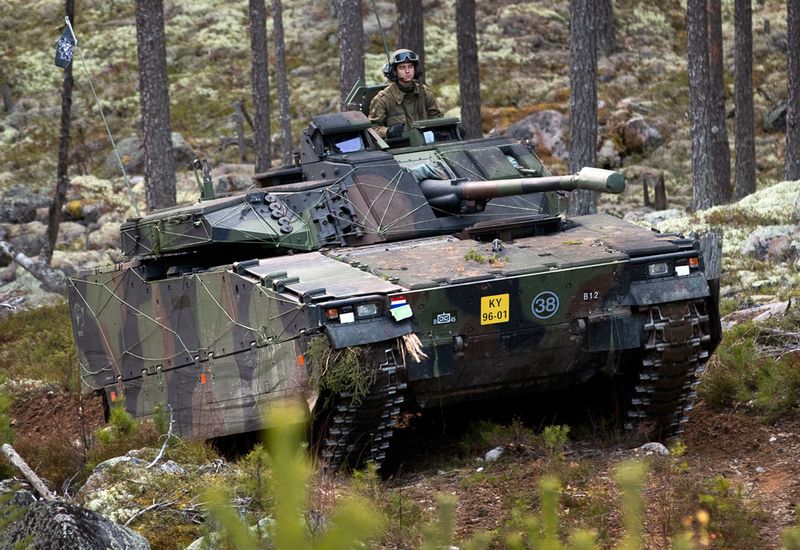
Externally, the appearance of the CV90 is consistent with the infantry fighting vehicles of that era. The internal configuration consists of the driver and engine in the front of the hull, the turret in the middle, and the fighting compartment in the rear. Its tracked design allows for relatively unobstructed travel both off-road and on-road. The glacis panels slope towards the roofline and provide a flat profile along the horizon.
A gate is installed at the rear of the vehicle, the sides of the hull are vertical and protected by a thin armored skirt with a slightly serrated design. The turret itself is well sloped on all sides for minimal ballistic protection. Due to the differences in the weapons available in the CV90 vehicle series, the displacement of the series can vary from 25 tons (short) to 39 tons (short). The vehicle is protected against 30mm Armor-piercing, Fin Stabilized Sleeve (APFSDS) projectiles, cannon spray and small arms fire.
Additional armor blocks can be installed to enhance protection in frontline urban environments and more. The vehicle is also equipped with an NBC (Nuclear, Biological, Chemical) protection kit and automatic fire extinguisher, as well as night vision goggles for the three crew members.
Its inherent design form also provides a low profile, making it more difficult to successfully engage long-range targets.
Standard combat personnel include the driver, commander, and gunner. The driver maintains the front left position of the fuselage under the armored hatch with large sight glass, and the power pack is located to his right, opening the middle and rear of the fuselage to the turret and passenger compartment.
The turret houses the commander and gunner in the traditional way. Passengers (up to 8 combat infantry) sit on two benches facing the centerline and enter and exit through a power door at the rear of the hull. The cabin also allows multiple infantrymen to emerge through the top of the hull through hatches and provide some fire support using their personal weapons.
Unlike some other vehicles in this class, the cabin is not fitted with ignition vents.
The CV90 is powered by a Scania DSI Type 14 or Type 16 V8 diesel engine producing 550 to 810 hp depending on engine specification. That's paired with an automatic transmission and torsion bar suspension, and it's capable of a top speed of 44 mph and a range of about 200 miles.
The undercarriage consists of seven twin-tire wheels on one side, with the drive sprocket at the front and the chain idler at the rear.
While the CV90 is traditionally equipped for the Swedish local army with a turret-mounted 40mm Bofors autocannon and a 30mm Bushmat II/35mm Bushmat III autocannon for export. The turret is capable of full 360-degree powered traversal, allowing engagement of ground targets at any angle. If the tower loses power, staff can manually operate it.
It is worth noting that the turret is not really centered along the fuselage roofline, but is slightly offset to the left due to the sideways mounting of the engine. Self-defense is provided by a coaxial 7.62mm Browning machine gun.
The vehicle is also equipped with 6 electric-start smoke grenade launchers for dynamic screening programs.
The original CV90 production model in 1993 was designated as "CV9040" in Swedish Army inventory. It is followed by the modified CV9040A with a gyro-stabilized main gun system and the CV9040B with a fully stabilized main gun. The CV9040C becomes the overseas variant of the Swedish army for UN missions and comes with enhanced armour protection and an optional high temperature climate kit. The export version of the CV90 became the CV9030 and used the 30mm Bushmaster II automatic cannon.
The successor brand is the CV9035 with a 35mm "Bushmaster III" automatic cannon. The CV90 is also available as a Forward Command Vehicle (FCV) with special navigation equipment and advanced communications equipment, a Forward Observation Vehicle (FOV) with advanced sensors and an Armored Rescue Vehicle (ARV) variants - all three vehicles are equipped with Defense system machine gun. Grkpbv 90120 ("Granatkastarpansarbandvagn") was developed as a self-propelled mortar for fire support in conjunction with a 120mm field mortar. The "armadillo" was developed into a special armored personnel carrier (APC). Designation CV90105 marks a series of light tanks with large turrets, armed with a 105mm main gun.
The CV90120-T is nothing more than a light tank with a 120mm main gun.
The CV90 had to wait until the end of 2007 for its debut (in Norwegian hands) as part of the UN coalition following the 2001 US-led invasion of Afghanistan. The main enemy is the Taliban forces, which have a unique combination of guerrilla tactics in a hostile environment. In addition, the real threat of landmines and improvised explosive devices (IEDs) has been confirmed on the scene. The CV90 performs well in hot, dry climates, attracts targets with good results at all ranges, and even proved effective against improvised explosive devices of all sizes during its tenure - although some cases have taken habitation away the life of the person.
The Afghan contingent included CV90s of the Swedish and Danish armies.
While the CV90 has been evaluated in the US, Canada, UK, Poland and Indonesia, the official operators are still Denmark, Finland, Netherlands, Norway, Switzerland and Sweden (basically the whole of Scandinavia) . Of these, Sweden is by far the largest such operator in terms of volume, with 551 service vehicles. Switzerland manages 186 systems and Norway manages 146 instances. Finland followed with 102 and Denmark with 45.
All data are from April 2013.
October 2018 - The Swedish CV90 Mark IV is vying to be the replacement for the US Army's aging M2 Bradley family of vehicles (as part of the Next Generation Fighting Vehicle program). The Mark IV entry represents a more robust variant that offers improved performance figures. The brand carries D-series turrets that can be replaced with an optional unmanned form.
The electronics are 4th generation and active damping technology improves off-road speed and performance.
Specification
Basic
Roles
- Technology
- Infantry Support
- Tank vs Tank
- Reconnaissance (RECCE)
- Troop Transport
Dimensions
6.55m
10.17 ft (3.1 m)
2.7m
30 tons (27,000 kg; 59,525 lb)
Performance
Performance
70 km/h
199 miles (320 km)
Armor
1 x 40mm Bofors Automatic Cannon (Swedish Army) or 1 x 30mm Bushmaster II Cannon or 1 x 35mm/50 Bushmaster III Cannon (Export).
1 x 7.62mm Browning Coaxial Machine Gun.
2 x 3 Smoke Grenade Launcher.
350 x 40mm bullet.
1,200x7.62mm ammunition.
6 x Smoke Grenade.
Changes
CV90 - Basic Series Name
CV9040 - Original production vehicle for the Swedish Army; equipped with a 40mm Bofors automatic cannon.
CV9040A - Updated Swedish Army CV9040 vehicle; gyro-stabilized main gun.
CV9040B - Swedish Army modernized CV9040 vehicle; fully stabilized main gun.
CV9040C - Swiss Army special overseas variant; increased armor protection; optional cooling equipment.
CV9030 (CV90 Mk II) - Export model; armed with a 30mm Bushmaster II cannon.
CV9030N (CV90 Mk I) - Norwegian Army designation for CV9030.
CV9030FIN (CV90 Mk II) - Finnish Army designation for CV9030.
CV9030CH (CV90 Mk II) - Swiss Army designation for CV9030.
CV9035 (CV90 Mk III) - Export model; equipped with a 35mm Bushmat III gun.
CV90 Mk IV - More powerful model and higher performance; optional unmanned turret; active damping suspension; D-series turret as standard; fourth-generation electronics.
CV9035NL - Dutch Army Number CV9035
CV9035DK - Danish Army Designation CV9035
CV90105 - Light tank; equipped with a rifled 105mm gun.
CV90120-T - Light tank; equipped with 120mm main battery.
CV9040 (TriAD) - Tracked self-propelled vehicle with anti-aircraft; equipped with a 40mm automatic cannon coupled to a radar kit.
CV90 FCV - Forward Command Vehicle; additional navigation and communications equipment.
CV90 FOV - Forward Observation Vehicle; additional sensors and equipment.
CV90 ARV - Armored rescue vehicle; defended with machine guns.
BgBv90 - Swedish Army Designation CV90 ARV
CV9056 - Anti-Tank Missile Carrier; Prototype
CV90 APC "Aradillo" - a special development of an armored personnel carrier.
Grkpbv 90120 ("Granatkastarpansarbandvagn") - Self-propelled mortar vehicle; matches the 120mm field mortar fire support role.
CV 90 "AMOS" - prototype of a 120mm twin mortar vehicle
 Argentina
 Armenia
 Australia
 Austria
 Austria-Hungary
 Belgium
 Brazil
 United Kingdom
 United States
 Brunei
 Bulgaria
 Canada
 Chile
Chile China
China Colonial America
 Colombia
 Confederate States
 Croatia
 Czech
Czech Denmark
 Egypt
Egypt Finland
 France
 Georgia
 Germany
 German Imperial
 Greece
 Holland
 Hungary
 India
India Indonesia
 Iran
Iran Iraq
Iraq Ireland
 Israel
 Italy
Italy Japan
Japan Japan (1940)
 Jordan
 Kingdom of Italy
 Malaysia
 Mexico
 Myanmar
 Nazi Germany
 Netherlands
 New Zealand
 North Korea
 Norway
 Pakistan
 Peru
Peru Philippines
 Poland
 Portugal
 Prussia
 Romania
 Russia
 Saudi Arabia
 Serbia
 Singapore
 Slovakia
 Slovenia
 South Africa
 South Korea
 Soviet Union
 Spain
Spain Switzerland
 Syria
Syria Taiwan
 Thailand
 Turkey
 UAE
UAE Ukraine
 Vietnam
 Yugoslavia