


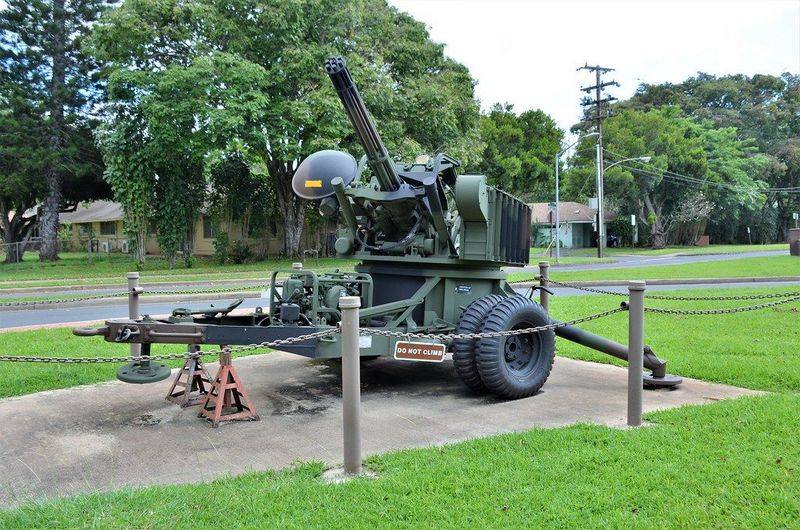
History of M167 Volcano
Since the U.S. Army introduced the M167 Vulcan in 1967, which required a large, fire-resistant, towed light air defense system, Vulcan production reached 626 units, which were eventually used by the U.S. Army as well.
The armies of Belgium, Botswana, Chile, Egypt, Honduras, Japan, Morocco, Thailand, Uruguay, South Korea, Sudan and Yemen. For the U.S. military, the M167 replaced the old M55 "Quad 50" system in use at the time.
NOTE: The M163 "Vulcan Air Defense System" (VADS) is a related self-propelled version of the towed M167 described in this article, whose artillery is based in part on the ubiquitous M113 Armored Personnel Carrier (APC).
The heart of the Vulcan system is its six-barreled 20mm M61 Vulcan aircraft cannon (fires 20x102mm projectiles). Through the use of rotating lugs, the weapon counteracts barrel overheating by providing a set of bored barrels that rotate on a single drum.
This arrangement also allows for quick extraction of ammo boxes and provides a high rate of fire, allowing Vulcan crews to saturate the airspace against incoming air threats - the trade-off, of course, is that the ammunition depots will quickly deplete. When pressed, Vulcan can also be used against lightly armored ground targets with ferocious results.
The rate of fire is operator adjustable from 1,000 to 3,000 rpm.
The M167 is a complete weapon system, including the weapon itself, mounting components, crew controls and rails. The van has two rubber wheels for transport with moving vehicles. The legs are extended to reduce the recoil effect when firing, which is connected to the bushing system at the front.
A typical crew consists of at least two people, one of whom sits at the gun to provide control. The M167 proved to be compact enough to be transported by any available means - train, air or rail.
During U.S. service, the M167 was reserved for close defense roles by the Army and Air Force. Its limited effective range is 1.2 km to air targets and 2.0 km to ground targets. The system lacks inherently accurate radar guidance, especially against moving targets, and is only granted to ranging radars with manual localization.
The 82nd Airborne Division was one of the most famous weapons operators in the United States, using the weapon from 1970 to 1994. Its versatility and portability have proven reliable.
In addition to the original M167A1 model, there was the M167A2, which introduced an improved Fire Control System (FCS). A road wheel was added to the sides of the carriage to offset the risk of a rollover, and improved weapon orientation was added.
The M167 was in service with all U.S. armed forces until 1994, when traditional land-based artillery was abandoned in favor of missilesprimarily the short-range "Stinger" series.
Despite the Cold War pedigree, other operators may still be using the M167 on the front lines.
Specification
Basic
Dimensions
2 tons (1,800 kg; 3,968 lbs)
Performance
1 mile (1 km)
Armor
1 x 20 mm M61 six-barrel revolving gun
Depends on the ammunition carrier.
Changes
M167 - Base Series Name
M167A1
M167A2 - Improved M167A1 with improved fire control subsystem.
K263 SPAAG M167 - Korean variant
 Argentina
 Armenia
 Australia
 Austria
 Austria-Hungary
 Belgium
 Brazil
 United Kingdom
 Brunei
 Bulgaria
 Canada
 Chile
Chile China
China Colonial America
 Colombia
 Confederate States
 Croatia
 Czech
Czech Denmark
 Egypt
Egypt Finland
 France
 Georgia
 Germany
 German Imperial
 Greece
 Holland
 Hungary
 India
India Indonesia
 Iran
Iran Iraq
Iraq Ireland
 Israel
 Italy
Italy Japan
Japan Japan (1940)
 Jordan
 Kingdom of Italy
 Malaysia
 Mexico
 Myanmar
 Nazi Germany
 Netherlands
 New Zealand
 North Korea
 Norway
 Pakistan
 Peru
Peru Philippines
 Poland
 Portugal
 Prussia
 Romania
 Russia
 Saudi Arabia
 Serbia
 Singapore
 Slovakia
 Slovenia
 South Africa
 South Korea
 Soviet Union
 Spain
Spain Sweden
 Switzerland
 Syria
Syria Taiwan
 Thailand
 Turkey
 UAE
UAE Ukraine
 Vietnam
 Yugoslavia