


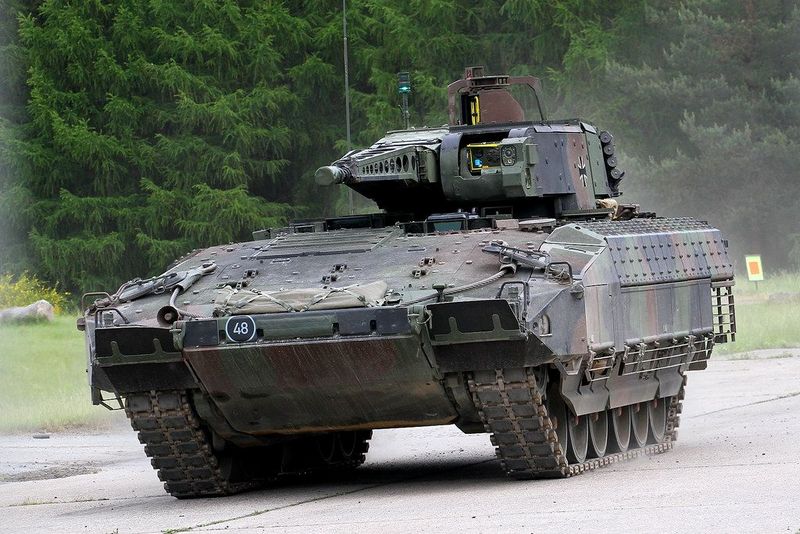
History of Puma Armor
The German Army is currently evaluating the Puma armoured personnel carrier as its latest infantry fighting vehicle (IFV), designed to replace the 1970s Cold War-era Marder IFV series. The Marder performed well at the time, working alongside Germany's first-class Leopard 1 and (later) Leopard 2 main battle tanks to provide formidable mechanized ground forces??.
Equipped with a 20mm Rheinmetall cannon, the car can carry 7 infantrymen and 3 of its own crew. However, the battlefield has changed dramatically since the Cold War era, and a new IFV project has been certified by the German Army and approved by senior government officials.
Thus, PSM GmbH ("Project System Management") was formed by the merger of Krauss-Maffei Wegmann and Rheinmetall Landsysteme, two German companies with a long history, designing and producing various vehicles (including tanks). and parts of the German Army during World War II. The result is a 35-ton tracked wheeled armoured vehicle with a front engine, rear turret and cabin, and armour protection based on recent combat experience.
The vehicle was named "Puma armored personnel carrier" and five pre-series models were delivered to the German Armed Forces in 2002. Serial production was released in 2009, which resulted in limited initial deliveries of the basic infantry fighting vehicle in 2010.
The Bundeswehr initially intended to procure a total of around 405 Puma vehicles, but this number has since been reduced to 350 to accommodate the recent reorganization of the Bundeswehr. Field trials are currently underway (2012) before large-scale approval is expected.
Consistent with modern IFV developments elsewhere, the Puma was designed from the outset to be modular within its basic scope, with minor changes to the weapon/turret layout and armor configuration allowing it to play various roles on the battlefield. roles. Exceed. Therefore, this type can use the existing power unit, landing gear and general layout to become a command vehicle, fire support vehicle, special armored personnel carrier, self-propelled air defense system, etc.
This results in commonality of parts, facilitates logistically friendly battlefield solutions, and is often a long-term cost-cutting effort. Many countries have since adopted this approach in their current and upcoming IFV designs - proving that the Germans are no different in this regard.
From the outside, the Puma appears to have a very traditional design, with the rider sitting on the front left of the fuselage, behind a wide, well-sloping front fender that protects the front fuselage fairing. The top of the hull is usually designed to be flat, with minimal sloping on the sides of the hull (designed to accommodate additional armor sets), while the upper rail area is protected by skirt armor. The track section spans the hull design with six wheels on each side with front drive sprockets and rear track idlers. One of the Puma's most unique design features is its turret, which is offset to the left of center, although the automatic cannon offset to the right of the turret remains fixed along the vehicle's centerline. The turret is loaded with many advanced optics, sensors and tracking equipment, giving the Puma crew a modern edge in both battlefield capabilities and survivability.
The Puma supports a standard crew of three - driver, commander and gunner - and can accommodate six additional combat-ready infantrymen in the rear compartment. Passengers enter through a power door at the rear of the fuselage, which hinges down and doubles as a ramp. This allows the vehicle to provide cover fire for disembarking/boarding personnel. The driver and turret crew each have their own boarding/exit hatches (sliding type). Armor protection is composite in nature and is both a weight saving measure and very effective against modern types of ammunition.
Additionally, the Puma is designed to support additional armor blocks to improve point defense (albeit at the cost of some speed and mobility). The entire vehicle is coated with paint that reduces thermal signatures and provides additional protection from mines and improvised explosive devices from all sides.
The Puma is primarily armed with the 30mm MK30-2/ABM autocannon, a rapid-fire system mounted in a 360-degree rotating turret with limited height. Powered by a dual feed system, the cannon can fire either armor-piercing (APFSDS-T) or kinetic energy (KETF) projectiles from its stored 400 rounds.
The former is used against armored targets and provides strong penetration at a distance through its fin-stabilizing lugs. Provides kinetic energy wheel with timed fire function for light targets and troop concentration.
The main gun was supported by a Heckler & Koch HK MG4 light machine gun mounted on a coaxial turret. The 2,000 x 5.56mm bullet is used in this weapon, which has been in service since 2005. Use the machine gun when the 30mm cannon is considered overkill.
According to the latest IFV developments appearing elsewhere, the Puma will go into battle using 2 anti-tank missile launchers from the "EuroSpike Spike LR" missile system. These missiles have proven themselves against main battle tanks and solid structures, and significantly expand the tactical range of Puma vehicles.
In addition to the integrated technical sensors and countermeasures, the Puma will continue to rely on two sets of four smoke grenade launchers (on the rear of the turret) to provide its own smoke protection during offensive or defensive operations. A 76mm 6-round grenade launcher is mounted on the rear of the vehicle as a deterrent against enemy infantry - a design detail that the Israeli army has extensively attested to during its years of urban combat.
The Puma vehicle is powered by a V10 892 series MTU diesel engine mounted in the front hull. The engine delivers 1,100 hp at 4,250 rpm, a top speed of 70 km/h and a range of 600 km. The vehicle is suspended on a hydropneumatic suspension system for excellent off-road maneuverability.
In terms of size, the Puma has a barrel length of 7.4 meters, a width of 3.4 meters (slightly wider after adding armor blocks), and a height of just over 3 meters. Due to its size and weight, it can be transported using the new Airbus Military A400M "Atlas" currently under development (2012).
In addition to the German army that is experimenting with the Puma (Norway has been conducting cold weather trials since late 2012), Canada is seriously considering the purchase of 108 new vehicles for tandem with their Leopard 2 main battle tank The Puma is far from Successful participation in the U.S. Army's ongoing Ground Combat Vehicle Program - efforts traditionally attributed to local companies.
However, Boeing and SAIC (International Scientific Applications Corporation) are leading the U.S. initiative in the U.S. on behalf of PSM.
Specification
Basic
Roles
- Infantry Support
- Reconnaissance (RECCE)
- Troop Transport
Dimensions
7.4m
3.7m
10.17 ft (3.1 m)
38 tons (34,700 kg; 76,500 lb)
Performance
Performance
70 km/h
373 miles (600 km)
Armor
1 x 30mm MK30-2/ABM automatic cannon.
1 x 5.56mm HK MG4 coaxial machine gun.
1 x 76mm grenade launcher (rear hull).
2 x 4 smoke grenade launchers (turret side).
400 x 30mm projectile.
2,000 x 5.56mm ammo.
6 x 76mm shells.
8 x Smoke Grenade
Changes
Puma IFV - Base Series Name
 Argentina
 Armenia
 Australia
 Austria
 Austria-Hungary
 Belgium
 Brazil
 United Kingdom
 United States
 Brunei
 Bulgaria
 Canada
 Chile
Chile China
China Colonial America
 Colombia
 Confederate States
 Croatia
 Czech
Czech Denmark
 Egypt
Egypt Finland
 France
 Georgia
 German Imperial
 Greece
 Holland
 Hungary
 India
India Indonesia
 Iran
Iran Iraq
Iraq Ireland
 Israel
 Italy
Italy Japan
Japan Japan (1940)
 Jordan
 Kingdom of Italy
 Malaysia
 Mexico
 Myanmar
 Nazi Germany
 Netherlands
 New Zealand
 North Korea
 Norway
 Pakistan
 Peru
Peru Philippines
 Poland
 Portugal
 Prussia
 Romania
 Russia
 Saudi Arabia
 Serbia
 Singapore
 Slovakia
 Slovenia
 South Africa
 South Korea
 Soviet Union
 Spain
Spain Sweden
 Switzerland
 Syria
Syria Taiwan
 Thailand
 Turkey
 UAE
UAE Ukraine
 Vietnam
 Yugoslavia