




History
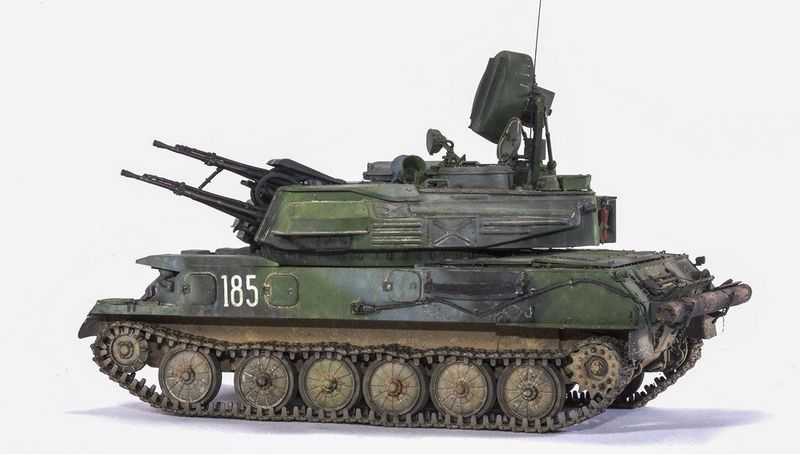
The ZSU-23-4 "Shilka" system was - and in many cases still is - a formidable air defense system for low-flying pilots around the world. The effectiveness of the Shilka at low altitudes has a well-documented history, as the system has played an important role in several major global conflicts.
Originally reserved primarily for the Soviet Army and its (now ex) supported countries during the Cold War, Shilka was later widely exported to allies in Asia, the Middle East, Africa and South America. The Shilka defense system, despite its origins in the 1960s, continues to serve in impressive numbers in several armies around the world.
At the time of its creation, no air defense platform in NATO's inventory could match the lethality of the ZSU-23-4 Shilka series.
Shilka arose out of the need for the Soviet Army to improve its existing self-propelled anti-aircraft gun capabilities. Their main adversaries at the time were the United States and the United Kingdom, both of which were fully capable of fielding first-class ground attack aircraft, including helicopters, that would be needed to limit the usefulness of Soviet weapons in the event of a full-scale war in Europe.
At the time, the main system available to the Red Army was the ZSU-57-2 tracked series, armed with a set of powerful 57mm guns. However, despite this large caliber weapon, the system is inherently limited by its optical alignment tracking system, lack of airborne radar, and inability to engage targets while "moving." Ammunition storage capacity on board is also limited to 300 rounds of 52mm projectiles.
Only a few notable variants of the ZSU-23-4 exist, many of which are minor upgrades and modernizations of previous generations of Shilka. The 1970 ZSU-23-4VI added an upgraded V-6R-1 family of engines, while the 1973 ZSU-23-4M (known as "Biryusa") had a pyrotechnic charging system over the original aerodynamic system, while Ammunition has been increased to 4,500 23mm projectiles. The ZSU-23-4MZ had a "friend or foe" identification system and became the new Shilka standard for early service models ("Shilka" continues to informally represent all advancements in the system, despite the "Biryusa" designation). The Soviet invasion of Afghanistan resulted in a modification of the Shilka in the ZSU-23-4M2, adding night vision goggles and losing the radar unit.
In 1999, the ZSU-23-4M4 was unveiled to the public, showing the latest modern version of the Shilka family. This special version is equipped with a hydrostatic transmission, a laser firing sensor for self-defense and an optoelectronic sight for the crew.
Ukraine has since modernized its existing shilkas, calling them "Donets". In 1999, the Malishev Tank Plant in Kharkiv modified the turret to adapt it to the surface-to-air missile defense system and installed it on the chassis of the T-80UD main battle tank. Likewise, the ZSU-23-4MP "Biala" represents an upgrade carried out by the Polish Army in 2000. Added ferocious anti-aircraft missiles and digital systems.
Some of the largest Shilka operators later became Algeria (possibly as many as 300), Egypt (330 and more to come), India (100), Iran (over 100), Iraq (over 200). Unknown), Libya (250), Syria (400) and Vietnam (100).
By the way, the designation ZSU-23-4 indicates the caliber of the gun ("23") and the number of barrels ("2"). The name "Shilka" comes from the Shilka River in western Russia. Shilka may also be known by his nickname "Zeus".
Specification
Basic
Roles
- Air Defense/Airspace Denial
Dimensions
6.54m
2.95m
2.25m
20 tons (18,597 kg; 40,999 lb)
Performance
Performance
50 km/h
280 miles (450 km)
for everyone else in our database)
Armor
Default:
4 x 23mm AZP-23 automatic cannons.
6 x SA-18 surface-to-air missiles (roof mounted).
6 x SA-16 surface-to-air missiles (side mounted).
2,000 to 4,500 x 23mm projectiles (depending on model).
6 x Short-Range Surface-to-Air Missiles (if the launcher is fitted).
Changes
ZSU-23-4 "Shilka" - pre-production and production model designation.
ZSU-23-4V - modernized variant from 1968
ZSU-23-4V1 - 1970's modernized variant; equipped with V-6R-1 family of engines.
ZSU-23-4M "Biryusa" - Appeared in 1973; equipped with a modern 2A7M automatic cannon and pyrotechnic reloading system.
ZSU-23-4MZ - Appeared in 1977; equipped with FOF (Friend or Foe) identification system; new standard for early ZSU-23-4 production models.
ZSU-23-4M2 - Appeared in 1978; revised for Soviet operations in Afghanistan; added night vision; increased ammunition from 2,000 to 4,000 rounds.
ZSU-23-4M4 - appeared in 1999; modernized variant; added SA-18 rocket launcher; laser launch sensor; electro-optical vision system; improved radar; hydrostatic transmission; added hydraulic booster; improved fluidity.
ZSU-23-4MP "Biala" - Polish modernized version, appeared in 2000; equipped with Grom anti-aircraft missiles; digital passive targeting system instead of radar.
4M4 - Ukrainian ZSU-23-4 variant
4M5 - Belarusian ZSU-23-4 variant
"Donets" - Ukrainian modernized version, released in 1999; installed on the chassis of the T-80UD main battle tank; improved tower; installed Strela-10 missile system; increased ammunition capacity.
 Argentina
 Armenia
 Australia
 Austria
 Austria-Hungary
 Belgium
 Brazil
 United Kingdom
 United States
 Brunei
 Bulgaria
 Canada
 Chile
Chile China
China Colonial America
 Colombia
 Confederate States
 Croatia
 Czech
Czech Denmark
 Egypt
Egypt Finland
 France
 Georgia
 Germany
 German Imperial
 Greece
 Holland
 Hungary
 India
India Indonesia
 Iran
Iran Iraq
Iraq Ireland
 Israel
 Italy
Italy Japan
Japan Japan (1940)
 Jordan
 Kingdom of Italy
 Malaysia
 Mexico
 Myanmar
 Nazi Germany
 Netherlands
 New Zealand
 North Korea
 Norway
 Pakistan
 Peru
Peru Philippines
 Poland
 Portugal
 Prussia
 Romania
 Russia
 Saudi Arabia
 Serbia
 Singapore
 Slovakia
 Slovenia
 South Africa
 South Korea
 Spain
Spain Sweden
 Switzerland
 Syria
Syria Taiwan
 Thailand
 Turkey
 UAE
UAE Ukraine
 Vietnam
 Yugoslavia