

History
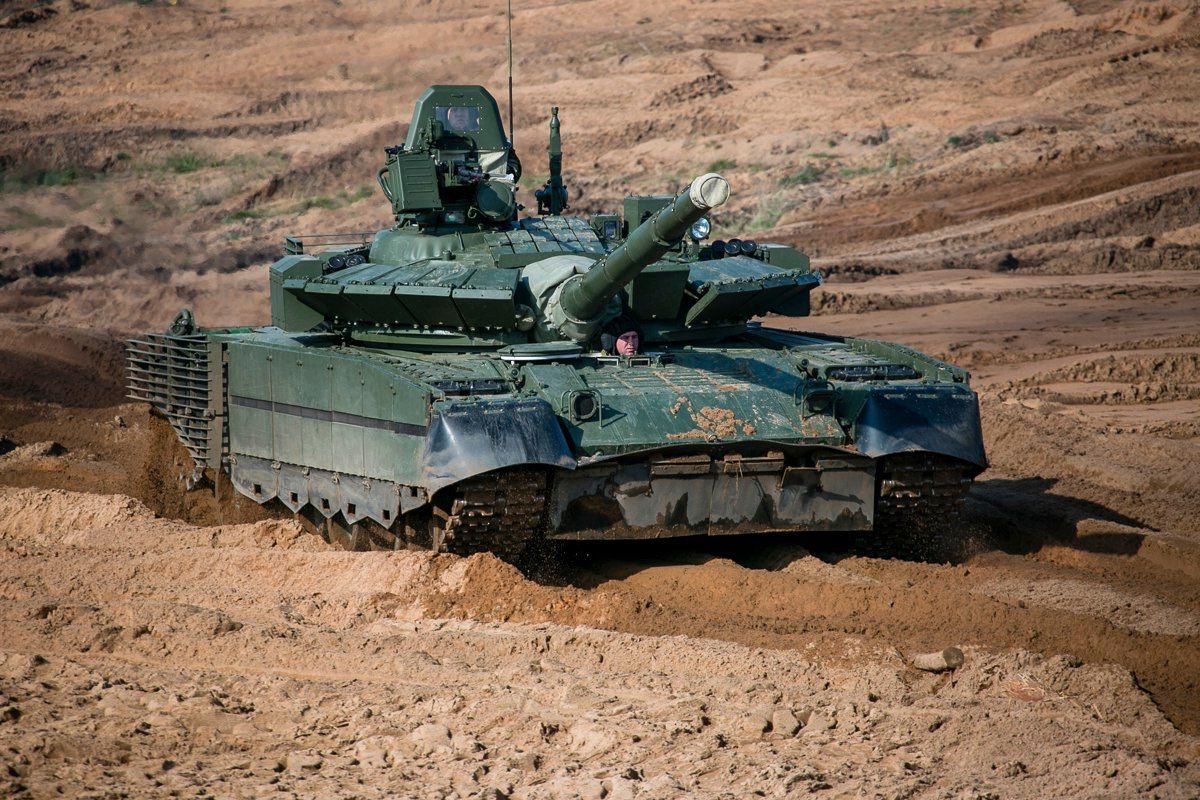
The T-80BVM is a Russian modernization of the Soviet-designed T-80BV main battle tank. Omsktransmash developed the upgrade to extend the service life of existing vehicles while improving their firepower, protection, observation equipment, and mobility systems.
The modernization retains the T-80 family’s compact three-person layout and gas-turbine propulsion. Its principal changes include a 125 mm 2A46M-4 smoothbore gun, the Sosna-U gunner’s sight, Relikt explosive reactive armor, and an improved GTD-1250-series engine.
Later vehicles received additional protection developed in response to combat experience. These measures include cage armor, roof screens, electronic countermeasures, and increasingly extensive barriers intended to reduce vulnerability to first-person-view attack drones.
Development
The original T-80 entered Soviet service in 1976 and became the first mass-produced main battle tank powered solely by a gas-turbine engine. The T-80BV followed in 1985 with Kontakt-1 explosive reactive armor fitted to the hull and turret. After the Soviet period, Russia retained many T-80BV tanks in active units or storage.
Omsktransmash began developing the T-80BVM modernization during the mid-2010s. The upgrade was intended to restore stored T-80BV vehicles and give them fire-control, ammunition, armor, and mobility improvements comparable to those introduced on other modernized Russian tanks.
A T-80BVM prototype was publicly displayed during the Zapad 2017 exercise. Production modernization subsequently began, with Russian service entry reported in 2018 or 2019. Orders announced in 2019 and 2020 covered at least 112 upgraded vehicles. Additional batches were delivered as Russia expanded the return of stored T-80-series tanks to service.
Combat-driven protection changes
T-80BVM tanks have been used during the Russia-Ukraine War since 2022. Combat conditions produced continuing changes to their protective equipment, particularly against top-attack munitions and small FPV drones. Fielded configurations have included turret-roof cages, wire screens around vulnerable rear areas, electronic counter-drone equipment, and additional armor modules.
An image circulated in August 2026 appeared to show a T-80BVM with a substantially enlarged anti-drone package. The tank was photographed on a railway flatcar, but its location, destination, and production status were not confirmed. It may represent a prototype, a limited modification, or a proposed production configuration.
The photographed vehicle had a broad turret-mounted roof cage, reinforced hull skirts, and rectangular panels extending around the turret sides and rear. Compared with earlier open grille arrangements, this configuration created a more continuous stand-off barrier against drones approaching from elevated, lateral, and rear angles. The visible evidence does not establish the composition of the rectangular modules or prove that the configuration provides complete protection around the vehicle.
Design
Layout and crew
The T-80BVM retains the conventional T-80 layout. The driver occupies the front of the hull, the turret and fighting compartment are in the center, and the engine compartment is at the rear. The crew consists of a commander, gunner, and driver. An automatic loading system removes the need for a fourth crew member.
The tracked chassis has six road wheels on each side, a front idler, and a rear drive sprocket. Torsion-bar suspension supports the vehicle. The compact hull and low turret reduce the tank’s height but also limit internal space.
Armament
The principal weapon is a stabilized 125 mm 2A46M-4 smoothbore gun. It can fire armor-piercing fin-stabilized discarding-sabot ammunition, high-explosive anti-tank rounds, high-explosive fragmentation projectiles, and compatible 9M119M Refleks-M guided missiles through the gun barrel. The guided missile is laser-directed and has a reported maximum range of approximately 5 km.
The modernization introduced changes to the gun and autoloader to support newer long-rod armor-piercing ammunition. The reported total ammunition load is 45 rounds. Secondary weapons include a 7.62 mm PKTM coaxial machine gun and a turret-roof 12.7 mm NSVT or Kord heavy machine gun. Smoke grenade launchers allow the crew to create a visual screen.
Fire control and observation
The T-80BVM uses the Sosna-U multichannel gunner’s sight with thermal imaging, a laser rangefinder, and guided-missile control. Improved stabilization and ballistic-computation equipment support firing while moving and engagement in reduced visibility. The driver is provided with night-observation equipment.
Published descriptions of the production tank do not consistently support the presence of an independent panoramic commander’s sight. Equipment can also differ between production batches and vehicles modified after delivery. A detailed technical overview is available from Army Recognition.
Protection
The underlying hull and turret armor of the T-80BV is supplemented by Relikt explosive reactive armor. Relikt modules cover much of the frontal hull, turret front, and hull sides. Their purpose is to reduce the effectiveness of shaped-charge warheads and improve resistance to some kinetic penetrators.
Armored skirts protect the upper track and suspension area. Cage armor has been fitted around portions of the hull and turret rear to provide stand-off protection against shaped-charge weapons. The tank also carries collective nuclear, biological, and chemical protection, smoke-generation equipment, and an automatic fire-suppression system.
Anti-drone cages create distance between an incoming munition and the main armor. They may obstruct a drone, change its impact angle, or cause a warhead to detonate before reaching the turret roof. Their effectiveness depends on the attack direction, warhead, impact point, and construction of the barrier.
The enlarged protection photographed in 2026 extended farther over the turret front, sides, and rear than earlier roof screens. Additional side and rear panels reduced visible approach paths toward the turret ring, crew hatches, and upper hull. These additions may increase weight, turret rotational inertia, vehicle height, and loads on the suspension. They can also interfere with observation, antennas, gun movement, crew escape, transport, and movement beneath trees or overhead cables.
Mobility
The T-80BVM is powered by a GTD-1250-series multifuel gas turbine producing approximately 1,250 hp. The engine gives the tank rapid acceleration and reliable starting in very cold conditions. Its disadvantages include high fuel consumption, cost, and maintenance demands compared with many diesel engines.
The tank has a reported road speed of approximately 70 km/h and a road range of about 500 km when appropriate external fuel capacity is used. It can pivot in place and has a reported power-to-weight ratio of approximately 27.2 hp per tonne. The vehicle can cross water up to 1.2 m deep without preparation, approximately 1.8 m with preparation, and up to 5 m with deep-wading equipment.
Operational history
Russia is the confirmed operator of the T-80BVM. The type has equipped Russian Ground Forces and naval infantry formations, including units assigned to cold northern and eastern regions where the gas turbine’s low-temperature starting characteristics are valuable.
T-80BVM tanks have participated in combat during the Russia-Ukraine War. Both Russian-operated vehicles and examples captured and used by Ukraine have been documented. Battlefield losses and recoveries demonstrated that the modernization improved several aspects of the older T-80BV but did not remove vulnerabilities to mines, artillery, anti-tank missiles, loitering munitions, and FPV drones.
The continuing appearance of revised roof cages, electronic countermeasures, and side protection indicates that the fielded design is still being adapted. The unusually extensive package photographed in 2026 illustrates this process, although one image is insufficient to establish whether it became an official production standard.
Variants
- T-80BVM prototype: Modernization configuration publicly shown in 2017 with upgraded armament, sights, powerplant equipment, and Relikt explosive reactive armor.
- T-80BVM production model: Series modernization of existing T-80BV tanks delivered to Russian units from the late 2010s. Details vary between production batches.
- T-80BVM with anti-drone protection: Field-modified and factory-associated configurations carrying turret-roof cages, additional screens, armor panels, and electronic counter-drone equipment.
- Expanded 2026 protection configuration: An unconfirmed configuration photographed with a large turret cage and more continuous side and rear protection. Its formal status has not been established.
Operators
- Russia: Primary operator and customer for the T-80BVM modernization. Vehicles serve with the Russian Ground Forces and naval infantry.
- Ukraine: Has operated captured Russian T-80BVM tanks during the Russia-Ukraine War. These vehicles were not acquired through a production or export contract.
Specifications (T-80BVM)
General characteristics
- Type: Main battle tank
- Crew: 3
- Combat weight: Approximately 46 tonnes
- Overall length: Approximately 9.6 m with gun forward
- Hull length: Approximately 7.0 m
- Width: Approximately 3.6 m
- Height: Approximately 2.2 m to the turret roof
- Ground clearance: Approximately 0.38 m
- Suspension: Torsion bar
Performance
- Engine: GTD-1250-series multifuel gas turbine
- Engine output: Approximately 1,250 hp
- Power-to-weight ratio: Approximately 27.2 hp per tonne
- Maximum road speed: Approximately 70 km/h
- Road range: Approximately 500 km with external fuel capacity
- Vertical obstacle: Approximately 1.0 m
- Trench: Approximately 2.85 m
- Fording depth: 1.2 m without preparation, 1.8 m with preparation, or up to 5 m with deep-wading equipment
Armament
- Main gun: 125 mm 2A46M-4 smoothbore gun
- Main-gun ammunition: 45 rounds reported
- Guided weapon: 9M119M Refleks-M missile fired through the main gun
- Coaxial weapon: 7.62 mm PKTM machine gun
- Roof weapon: 12.7 mm NSVT or Kord heavy machine gun
- Gun elevation: Approximately -5 to +14 degrees
- Turret traverse: 360 degrees
Protection and equipment
- Primary armor: Steel and composite armor retained from the T-80BV base vehicle
- Reactive armor: Relikt modules on the hull, turret, and side areas
- Additional protection: Armored skirts and cage armor, with anti-drone roof protection on later configurations
- Gunner’s sight: Sosna-U multichannel sight with thermal imaging and laser rangefinding
- Other systems: Nuclear, biological, and chemical protection, smoke equipment, radio communications, and fire suppression
Published specifications vary by source and production configuration. The values above represent commonly reported figures for the T-80BVM and are consistent with the dedicated T-80BVM reference.
Related equipment
- T-80BV: Soviet main battle tank that provides the principal donor hulls for the T-80BVM modernization.
- T-80U: Advanced Soviet T-80 variant that introduced a 1,250 hp gas turbine and improved armor and fire-control equipment.
- T-90M: Russian main battle tank sharing some modern sighting, ammunition, and protection concepts with the T-80BVM.
 Argentina
 Armenia
 Australia
 Austria
 Austria-Hungary
 Belgium
 Brazil
 United Kingdom
 United States
 Brunei
 Bulgaria
 Canada
 Chile
Chile China
China Colonial America
 Colombia
 Confederate States
 Croatia
 Czech
Czech Denmark
 Egypt
Egypt Finland
 France
 Georgia
 Germany
 German Imperial
 Greece
 Holland
 Hungary
 India
India Indonesia
 Iran
Iran Iraq
Iraq Ireland
 Israel
 Italy
Italy Japan
Japan Japan (1940)
 Jordan
 Kingdom of Italy
 Malaysia
 Mexico
 Myanmar
 Nazi Germany
 Netherlands
 New Zealand
 North Korea
 Norway
 Pakistan
 Peru
Peru Philippines
 Poland
 Portugal
 Prussia
 Romania
 Saudi Arabia
 Serbia
 Singapore
 Slovakia
 Slovenia
 South Africa
 South Korea
 Soviet Union
 Spain
Spain Sweden
 Switzerland
 Syria
Syria Taiwan
 Thailand
 Turkey
 UAE
UAE Ukraine
 Vietnam
 Yugoslavia