
History
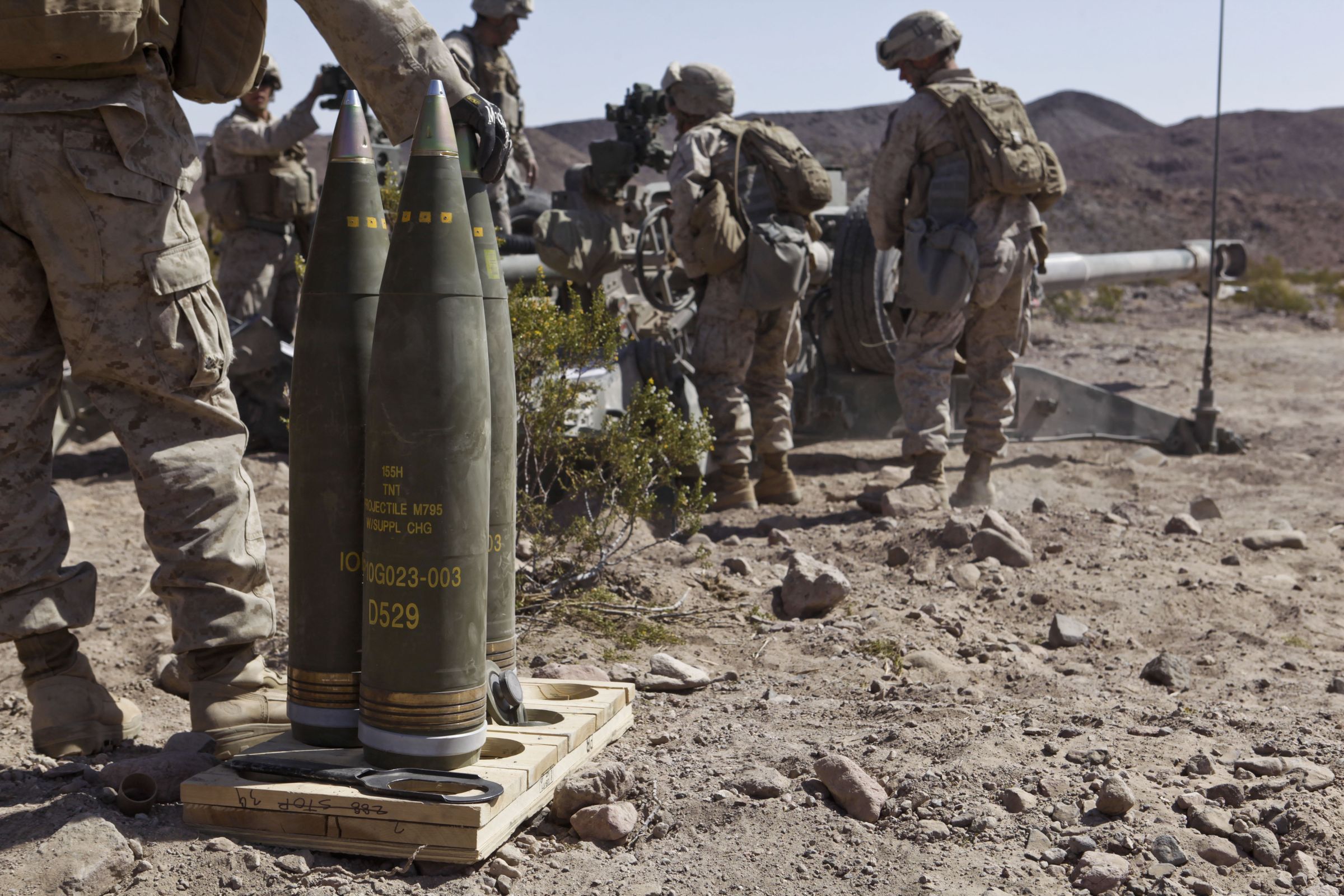
The M795 is a 155 mm high-explosive artillery projectile developed in the United States for conventional fire support. It is intended for use against personnel, vehicles, equipment, supply points, and command and communications installations.
The projectile belongs to a family of ballistically similar 155 mm ammunition and was designed to replace the older M107 high-explosive projectile. Its aerodynamic shape, high-fragmentation steel body, and larger effective range improve its performance against personnel and materiel.
General Dynamics Ordnance and Tactical Systems and American Ordnance publish information about the M795 and manufacture the projectile. In August 2026, the United States approved a possible Foreign Military Sale of additional M795 projectiles and support services to Norway.
The M795 was documented in U.S. Army technical material by 2003. The design uses a body similar in external configuration to the M483A1, although the M795 is approximately 51 mm (2 in) shorter. Contemporary product information identifies the projectile as conventional ammunition for the U.S. Army, U.S. Marine Corps, and approved international customers.
On 5 August 2026, the U.S. Department of State notified Congress of its determination approving a possible sale to Norway. The notification expanded an earlier Foreign Military Sales case valued at $99.99 million. The combined case was estimated at $270 million and covered additional projectiles, technical documentation, technical assistance, and engineering, logistics, and program support. The notification did not disclose the number of projectiles.
The State Department notification identified American Ordnance in Middletown, Iowa, and General Dynamics in Camden, Arkansas, as the principal contractors. The approval represented authorization for a possible sale rather than confirmation that a final contract or delivery had occurred.
Design
Projectile construction
The M795 has a high-fragmentation HF-1 steel body surrounded near its base by a gilding-metal rotating band. The band engages the rifling inside a howitzer barrel, helping to seal propellant gases and impart spin to the projectile. A plastic obturator provides an additional gas seal.
The complete projectile weighs approximately 47 kg (103 lb). Its body contains 10.8 kg (23.8 lb) of TNT or IMX-101 high explosive. IMX-101 is an insensitive explosive formulation intended to reduce vulnerability to accidental detonation during handling and storage. Detailed dimensions and explosive data are published in the General Dynamics product sheet.
A protective lifting plug covers the fuze well during transport and handling. The rotating band is protected by a flexible cover, while a shock-attenuating lifting plug and specialized pallet support packaged projectiles. If the lifting plug breaks at its neck and leaves its threaded portion inside the fuze well, the projectile cannot be fitted with a fuze and must be returned to the supply point.
Compatibility and fuzes
The M795 is compatible with current U.S. 155 mm howitzers and the Modular Artillery Charge System. Manufacturer information also describes compatibility with towed and self-propelled 155 mm howitzers.
The projectile can use impact, mechanical-time, and short-intrusion proximity fuzes. It contains a supplementary charge that is not removed because the use of long-intrusion proximity fuzes is not authorized. This configuration is described in technical-manual-derived information compiled by Bulletpicker.
Range and effects
The stated maximum range is 22.5 km, compared with 17.5 km for the earlier M107. General Dynamics describes this as a 29 percent range increase and attributes improved accuracy to the projectile's aerodynamic shape.
General Dynamics states that the M795 provides twice the lethality of the M107 against personnel and an 80 percent increase against trucks. American Ordnance describes an overall effectiveness increase of more than 30 percent against major ground-force threats. These figures represent different manufacturer comparisons and should not be treated as measurements of the same target set.
The projectile is intended for conventional support fire against personnel, trucks, electronic surveillance and target-acquisition equipment, supply points, command, control and communications installations, and mechanized or armored forces. The American Ordnance product sheet provides additional construction and performance data.
Procurement and status
The U.S. Army and U.S. Marine Corps use the M795 as conventional 155 mm high-explosive ammunition. American Ordnance also produces it for other customers approved by the U.S. Department of State.
The proposed Norwegian purchase was intended to strengthen Norway's artillery and medium-range fire capability and improve interoperability with U.S. and allied forces. The State Department stated that Norway could absorb the equipment without additional U.S. government or contractor representatives being assigned to the country. Norway remained a prospective recipient under the cited notification, rather than a confirmed operator based solely on that approval.
Operators
- United States Army: Uses the M795 as conventional 155 mm high-explosive ammunition.
- United States Marine Corps: Uses the M795 as conventional 155 mm high-explosive ammunition.
Specifications (M795)
General characteristics
- Caliber: 155 mm
- Type: High-explosive artillery projectile
- Projectile weight: Approximately 47 kg (103.4 lb)
- Length with fuze: 843 mm (33.2 in)
- Body material: HF-1 high-fragmentation steel
- Explosive filling: 10.8 kg (23.8 lb) of TNT or IMX-101
- Rotating band: Gilding metal
- Fuzes: Impact, mechanical-time, and short-intrusion proximity types
Performance
- Maximum range: 22.5 km
Related equipment
- M107: Earlier 155 mm high-explosive projectile that the M795 was intended to replace.
- M483A1: 155 mm projectile with a broadly similar external configuration; the M795 is approximately 51 mm shorter.
 Argentina
 Armenia
 Australia
 Austria
 Austria-Hungary
 Belgium
 Brazil
 United Kingdom
 Brunei
 Bulgaria
 Canada
 Chile
Chile China
China Colonial America
 Colombia
 Confederate States
 Croatia
 Czech
Czech Denmark
 Egypt
Egypt Finland
 France
 Georgia
 Germany
 German Imperial
 Greece
 Holland
 Hungary
 India
India Indonesia
 Iran
Iran Iraq
Iraq Ireland
 Israel
 Italy
Italy Japan
Japan Japan (1940)
 Jordan
 Kingdom of Italy
 Malaysia
 Mexico
 Myanmar
 Nazi Germany
 Netherlands
 New Zealand
 North Korea
 Norway
 Pakistan
 Peru
Peru Philippines
 Poland
 Portugal
 Prussia
 Romania
 Russia
 Saudi Arabia
 Serbia
 Singapore
 Slovakia
 Slovenia
 South Africa
 South Korea
 Soviet Union
 Spain
Spain Sweden
 Switzerland
 Syria
Syria Taiwan
 Thailand
 Turkey
 UAE
UAE Ukraine
 Vietnam
 Yugoslavia