
History
The M139 Volcano is a United States scatterable-mine delivery system designed to establish large tactical minefields rapidly. The same dispenser can be carried by ground vehicles or UH-60 helicopters through platform-specific mounting kits.
The system combines four launcher racks, preloaded mine canisters, a dispenser control unit and mounting hardware. A full load can contain 160 canisters and up to 960 mines.
The U.S. Army later adapted the legacy system for autonomous ground operation. During demonstrations in May 2026, an unmanned truck remotely fired inert canisters and then autonomously established two minefields.
The U.S. Army developed Volcano during the 1980s as a replacement for earlier ground and helicopter mine-dispensing equipment. A June 1990 Army contractor report documented the associated M89 training canister, providing dated evidence that recognizable system hardware existed by that year. The dispenser and its maintenance procedures were documented in Army technical publications during the early 1990s.
Ground Volcano was fielded before the helicopter configuration entered production. Air Volcano production ran from January to July 1995, and the first unit was equipped in August 1995. It was intended to replace the M56 helicopter mine-dispensing system, while ground installations replaced the Ground Emplaced Mine Scattering System in heavy formations.
The U.S. Army removed Volcano equipment from active units during the late 1990s and placed components in storage. The service began returning the system to use in 2017. Demonstrations were also conducted for Poland in 2019 and 2020, although Poland was not identified as an operator.
A current U.S. Army fact sheet identifies Northrop Grumman as the industry partner and describes Volcano as an anti-vehicle capability compliant with U.S. landmine policy. The fact sheet lists the U.S. Army and U.S. Marine Corps as stakeholders.
Autonomous Volcano
The Autonomous Volcano project combines the M139 dispenser with a driverless Palletized Load System A1 truck. Forterra integrated the existing dispenser with the autonomous vehicle as part of a joint United States and United Kingdom development effort.
At Camp Grayling, Michigan, soldiers from the 4th Engineer Battalion remotely fired inert canisters during the first live-fire scenario in May 2026. The vehicle subsequently emplaced two minefields simultaneously without a human driver. It also recorded mine locations and uploaded them to the Army common operating picture. Further realistic battlefield trials were planned after the demonstration, according to the contemporary test report.
Design
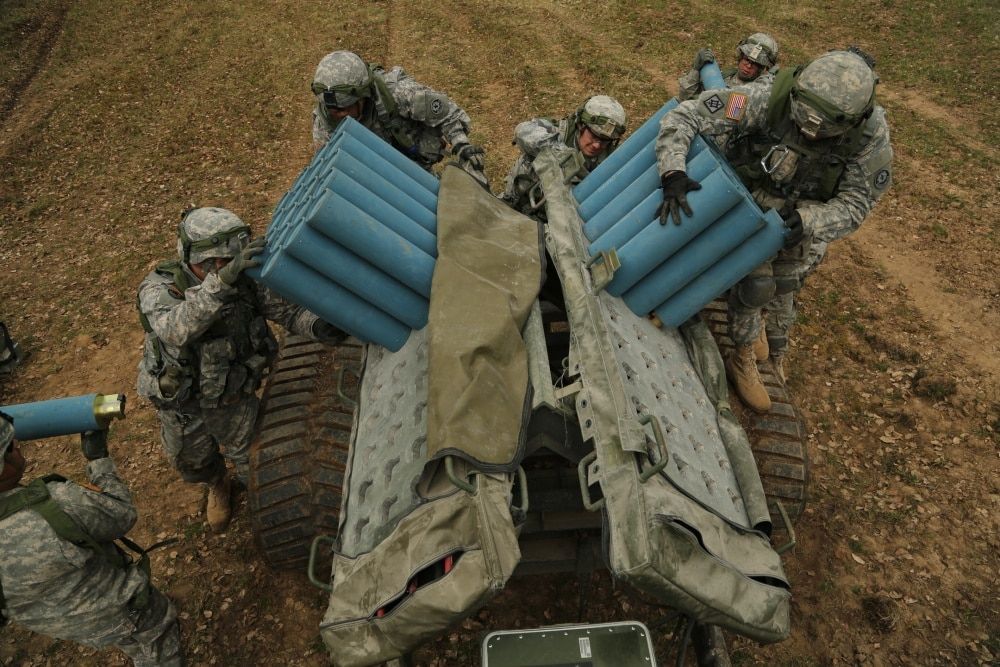
The M139 dispenser has four launcher racks. Each rack accepts as many as 40 canisters, giving the complete system a capacity of 160 canisters. The racks provide mechanical support and electrical connections between the canisters and the dispenser control unit.
The mounting kit allows the main dispensing equipment to be transferred among compatible vehicles. Ground installations have included the M548 tracked carrier, M939-series truck, M977 Heavy Expanded Mobility Tactical Truck and M1074 or M1075 Palletized Load System vehicle. Air Volcano uses special UH-60 mounting hardware with an emergency jettison mechanism.
Control system
The dispenser control unit governs the arming sequence, delivery speed and mine self-destruct setting. It permits dispensing to be started or stopped and displays the number of canisters remaining on each side. The aircraft installation places firing switches on both pilots' cyclic controls.
Ground Volcano draws electrical power from its carrier vehicle. The historical system required an operator, but its controls were designed for personnel with limited specialist training. The 2026 autonomous installation transferred vehicle movement, minefield placement and location recording to an unmanned platform while retaining remote control for the initial firing demonstration.
Canisters and mines
The historical M87 canister contains five anti-tank mines and one anti-personnel mine. The mixture is fixed and cannot be changed in the field. The M87A1 instead contains six anti-tank mines. Each canister uses a propelling charge to eject its contents laterally from the carrier.
The M88 practice canister contains six inert mines and reproduces the dispersal pattern of live ammunition. The completely inert M89 is used for loading instruction, flight training and fault diagnosis.
Historical documentation gives selectable self-destruct periods of four hours, 48 hours or 15 days. The current Army description states a range from four hours to 15 days. It characterizes the present Volcano capability as anti-vehicle, while older manuals describe the mixed anti-tank and anti-personnel M87 load.
Minefield emplacement
Volcano can create disrupt, fix, turn and block minefields. These layouts are intended respectively to confuse a formation, hold it for engagement, redirect movement or deny terrain. Ground systems provide more controlled placement, while helicopter carriage permits faster establishment of distant obstacles.
From a ground vehicle, mines are dispersed approximately 25 to 60 metres (82 to 197 feet) from the vehicle while it travels at 8 to 89 kilometres per hour (5 to 55 mph). From a UH-60, they are dispersed 35 to 70 metres (115 to 230 feet) from the flight path. The helicopter flies at a minimum altitude of about 1.5 metres (5 feet) and at 20 to 120 knots (37 to 222 kilometres per hour).
A complete load can form a terrain obstacle approximately 120 metres by 1,100 metres and can be delivered from a helicopter in about 17 to 18 seconds at the highest specified speed. High-speed delivery reduces placement accuracy. The aircraft must also maintain a predictable low-altitude flight path, increasing its vulnerability to enemy fire.
Operational history
Combat engineer units normally operate Ground Volcano to reinforce existing obstacles, close lanes or gaps, protect flanks and establish reserve obstacles after enemy movement becomes apparent. Air Volcano performs similar missions where speed and reach are more important than the greater precision of ground emplacement.
South Korea has operated Volcano on M548 carriers. The United Kingdom used the related Shielder installation on modified Alvis Stormer vehicles from 1999 until the vehicles were withdrawn in 2013–2014.
The United States approved a Volcano sale to Taiwan in 2022. Available source material described delivery of the first seven systems as planned by the end of 2023 and the remaining systems by the end of 2026, but it does not independently confirm completion of the full delivery schedule.
Variants
- Ground Volcano: M139 dispenser installation for tracked and wheeled ground vehicles.
- Air Volcano: UH-60-mounted installation using aircraft-specific racks, controls and emergency jettison hardware.
- Shielder: British installation of Volcano equipment on modified Alvis Stormer armored vehicles.
- Autonomous Volcano: Experimental integration of the M139 dispenser with a driverless PLS A1 truck, demonstrated with inert canisters in 2026.
Operators
- United States: The U.S. Army returned stored Volcano equipment to use beginning in 2017 and tested Autonomous Volcano in 2026.
- South Korea: The Republic of Korea Army operates Volcano equipment on M548 carriers.
- United Kingdom: Former operator of the Shielder configuration, withdrawn in 2013–2014.
Specifications (M139 Volcano)
General characteristics
- Type: Vehicle- and helicopter-mounted scatterable-mine dispenser
- Launcher arrangement: Four racks
- Canisters per rack: 40
- Total canister capacity: 160
- Maximum mine capacity: 960
- Power supply: Host vehicle or aircraft
- Air Volcano system weight: Approximately 2,909 kilograms (6,413 pounds)
- UH-60 installation time: Approximately four hours
Emplacement performance
- Standard large obstacle: Approximately 120 by 1,100 metres (394 by 3,609 feet)
- Ground lateral dispersal distance: 25–60 metres (82–197 feet)
- Ground carrier speed: 8–89 kilometres per hour (5–55 mph)
- Air lateral dispersal distance: 35–70 metres (115–230 feet)
- Air delivery speed: 20–120 knots (37–222 kilometres per hour)
- Minimum aircraft altitude: Approximately 1.5 metres (5 feet)
- Selectable historical self-destruct periods: Four hours, 48 hours or 15 days
Historical ammunition
- M87: Five anti-tank mines and one anti-personnel mine per canister
- M87A1: Six anti-tank mines per canister
- M88: Six inert practice mines per canister
- M89: Inert training and diagnostic canister without mines
 Argentina
 Armenia
 Australia
 Austria
 Austria-Hungary
 Belgium
 Brazil
 United Kingdom
 Brunei
 Bulgaria
 Canada
 Chile
Chile China
China Colonial America
 Colombia
 Confederate States
 Croatia
 Czech
Czech Denmark
 Egypt
Egypt Finland
 France
 Georgia
 Germany
 German Imperial
 Greece
 Holland
 Hungary
 India
India Indonesia
 Iran
Iran Iraq
Iraq Ireland
 Israel
 Italy
Italy Japan
Japan Japan (1940)
 Jordan
 Kingdom of Italy
 Malaysia
 Mexico
 Myanmar
 Nazi Germany
 Netherlands
 New Zealand
 North Korea
 Norway
 Pakistan
 Peru
Peru Philippines
 Poland
 Portugal
 Prussia
 Romania
 Russia
 Saudi Arabia
 Serbia
 Singapore
 Slovakia
 Slovenia
 South Africa
 South Korea
 Soviet Union
 Spain
Spain Sweden
 Switzerland
 Syria
Syria Taiwan
 Thailand
 Turkey
 UAE
UAE Ukraine
 Vietnam
 Yugoslavia