
History
MAGURA, or Maritime Autonomous Guard Unmanned Robotic Apparatus V-type, is a Ukrainian family of multipurpose unmanned surface vehicles. The family supports reconnaissance, patrol, maritime security, mine-countermeasure, search-and-rescue, and combat missions.
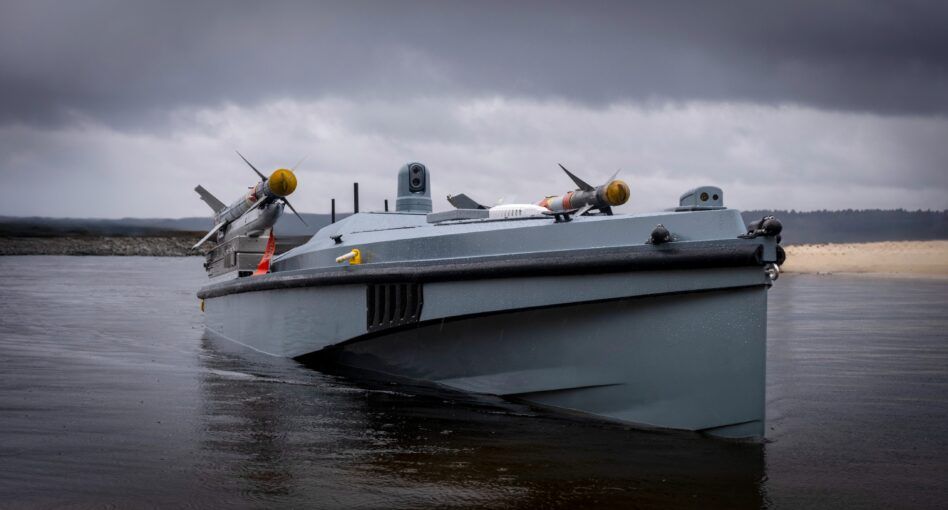
The original MAGURA V5 is a compact, low-profile craft developed for operations by the Main Directorate of Intelligence of Ukraine. Later models expanded the platform with larger payloads, defensive weapons, and missile or unmanned-aircraft configurations.
MAGURA vessels have been used extensively in the Black Sea during the Russia-Ukraine War. Their missions have included attacks against ships and small craft, aerial engagements, surveillance, and operations near occupied Crimea.
Development
The Ukrainian government announced the development of a combat surface drone with a range of up to 800 km in November 2022. The MAGURA V5 was publicly presented at the International Defence Industry Fair in Istanbul in July 2023. Reporting later that month confirmed that the craft was an operational system rather than only an exhibition model.
The V5 was designed as a relatively small and manoeuvrable platform suited to attacking moving ships at sea. MAGURA and other Ukrainian maritime drones were assigned to the 385th Unmanned Surface Vessel Brigade after its formation in August 2023, while personnel from Ukrainian intelligence organizations continued to operate the systems.
The MAGURA V6P and the enlarged MAGURA V7 appeared in 2025. Missile-armed development included configurations using modified R-73 missiles and AIM-9 Sidewinder missiles for surface-to-air engagements. In 2026, UForce and ReconCraft announced cooperation on production of MAGURA V7 vessels in the United States. Further information about the family is available from GlobalMilitary.net and Janus Marine and Defense.
Design
The MAGURA V5 has a hydrodynamic, low-profile hull intended to reduce its visual and radar signature. Its compact dimensions permit launch from remote locations and reduce the supporting infrastructure required for deployment.
The control architecture combines autonomous navigation with remote operation. Reported equipment includes an autopilot, satellite-navigation and inertial guidance, video subsystems, night-vision equipment, and redundant communication modules. A ground control station, transportation and storage equipment, and data-processing facilities support vessel operations.
The platform has a modular payload arrangement. Mission equipment can include sensors, an explosive charge, missiles, remotely operated weapons, or unmanned-aircraft launch systems, depending on the variant and configuration. The unmanned design removes an onboard crew from hazardous reconnaissance and attack missions.
V7 development
The MAGURA V7 is larger than the V5 and uses a reported 270 hp diesel engine. Documented configurations include two AIM-9 Sidewinder missiles, a turret-mounted machine gun, and launch equipment for unmanned aircraft. UForce mission-management software reportedly supports route planning, coordinated operations, and control of multiple vessels. A 2026 report by Defense Express described MAGURA V7 and MV7 configurations carrying several types of unmanned aircraft.
Operational history
In November 2023, MAGURA vessels were used in an attack that sank a Serna-class landing craft and an Akula-class landing craft at Chornomorske in occupied Crimea. On 1 February 2024, multiple MAGURA V5 vessels struck and sank the Russian missile corvette Ivanovets near Lake Donuzlav.
MAGURA V5 vessels attacked and sank the landing ship Tsezar Kunikov near Alupka on 14 February 2024. On 5 March, they were used against the patrol ship Sergey Kotov near the Kerch Strait. Ukrainian Defence Intelligence subsequently reported the destruction of two KC-701 boats on 30 May and another KS-701 boat on 10 August 2024.
On 31 December 2024, Ukrainian Defence Intelligence reported that a MAGURA V5 carrying modified R-73 missiles shot down a Russian Mi-8 helicopter near Cape Tarkhankut and damaged another helicopter. This was presented as the first successful destruction of an aerial target by an unmanned surface vessel.
On 2 May 2025, Ukrainian Defence Intelligence reported that missile-armed MAGURA V7 vessels shot down two Russian Su-30SM fighters west of Novorossiysk using AIM-9 Sidewinder missiles. The claim identified at least three MAGURA vessels as participants in the engagement.
A MAGURA vessel was deployed by the United States Army's 1st Special Forces Group during the Balikatan 2026 exercise in the Philippines. This exercise deployment did not by itself establish adoption of MAGURA as an operational United States system.
On 7 August 2026, Group 13 operators conducted an operation with several MAGURA combat platforms near Yalta in occupied Crimea. Published imagery showed the vessels moving close to the coast, but Ukrainian Defence Intelligence did not immediately disclose the mission results or confirm the payload configuration.
Variants
- MAGURA V5: Original compact unmanned surface vehicle used for reconnaissance, patrol, security, and strike missions. Explosive-charge and surface-to-air missile configurations have been documented.
- MAGURA V6P: Multirole member of the MAGURA family introduced in 2025. Available sources do not provide a complete independent specification set.
- MAGURA V7: Enlarged diesel-powered model configured for heavier payloads. Documented equipment includes AIM-9 missiles, a remotely operated machine gun, and unmanned-aircraft launch systems.
- MAGURA MV7: A UForce configuration described in 2026 for modular missions, including the carriage and deployment of unmanned aircraft.
Operators
- Ukraine: Operated by the Main Directorate of Intelligence, including the specialized Group 13 unit, in conjunction with the 385th Unmanned Surface Vessel Brigade.
Specifications (MAGURA V5)
General characteristics
- Type: Multipurpose unmanned surface vehicle
- Length: 5.5 m (18 ft)
- Mass: Less than 1,000 kg (2,200 lb)
- Payload capacity: Up to 300 kg (660 lb)
- Endurance: Up to 60 hours
Performance
- Maximum speed: 42 knots (78 km/h)
- Cruising speed: 22 knots (41 km/h)
- Operational range: Up to 800 km (500 mi)
Guidance and equipment
- Guidance: Satellite navigation, inertial navigation, and visual guidance
- Control: Autonomous navigation and remote operation
- Sensors: Video and night-vision systems
- Communications: Redundant communication modules
Armament
- Strike configuration: Explosive charge of up to 300 kg (660 lb)
- Air-defence configuration: Two modified R-73 air-to-air missiles adapted for surface launch
 Argentina
 Armenia
 Australia
 Austria
 Austria-Hungary
 Belgium
 Brazil
 United Kingdom
 United States
 Brunei
 Bulgaria
 Canada
 Chile
Chile China
China Colonial America
 Colombia
 Confederate States
 Croatia
 Czech
Czech Denmark
 Egypt
Egypt Finland
 France
 Georgia
 Germany
 German Imperial
 Greece
 Holland
 Hungary
 India
India Indonesia
 Iran
Iran Iraq
Iraq Ireland
 Israel
 Italy
Italy Japan
Japan Japan (1940)
 Jordan
 Kingdom of Italy
 Malaysia
 Mexico
 Myanmar
 Nazi Germany
 Netherlands
 New Zealand
 North Korea
 Norway
 Pakistan
 Peru
Peru Philippines
 Poland
 Portugal
 Prussia
 Romania
 Russia
 Saudi Arabia
 Serbia
 Singapore
 Slovakia
 Slovenia
 South Africa
 South Korea
 Soviet Union
 Spain
Spain Sweden
 Switzerland
 Syria
Syria Taiwan
 Thailand
 Turkey
 UAE
UAE Vietnam
 Yugoslavia