
History
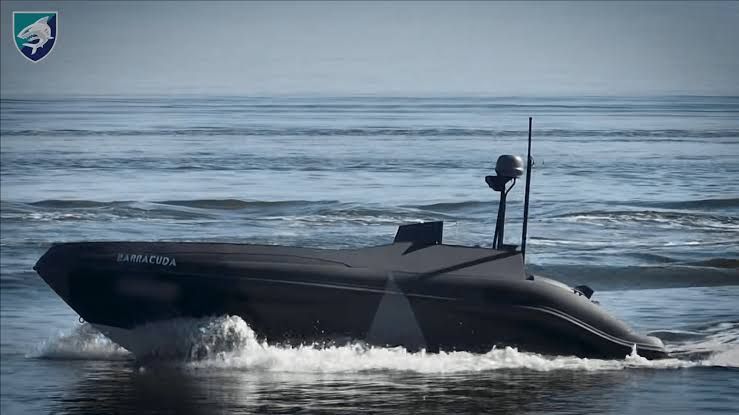
Barracuda is a Ukrainian family of modular unmanned surface vessels developed and operated by the Barracuda special unit of the 40th Separate Marine Brigade. Selected versions serve as motherships that transport and launch FPV drones for reconnaissance and attack missions.
The vessels can perform reconnaissance, strike, transport, evacuation, mine-laying, ammunition-delivery, and communications-relay tasks. Other configurations carry remotely controlled weapons, electronic-warfare equipment, or explosive payloads.
Barracuda vessels have operated on the Dnipro River and in its delta during the Russo-Ukrainian War. Their modular payloads allow the same basic concept to support several distinct missions.
The Barracuda unit initially assembled its vessels from available hulls, engines, and other components. An early improvised craft reportedly disrupted a Russian advance in the Dnipro delta by delivering explosives to a concentration of personnel and equipment.
The family first appeared publicly in August 2025. The initial presentation showed a vessel fitted with single-use grenade launchers. An FPV-drone carrier was subsequently displayed. A review published by Defense Express described nine numbered configurations divided among four platform families.
In December 2025, a Barracuda river drone was documented striking a Russian boat. By April 2026, the unit was conducting field tests in southern Ukraine. A report by Ukrinform described modular payload integration, onboard cameras, remote control, target-tracking functions, and the use of artificial intelligence.
Design
Barracuda is not a single standardized vessel. The name covers several unmanned craft built on different hull types. Reported platforms include conventional small boats, personal-watercraft hulls, larger tow-sport or water-ski boats, and a long-range heavy-payload craft.
The vessels are remotely controlled and carry onboard cameras. Operators plan fuel requirements for each mission, while navigators select routes and account for currents, waterways, and electronic-warfare threats. The control system reportedly uses satellite communications with a redundant radio link on several variants.
Payloads are modular. Depending on the variant, a Barracuda can carry FPV drones, electronic-warfare equipment, a remotely controlled machine gun, grenade launchers, a possible anti-tank guided missile installation, evacuation loads, or an explosive warhead. FPV-carrier variants transport smaller aerial drones to a launch point, extending their practical reach over water and contested coastal areas.
The broader family has been reported with speeds of up to 110 km/h, while individual platform groups have different performance limits. Reported explosive payloads range from 70 kg on lighter configurations to a possible 1,000 kg on the largest vessel. These figures apply to different variants and should not be treated as specifications for one craft.
Operational history
Barracuda vessels have been used for missions on the Dnipro River and its delta. Confirmed roles include attacks against boats and personnel, reconnaissance, and the deployment of FPV drones.
In August 2026, Barracuda motherships supported an attack near Zaliznyi Port in Kherson Oblast. Russian forces attempted to intercept the surface vessels with Geran-4 Seeker jet-powered unmanned aircraft. One vessel was destroyed, while the remaining craft continued to the FPV-drone launch area. Their operators then located and attacked Russian boats carrying troops. The 40th Brigade stated that the operation disrupted the rotation and destroyed the landing force.
Variants
- Barracuda 1: Conventional-hull FPV-drone mothership reported to carry four to eight aerial drones for reconnaissance and strikes.
- Barracuda 2: Conventional-hull escort configuration with a remotely controlled machine gun and electronic-warfare equipment.
- Barracuda 3: Conventional-hull one-way attack variant with a reported 250–400 kg warhead.
- Barracuda 4: Personal-watercraft-based configuration carrying four FPV drones.
- Barracuda 5: Personal-watercraft-based one-way attack variant with a reported 70–250 kg warhead.
- Barracuda 6: Armed personal-watercraft-based configuration reported with grenade launchers and a possible anti-tank guided missile installation. Details of the missile system and its stabilization have not been confirmed.
- Barracuda 7: Larger evacuation configuration with a reported payload capacity of up to 250 kg.
- Barracuda 8: Heavy one-way attack vessel intended for targets such as bridges, ships, and barges, with a reported 100–400 kg warhead.
- Barracuda 9: Long-range heavy-payload platform with a reported maximum payload of 1,000 kg. Its precise payload configuration has not been disclosed.
Operators
- Ukraine: Operated by the Barracuda special unit of the 40th Separate Marine Brigade, part of the 30th Marine Corps.
Specifications (Barracuda 1)
General characteristics
- Type: Unmanned surface vessel and FPV-drone mothership
- Payload: Four to eight FPV drones
- Control: Satellite communications with a redundant radio link
Performance
- Maximum speed: Up to 70 km/h
- Operational range: 350–400 km
Mission equipment
- Primary roles: Transport and launch of FPV drones for reconnaissance and strike missions
- Sensors: Onboard cameras
 Argentina
 Armenia
 Australia
 Austria
 Austria-Hungary
 Belgium
 Brazil
 United Kingdom
 United States
 Brunei
 Bulgaria
 Canada
 Chile
Chile China
China Colonial America
 Colombia
 Confederate States
 Croatia
 Czech
Czech Denmark
 Egypt
Egypt Finland
 France
 Georgia
 Germany
 German Imperial
 Greece
 Holland
 Hungary
 India
India Indonesia
 Iran
Iran Iraq
Iraq Ireland
 Israel
 Italy
Italy Japan
Japan Japan (1940)
 Jordan
 Kingdom of Italy
 Malaysia
 Mexico
 Myanmar
 Nazi Germany
 Netherlands
 New Zealand
 North Korea
 Norway
 Pakistan
 Peru
Peru Philippines
 Poland
 Portugal
 Prussia
 Romania
 Russia
 Saudi Arabia
 Serbia
 Singapore
 Slovakia
 Slovenia
 South Africa
 South Korea
 Soviet Union
 Spain
Spain Sweden
 Switzerland
 Syria
Syria Taiwan
 Thailand
 Turkey
 UAE
UAE Vietnam
 Yugoslavia