
History
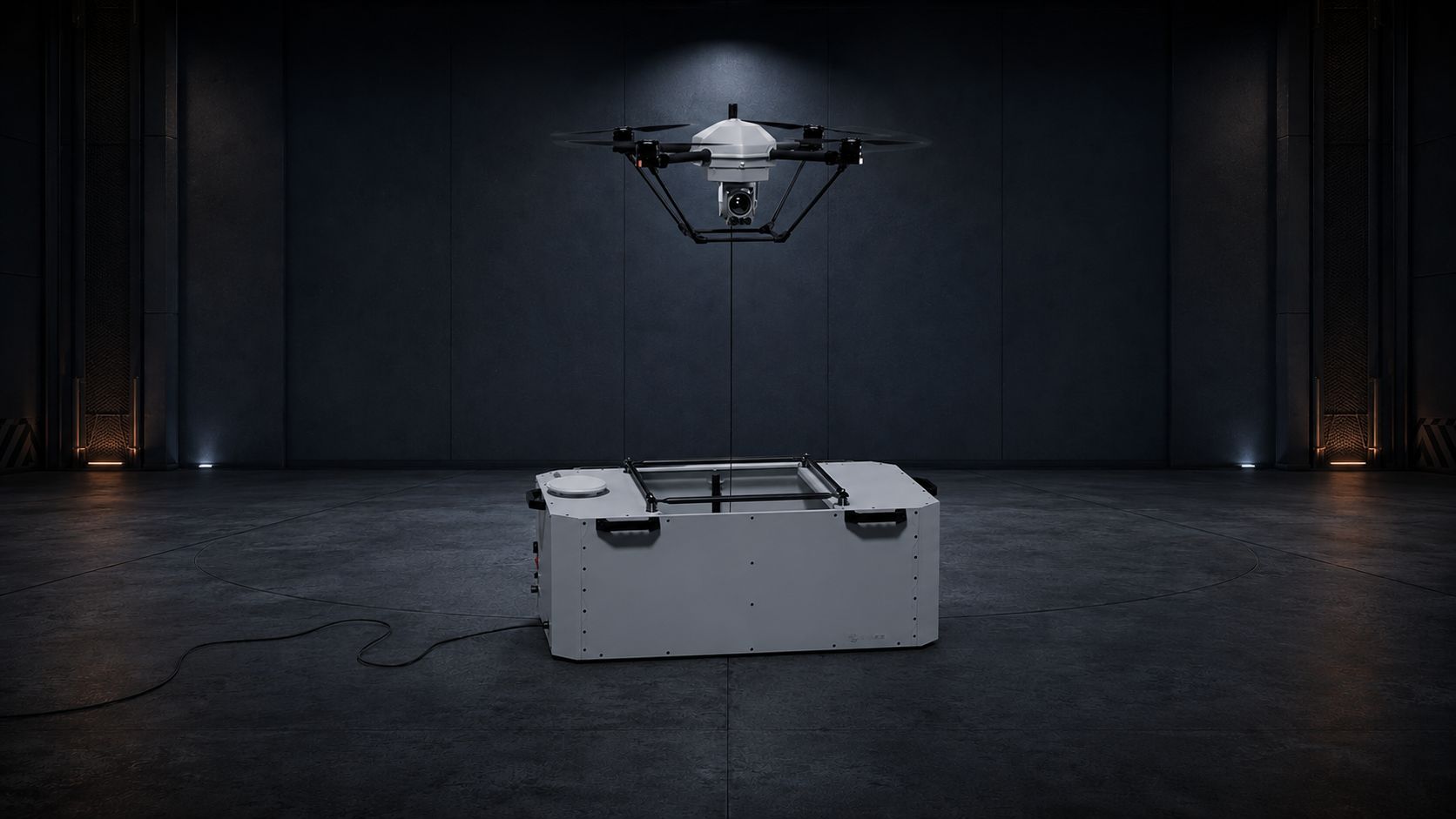
The Huless Highline-T is a Ukrainian tethered quadcopter designed to carry communications, electronic intelligence, and electronic warfare equipment. Electrical power, control signals, and payload data pass through a cable connected to a ground system.
The cable-powered arrangement allows the aircraft to remain above a fixed position for extended periods while serving as a variable-height antenna. Its modular payload interface supports equipment selected and installed by the user.
Huless developed the system to move radio equipment above obstacles and difficult terrain. This can extend communications and remote-control coverage for unmanned aircraft, unmanned ground vehicles, remotely operated turrets, and tactical radio networks.
The first version appeared in 2022. By August 2026, Huless had presented the sixth iteration of the project. The company also reported that it was developing a mobile version for installation on unmanned ground vehicles and unmanned surface vessels.
In January 2025, Huless reportedly raised $1 million from private investment, loans, and grants. The funding was intended partly to support development and market expansion for Highline-T.
Design
Aircraft and tether
Highline-T is described as a 28-inch tethered quadcopter. The complete system includes the aircraft, an automated winch, a ground control station, an uninterruptible power arrangement, a directional camera, and a single-axis antenna mount.
The winch carries 170 m of cable and supports operation at altitudes up to 150 m. The cable supplies electrical power and carries control and payload data. This reduces dependence on radio-frequency control links between the aircraft and its ground station. The Huless product page lists a data rate of up to 100 Mbit/s. The developer has also reported an optional optical cable capable of higher data-transfer rates.
Optical odometry sensors estimate the aircraft's position and orientation to maintain stable positioning. This is particularly important when the payload includes a directional antenna that must remain aligned with its intended coverage area.
Safety and endurance
The aircraft has reserve electrical power for a primary-power failure and an emergency parachute. Huless states that its motors are resistant to overheating and have a service life of 2,000 hours.
The manufacturer's published specification gives a continuous flight time of up to four hours, while other supplied material describes missions exceeding four hours. The system is intended for repeated operation throughout the day rather than unrestricted continuous flight.
Payloads and control
Highline-T can carry payloads weighing up to 5 kg. Supported roles include relaying FPV-drone links, extending remote control for ground robots and turrets, relaying tactical communications, and lifting electronic intelligence or electronic warfare equipment.
The ground software controls the aircraft and its payload while monitoring system condition. The complex can also integrate with software associated with other radio communications and electronic warfare equipment.
Huless describes Highline-T as resistant to electronic warfare because essential aircraft power, control, and data functions can use the physical tether. The radio characteristics of an installed mission payload depend on that payload and its operational role.
Program status
Highline-T was publicly available in its sixth project iteration by August 2026. Huless offered training for crews of up to three people, with the course adjusted to the operators' previous experience. The system was also listed for acquisition through Ukraine's The Chain platform using electronic reward points.
Manufacturer-supplied information reproduced in The Power Behind Ukrainian Defence Tech describes Highline-T as a relay platform for unmanned aircraft, ground robots, tactical radios, and signals-intelligence equipment. Public sources do not provide confirmed production quantities or identify specific military operators.
Specifications (Highline-T)
General characteristics
- Configuration: 28-inch tethered quadcopter
- Maximum payload: 5 kg
- Tether length: 170 m
- System components: aircraft, automated winch, ground control station, uninterruptible power equipment, single-axis antenna mount, and directional camera
- Safety equipment: reserve power and emergency parachute
Performance
- Maximum operating altitude: 150 m
- Published continuous flight time: up to 4 hours
- Published cable data rate: up to 100 Mbit/s
- Motor service life: 2,000 hours
- Reported remote-control extension: up to 15 km for unmanned ground vehicles and remotely operated turrets
Mission equipment
- Supported roles: communications relay, electronic intelligence, and electronic warfare
- Navigation and stabilization: optical odometry
- Payload control: ground-station software with system-condition monitoring
 Argentina
 Armenia
 Australia
 Austria
 Austria-Hungary
 Belgium
 Brazil
 United Kingdom
 United States
 Brunei
 Bulgaria
 Canada
 Chile
Chile China
China Colonial America
 Colombia
 Confederate States
 Croatia
 Czech
Czech Denmark
 Egypt
Egypt Finland
 France
 Georgia
 Germany
 German Imperial
 Greece
 Holland
 Hungary
 India
India Indonesia
 Iran
Iran Iraq
Iraq Ireland
 Israel
 Italy
Italy Japan
Japan Japan (1940)
 Jordan
 Kingdom of Italy
 Malaysia
 Mexico
 Myanmar
 Nazi Germany
 Netherlands
 New Zealand
 North Korea
 Norway
 Pakistan
 Peru
Peru Philippines
 Poland
 Portugal
 Prussia
 Romania
 Russia
 Saudi Arabia
 Serbia
 Singapore
 Slovakia
 Slovenia
 South Africa
 South Korea
 Soviet Union
 Spain
Spain Sweden
 Switzerland
 Syria
Syria Taiwan
 Thailand
 Turkey
 UAE
UAE Vietnam
 Yugoslavia