
History
The General Dynamics Land Systems M1E3 Abrams is a next-generation main battle tank under development for the United States Army. It is intended to preserve the firepower and protection associated with the Abrams family while reducing weight, fuel demand, and the logistical burden imposed by later M1A2 configurations.
The M1E3 is a fundamental redesign rather than another System Enhancement Package for the existing tank. Its principal features include a three-person layout, greater automation, a government-owned open systems architecture, and protection designed around modern threats such as drones, loitering munitions, and long-range precision weapons.
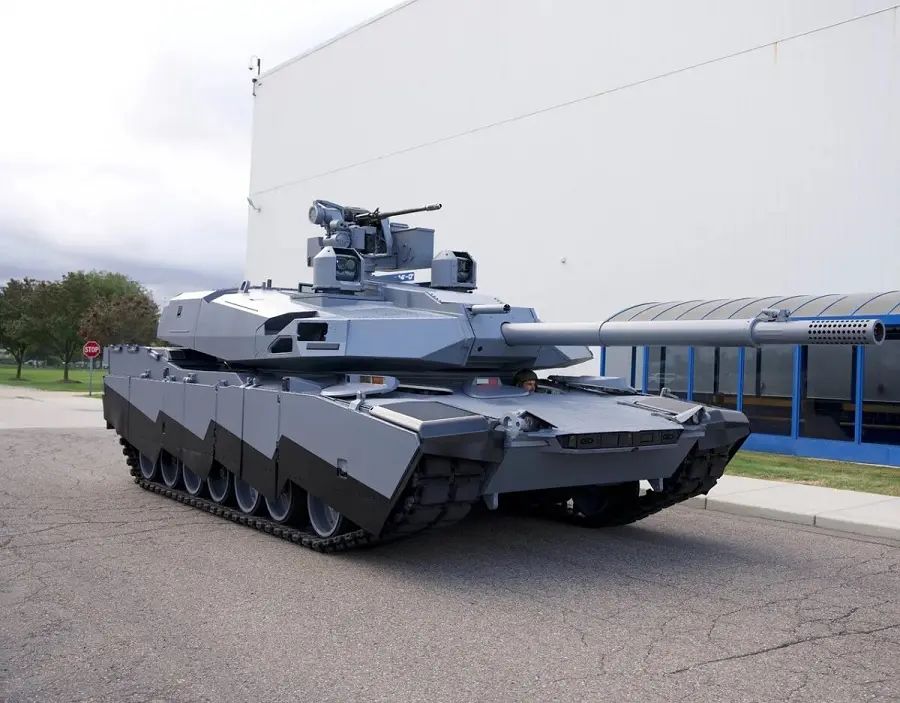
The first physically recognizable M1E3 prototype was unveiled in Detroit in January 2026. Four prototypes were expected to reach the 1st Armored Brigade Combat Team, 1st Cavalry Division, by the end of 2026 for operational evaluation.
Origins of the program
The original M1 Abrams entered U.S. Army service in 1980. Successive M1A1, M1A2, and System Enhancement Package configurations added improved weapons, armor, sensors, communications equipment, and protection systems. These changes also increased the vehicle's weight, complexity, fuel requirements, and demand on transport and recovery equipment.
In September 2023, the U.S. Army ended development of the planned M1A2 SEPv4 configuration and redirected modernization work toward the M1E3. The Army concluded that the existing Abrams architecture had insufficient capacity for another long cycle of incremental additions. The replacement program emphasized reduced weight, improved mobility, easier sustainment, modular protection, and sufficient electrical and physical capacity for future systems.
Prototype development
General Dynamics Land Systems developed the M1E3 for the U.S. Army with contributions from government organizations and companies outside the traditional armored-vehicle industry. Soldier feedback and testing informed the vehicle's digital controls, crew arrangement, and sustainment objectives.
The Army publicly presented its first prototype at the North American International Auto Show in Detroit in January 2026. An NGAUS account of the unveiling described seating for three people, improved fuel mileage, better off-road handling, a 120 mm smoothbore cannon, advanced protection, and a smaller logistical footprint.
The fiscal year 2027 budget request included $474 million to accelerate prototype completion before the planned start of production in fiscal year 2028. Initial operational capability has been reported as a goal for around 2030 or the early 2030s, but this remains a planned milestone rather than an achieved service date.
Operational evaluation
In August 2026, the Army announced plans to provide four M1E3 prototypes to the Iron Horse Brigade, formally the 1st Armored Brigade Combat Team of the 1st Cavalry Division. Delivery was expected by the end of 2026.
The platoon-sized group was intended for evaluation by an active armored formation. Testing was expected to examine mobility, protection, maintenance, refueling, ammunition resupply, crew workload, tactical networking, and integration into combined-arms operations. Results from these trials could lead to changes in the production design.
Design
The M1E3 is designed around lower logistical demand and greater adaptability. Instead of relying on successive additions to the M1A2 structure, the new architecture is intended to accept upgraded sensors, defensive equipment, software, communications systems, and weapons through standardized interfaces.
Crew arrangement and turret
The prototype provides positions for three crew members: commander, gunner, and driver. This arrangement removes the dedicated human loader used in earlier Abrams tanks.
The displayed prototype has been reported with a crewless turret and an automatic loading system. Relocating the crew from the turret to protected positions in the hull can reduce the volume requiring heavy armor. It also separates personnel from some of the most exposed equipment. The precise internal layout and final production protection package have not been publicly fixed.
Armament
The primary weapon is a 120 mm smoothbore cannon derived from the M256 family. An autoloader handles the ammunition and allows operation by the reduced crew. Compatibility with established and emerging U.S. 120 mm ammunition is an important program requirement, although the production ammunition allocation has not been announced.
The 2026 prototype was displayed with an EOS R400 Mk2 remote weapon station. The reported demonstration arrangement combined a 40 mm Mk19 automatic grenade launcher, a 7.62 mm machine gun, and an FGM-148 Javelin launcher. This modular installation also supported the prototype's counter-drone demonstration role and should not be treated as a confirmed production armament fit.
Protection
The M1E3 program combines passive armor with sensors, active protection, electronic countermeasures, and measures intended to reduce the vehicle's observable signatures. This differs from the earlier practice of meeting each new threat primarily by adding more passive armor.
The design is intended to accommodate active protection systems through a modular architecture. Such systems detect and attempt to defeat incoming anti-tank weapons before impact. The final choice of armor modules and active protection equipment may change following prototype evaluation.
The prototype configuration has also been associated with all-around electro-optical and infrared cameras, laser-warning equipment, smoke grenade launchers, and radar-assisted detection of small aerial targets. A published M1E3 technical profile identifies EchoGuard radar and stabilized S3-series sights among the displayed equipment.
Mobility and power
Weight reduction is a central requirement because the heaviest M1A2 configurations restrict bridge access, route selection, recovery options, and strategic transport. A lighter vehicle would also reduce the demand placed on tank transporters and supporting engineer units.
The 2026 prototype has been reported with a 1,500 hp AGT1500 gas-turbine engine. A hybrid-electric power system has been identified as a possible production solution. The intended benefits include lower fuel consumption, greater electrical capacity for sensors and defensive systems, and the ability to operate equipment without continuously running the main engine.
Public estimates have placed prototype combat weight at approximately 66,000 kg, but the Army has not established this as the final production figure. Published dimensions, road speed, and range also remain provisional while the configuration is under development.
Digital architecture
The tank uses a government-owned open systems architecture designed to simplify both software and hardware upgrades. This approach should allow individual sensors, electronic warfare components, fire-control functions, and communications equipment to be replaced without redesigning the complete vehicle.
Artificial intelligence and generative-AI tools have been used during digital engineering and systems integration. This does not mean that the prototype operates as an autonomous tank. The publicly described role of these tools is to accelerate design work, integrate technologies, and manage information presented to the crew.
Program status
As of August 2026, the M1E3 remained a prototype and test program. It had not entered operational service or full-rate production. The United States Army was the development authority and intended user.
The planned Iron Horse Brigade evaluation was intended to determine whether the redesigned vehicle could provide a useful reduction in weight and sustainment demand without sacrificing the direct-fire and protection functions of a main battle tank. The evaluation would also test whether automation and the three-person arrangement produced an acceptable crew workload during combat and maintenance tasks.
M1A2 SEPv3 production was expected to continue at a reduced level while M1E3 development proceeded. Production of the new design was planned to begin in fiscal year 2028, subject to successful testing, funding, and configuration decisions.
Specifications (2026 M1E3 prototype)
General characteristics
- Type: Main battle tank prototype
- Manufacturer: General Dynamics Land Systems
- Development authority: United States Army
- Crew: Three: commander, gunner, and driver
- Configuration: Tracked hull with a reported crewless turret and protected hull crew positions
- Combat weight: Approximately 66,000 kg reported; final production weight not confirmed
- Architecture: Government-owned modular open systems architecture
Mobility
- Prototype powerplant: Reported 1,500 hp AGT1500 gas turbine
- Production power concept: Hybrid-electric propulsion under development or consideration
- Mobility objectives: Reduced weight, improved fuel economy, better off-road handling, and a smaller sustainment footprint
Armament
- Main armament: One 120 mm smoothbore cannon
- Loading system: Automatic loader
- Displayed remote weapon station: EOS R400 Mk2 in a reported configuration with a 40 mm Mk19 grenade launcher, 7.62 mm machine gun, and one FGM-148 Javelin launcher
Sensors and protection
- Protection concept: Modular passive protection combined with active protection, warning sensors, and electronic countermeasures
- Situational awareness: All-around day and night electro-optical and infrared coverage reported for the prototype
- Counter-drone equipment: Radar-assisted detection and a modular remote weapon station demonstrated on the prototype
- Upgrade method: Standardized digital and hardware interfaces for faster replacement or integration of subsystems
Related equipment
- M1A2 SEPv3 Abrams: The current production Abrams configuration that the M1E3 is intended eventually to succeed.
- M1A2 SEPv4: A planned incremental modernization program ended in 2023 when the Army redirected development toward the M1E3.
- AbramsX: A General Dynamics Land Systems technology demonstrator that explored reduced crew requirements, automation, hybrid propulsion, and a crewless turret before the M1E3 prototype appeared.
 Argentina
 Armenia
 Australia
 Austria
 Austria-Hungary
 Belgium
 Brazil
 United Kingdom
 Brunei
 Bulgaria
 Canada
 Chile
Chile China
China Colonial America
 Colombia
 Confederate States
 Croatia
 Czech
Czech Denmark
 Egypt
Egypt Finland
 France
 Georgia
 Germany
 German Imperial
 Greece
 Holland
 Hungary
 India
India Indonesia
 Iran
Iran Iraq
Iraq Ireland
 Israel
 Italy
Italy Japan
Japan Japan (1940)
 Jordan
 Kingdom of Italy
 Malaysia
 Mexico
 Myanmar
 Nazi Germany
 Netherlands
 New Zealand
 North Korea
 Norway
 Pakistan
 Peru
Peru Philippines
 Poland
 Portugal
 Prussia
 Romania
 Russia
 Saudi Arabia
 Serbia
 Singapore
 Slovakia
 Slovenia
 South Africa
 South Korea
 Soviet Union
 Spain
Spain Sweden
 Switzerland
 Syria
Syria Taiwan
 Thailand
 Turkey
 UAE
UAE Ukraine
 Vietnam
 Yugoslavia