
History
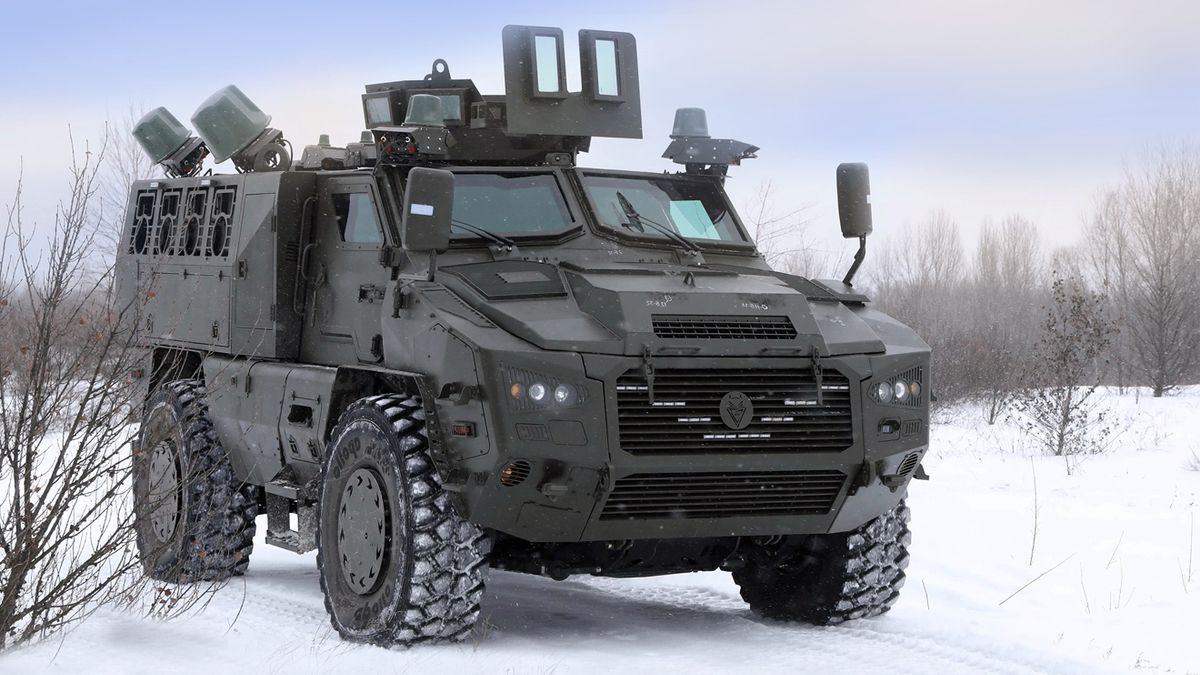
The MAC HUB OWL-APC is a Ukrainian 4×4 armored personnel carrier designed to transport personnel, provide fire support, conduct patrols and special operations, and operate during emergency response missions. Its protective structure combines a V-shaped monocoque hull, a double floor, blast-absorbing components, and blast-resistant seating.
The vehicle carries up to six infantry personnel in addition to a three-person crew. A modular troop compartment allows conversion to a medical evacuation configuration within several hours.
A distinctive feature is a Ukrainian-developed 360-degree virtual-reality viewing system with night vision. The driver wears VR goggles to observe the area around the vehicle without relying only on conventional viewing ports.
The OWL-APC followed the earlier MAC OWL armored vehicle in the manufacturer's product line. Reporting on the broader OWL program stated that MAC HUB publicly presented the MAC OWL on 16 January 2026 and sent it for testing with Ukrainian military units in February 2026. The earlier vehicle was developed over approximately a year and a half with technical cooperation from Paramount Greece. It used a modified armored hull derived from the South African Mbombe 4 design. Details of this development were published by Mezha Defense, while the testing chronology was reported by Army Recognition.
On 13 August 2026, Ukraine's Ministry of Defence announced that it had codified the OWL-APC after testing confirmed its stated tactical and technical characteristics. Codification approved the vehicle for use by the Ukrainian Defence Forces and expanded the OWL family beyond the previously codified MAC OWL. The announcement and description of the vehicle were published by the Ministry of Defence of Ukraine.
Design
Hull and protection
The OWL-APC has a load-bearing V-shaped monocoque hull and a double floor. The shape is intended to redirect blast forces away from the occupied compartment. Inertial blast-absorbing components and shock-absorbing seats are used to reduce the effects of an explosion on the crew and passengers.
Mine protection is stated as STANAG 4569 Levels 4a and 4b. These ratings concern explosions beneath a wheel and beneath the vehicle's central hull area. The circular ballistic protection of the personnel and engine compartments is classified as PZSA-6 under the Ukrainian DSTU 3975-2000 standard.
Crew and internal arrangement
The standard crew consists of three people, including an operator for the combat module. The troop compartment accommodates up to six infantry personnel. Its modular fittings permit the seating arrangement to be replaced for medical evacuation duties within several hours.
Mobility
A 450 hp engine powers the four-wheel-drive vehicle. The reported maximum speed is 100 km/h on a paved road and 60 km/h on an unpaved road. The curb weight is 15,000 kg with a stated tolerance of 200 kg, while the maximum payload is 2,200 kg.
Observation and mission equipment
The in-house-developed surround-view system combines external cameras, virtual-reality goggles, and night-vision capability. It provides the driver with a continuous view around the armored carrier. The design is also intended to have a comparatively low battlefield signature and lower maintenance requirements than larger armored personnel carriers.
Armament
The OWL-APC can be fitted with the Tavria-14.5/7.62 remotely operated combat module. Its designation indicates compatibility with 14.5 mm and 7.62 mm weapons. The selected armament and mission equipment may depend on the customer configuration.
Program status
The OWL-APC completed the testing required for Ukrainian codification in 2026. The Ministry of Defence subsequently approved it for operation by Defence Forces units. Public sources do not provide confirmed production quantities, contracts, or details of operational deployment. A contemporary summary of the codification and principal characteristics is available from Mezha.
Specifications (OWL-APC)
General characteristics
- Type: Mine-resistant armored personnel carrier
- Configuration: 4×4 wheeled vehicle
- Crew: Three
- Troop capacity: Up to six personnel
- Curb weight: 15,000 ± 200 kg
- Maximum payload: 2,200 kg
- Engine power: 450 hp
Performance
- Maximum road speed: 100 km/h
- Maximum speed on unpaved roads: 60 km/h
Protection and equipment
- Mine protection: STANAG 4569 Levels 4a and 4b
- Ballistic protection: PZSA-6 under DSTU 3975-2000 for the personnel and engine compartments
- Hull: V-shaped monocoque with a double floor
- Observation: 360-degree VR surround-view system with night vision
- Medical configuration: Modular troop compartment convertible for medical evacuation
Armament
- Optional combat module: Tavria-14.5/7.62
Related equipment
- MAC OWL: The preceding and smaller vehicle in MAC HUB's OWL family. It was publicly presented and tested before the OWL-APC received codification.
- Mbombe 4: A South African armored vehicle whose hull design formed the basis for the earlier MAC OWL developed with support from Paramount Greece.
 Argentina
 Armenia
 Australia
 Austria
 Austria-Hungary
 Belgium
 Brazil
 United Kingdom
 United States
 Brunei
 Bulgaria
 Canada
 Chile
Chile China
China Colonial America
 Colombia
 Confederate States
 Croatia
 Czech
Czech Denmark
 Egypt
Egypt Finland
 France
 Georgia
 Germany
 German Imperial
 Greece
 Holland
 Hungary
 India
India Indonesia
 Iran
Iran Iraq
Iraq Ireland
 Israel
 Italy
Italy Japan
Japan Japan (1940)
 Jordan
 Kingdom of Italy
 Malaysia
 Mexico
 Myanmar
 Nazi Germany
 Netherlands
 New Zealand
 North Korea
 Norway
 Pakistan
 Peru
Peru Philippines
 Poland
 Portugal
 Prussia
 Romania
 Russia
 Saudi Arabia
 Serbia
 Singapore
 Slovakia
 Slovenia
 South Africa
 South Korea
 Soviet Union
 Spain
Spain Sweden
 Switzerland
 Syria
Syria Taiwan
 Thailand
 Turkey
 UAE
UAE Vietnam
 Yugoslavia