
History
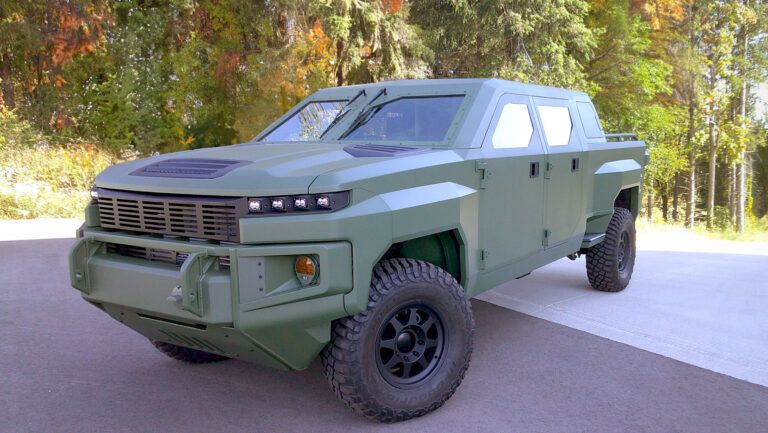
The Ford Infantry Squad Vehicle-Heavy, or ISV-Heavy, is a prototype tactical vehicle being developed for a U.S. Army competition. Ford's candidate is based on the company's F-Series Super Duty commercial truck platform.
The Army intends the ISV-Heavy to transport up to six personnel while carrying mission equipment and supplying substantial electrical power. The requirement emphasizes mobility, payload capacity, exportable power, and support for electrically dependent battlefield systems.
The Ford vehicle remains under development. Ford is scheduled to deliver three prototypes by March 30, 2027, after which the Army plans operational assessments and limited developmental testing.
Development
In spring 2026, the U.S. Army issued a commercial requirement for a heavier member of the Infantry Squad Vehicle family. The program addresses a need for mobile electrical power that can accompany small formations and field command posts. The vehicle is intended for the Army's planned Mobile Brigade Combat Teams.
On June 30, 2026, the Army awarded firm-fixed-price Other Transaction Agreements to Ford Motor Company, GM Defense, and BC Customs. Each company was selected to provide three prototypes. The resulting fleet of nine vehicles will allow the Army to compare different commercial-platform approaches before making fielding and sustainment decisions. The awards and delivery plan were confirmed in reports by Military Times, Inside Defense, and Breaking Defense.
Ford confirmed that its proposal would use an F-Series Super Duty truck as its foundation. The company had not disclosed the candidate's propulsion system, energy-storage arrangement, detailed dimensions, protection level, or final configuration as of the prototype award. Contemporary coverage described the entry as a modified F-Series vehicle but did not identify a separate production designation. The three-company competition was also summarized by The National Interest.
Design
Vehicle platform
The Ford candidate uses the F-Series Super Duty architecture, which provides a commercially derived heavy-duty chassis for military adaptation. Ford has indicated that it plans to use its Ford Pro support network for parts supply, logistics support, and fleet management. The extent to which the production candidate will retain commercial components has not been disclosed.
The Army requirement calls for accommodation for as many as six personnel. Requested interior features include rotating rear seats, mobile workstations, and rear seating that can be rearranged without tools to carry a medical litter. These features are program requirements and should not be treated as confirmed characteristics of a completed Ford prototype until the vehicle is delivered and evaluated.
Electrical power
Exportable electrical power is a central part of the ISV-Heavy requirement. The vehicle is intended to supply power to command-and-control equipment, electronic-warfare systems, counter-uncrewed-aircraft systems, directed-energy equipment, and other mission loads without requiring a separate generator vehicle.
The Army requires 60 kW of continuous high-voltage direct-current power, 15 kW at 28 volts DC, and 4.8 kW at 120 volts AC. It also requires the onboard energy system to recover to 90 percent charge within six hours. Ford has not publicly described how its candidate will generate or store this power.
Mobility and utility requirements
The requested vehicle must carry a payload of 1,814 kg (4,000 lb) and tow a trailer weighing 2,948 kg (6,500 lb). The Army also seeks operation in temperatures from approximately −32°C to 54°C (−25°F to 130°F).
The requirement includes provision for drive-by-wire architecture, in which electronic controls can operate vehicle functions without direct mechanical control links. This feature is intended to support possible future autonomous functions. No autonomous capability has yet been confirmed for the Ford prototype.
Program status
Ford is scheduled to provide three ISV-Heavy prototypes by March 30, 2027. The vehicles are then expected to undergo operational assessments and limited developmental testing under the U.S. Army Test and Evaluation Command. Testing will examine whether the candidate can meet mobility, payload, electrical-output, environmental, and reliability requirements.
The Ford ISV-Heavy is not an operational vehicle and has not been selected for production. The Army has described a potential requirement for 606 ISV-Heavy vehicles. Its fiscal year 2027 budget submission requested $21 million for 34 vehicles and listed a gross weapon-system unit cost of $617,000, but these program figures do not constitute a production award to Ford.
Specifications (Ford ISV-Heavy candidate requirements)
The following values are U.S. Army program requirements for the competing prototypes. They are not verified performance results for the Ford vehicle.
General characteristics
- Base platform: Ford F-Series Super Duty
- Personnel capacity: Up to six
- Required payload: 1,814 kg (4,000 lb)
- Required trailer capacity: 2,948 kg (6,500 lb)
- Required operating temperature: Approximately −32°C to 54°C (−25°F to 130°F)
Electrical system requirements
- Continuous high-voltage DC output: 60 kW
- 28-volt DC output: 15 kW
- 120-volt AC output: 4.8 kW
- Recharge requirement: Recovery to 90 percent charge within six hours
Requested equipment
- Control architecture: Drive-by-wire provision for possible future autonomous operation
- Rear seating: Rotating seats with tool-free conversion for medical-litter carriage
- Workstations: Ergonomic mobile workstations requested
Related equipment
- GM Defense ISV-Heavy: A competing prototype based on a militarized Chevrolet Silverado heavy-duty platform.
- BC Customs ISV-Heavy: A competing prototype for the same Army evaluation; its configuration has not been publicly detailed.
- GM Defense Infantry Squad Vehicle: The lighter production ISV based on the Chevrolet Colorado platform and already supplied to the U.S. Army.
 Argentina
 Armenia
 Australia
 Austria
 Austria-Hungary
 Belgium
 Brazil
 United Kingdom
 Brunei
 Bulgaria
 Canada
 Chile
Chile China
China Colonial America
 Colombia
 Confederate States
 Croatia
 Czech
Czech Denmark
 Egypt
Egypt Finland
 France
 Georgia
 Germany
 German Imperial
 Greece
 Holland
 Hungary
 India
India Indonesia
 Iran
Iran Iraq
Iraq Ireland
 Israel
 Italy
Italy Japan
Japan Japan (1940)
 Jordan
 Kingdom of Italy
 Malaysia
 Mexico
 Myanmar
 Nazi Germany
 Netherlands
 New Zealand
 North Korea
 Norway
 Pakistan
 Peru
Peru Philippines
 Poland
 Portugal
 Prussia
 Romania
 Russia
 Saudi Arabia
 Serbia
 Singapore
 Slovakia
 Slovenia
 South Africa
 South Korea
 Soviet Union
 Spain
Spain Sweden
 Switzerland
 Syria
Syria Taiwan
 Thailand
 Turkey
 UAE
UAE Ukraine
 Vietnam
 Yugoslavia