
History
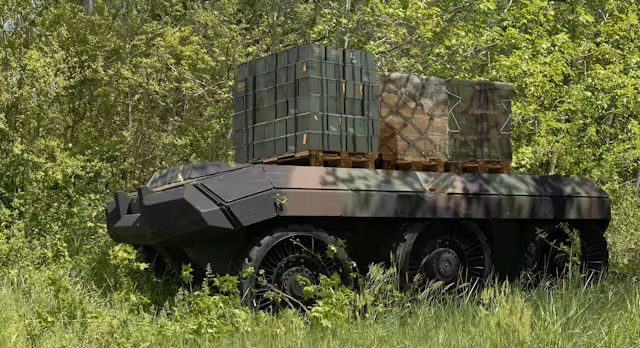
The BLADE Dire WOLF is a six-wheeled unmanned ground vehicle developed for autonomous logistics and battlefield sustainment. It is intended to transport heavy supplies across difficult terrain while reducing the exposure of soldiers to dangerous resupply routes.
Dire WOLF uses a diesel-electric hybrid powertrain, pivot steering, non-pneumatic tires, and an onboard battery pack that can supply electrical power to external equipment. The vehicle is derived from BLADE's WOLF-X robotic combat vehicle.
In 2026, HDT Robotics, operating as BLADE, offered Dire WOLF for the United States Army's Project Sustainment initiative. The project evaluates autonomous systems for distributing supplies in contested environments.
The National Advanced Mobility Consortium selected five industry participants for Project Sustainment: AM General, American Rheinmetall, Carnegie Robotics, HDT Robotics through BLADE, and Stratom. Their different backgrounds in tactical vehicles, robotics, and autonomous technology allow the Army to examine multiple approaches rather than a single vehicle design.
BLADE announced its selection on 23 July 2026 and presented Dire WOLF as its proposed system. The manufacturer stated that the design incorporates more than two decades of experience with unmanned ground vehicles. BLADE is working with Carnegie Robotics and Michelin on the project.
The selection is a development and evaluation milestone rather than a production decision. Public information does not confirm Army-wide fielding, production quantities, or an operational introduction date. Further information is available in the BLADE announcement.
Design
Configuration and mobility
Dire WOLF has a six-wheel configuration adapted from the WOLF-X platform. Its pivot-steering system allows the vehicle to turn within a confined area without following the wide turning path of a conventional truck.
The mobility system is intended for both long-range and short-range logistics over extreme terrain. BLADE states that the vehicle can negotiate steep slopes, cross wide gaps, and climb vertical obstacles up to 0.6 m (2 ft) high. Detailed dimensions, ground clearance, suspension specifications, gross weight, and maximum speed have not been released.
The vehicle uses non-pneumatic Michelin Tweels. These wheels replace a conventional air-filled tire with a flexible spoke structure, eliminating punctures caused by loss of air pressure. They are intended to maintain mobility through vegetation, rubble, and debris-strewn terrain.
Propulsion and electrical power
A high-power diesel-electric hybrid system provides propulsion. BLADE has not published the engine model, electrical architecture, fuel capacity, output, range, or fuel consumption.
An onboard battery pack uses what the manufacturer describes as a safe battery chemistry. Stored energy can be exported to equipment at forward positions. Potential supported equipment may include communications, sensors, command systems, electronic-warfare equipment, and counter-unmanned-aircraft systems, although specific integrations and electrical output ratings have not been disclosed.
Cargo system
Dire WOLF is designed to carry thousands of pounds of mission-essential cargo. The manufacturer has not released a precise payload rating or details of the cargo deck, loading equipment, or modular interfaces.
The intended role includes moving supplies to forces at the tactical edge without placing a driver aboard the vehicle. This could permit smaller loads to travel over dispersed routes in areas threatened by drones, long-range weapons, or other hazards.
Autonomy and control
Dire WOLF is proposed as an autonomous logistics vehicle, but BLADE has not disclosed its sensor suite, navigation hardware, autonomy architecture, communications system, or level of independent control. Carnegie Robotics is a program partner, indicating that autonomous navigation technology will be integrated with the vehicle platform.
Publicly available information does not establish how the system performs when satellite navigation or communications are degraded. It also does not describe remote-control provisions, cybersecurity measures, obstacle-recognition methods, or recovery procedures.
Protection
The non-pneumatic wheels improve resistance to mobility loss caused by tire punctures. No ballistic armor, mine protection, electronic-protection system, or integrated counter-drone equipment has been announced for Dire WOLF. Its disclosed survivability features therefore concern continued mobility rather than confirmed protection against weapons.
Program status
As of the 2026 announcement, Dire WOLF was BLADE's proposed vehicle for the prototype-oriented Project Sustainment effort. The Army had not announced a production order or operational deployment.
The program is intended to compare autonomous logistics technologies that can distribute supplies in contested areas. Evaluation is expected to determine whether the competing systems can reduce personnel risk while providing useful payload, mobility, endurance, autonomy, and maintainability under battlefield conditions.
Specifications (Dire WOLF)
General characteristics
- Type: Autonomous logistics unmanned ground vehicle
- Configuration: Six wheels
- Payload: Thousands of pounds of cargo; exact rating not disclosed
- Vertical obstacle: Up to 0.6 m (2 ft)
- Steering: Pivot steering
- Wheels: Non-pneumatic Michelin Tweels
Powerplant and equipment
- Powertrain: Diesel-electric hybrid
- Energy storage: Onboard battery pack
- External power: Exportable electrical power; output not disclosed
- Primary role: Long-range and short-range transport of mission-essential supplies in contested environments
Related equipment
- WOLF-X: BLADE robotic combat vehicle that provided the basis for the six-wheeled Dire WOLF logistics design.
- Hunter WOLF: A smaller member of BLADE's unmanned ground vehicle family used for logistics and payload-carrying missions.
 Argentina
 Armenia
 Australia
 Austria
 Austria-Hungary
 Belgium
 Brazil
 United Kingdom
 Brunei
 Bulgaria
 Canada
 Chile
Chile China
China Colonial America
 Colombia
 Confederate States
 Croatia
 Czech
Czech Denmark
 Egypt
Egypt Finland
 France
 Georgia
 Germany
 German Imperial
 Greece
 Holland
 Hungary
 India
India Indonesia
 Iran
Iran Iraq
Iraq Ireland
 Israel
 Italy
Italy Japan
Japan Japan (1940)
 Jordan
 Kingdom of Italy
 Malaysia
 Mexico
 Myanmar
 Nazi Germany
 Netherlands
 New Zealand
 North Korea
 Norway
 Pakistan
 Peru
Peru Philippines
 Poland
 Portugal
 Prussia
 Romania
 Russia
 Saudi Arabia
 Serbia
 Singapore
 Slovakia
 Slovenia
 South Africa
 South Korea
 Soviet Union
 Spain
Spain Sweden
 Switzerland
 Syria
Syria Taiwan
 Thailand
 Turkey
 UAE
UAE Ukraine
 Vietnam
 Yugoslavia