
History
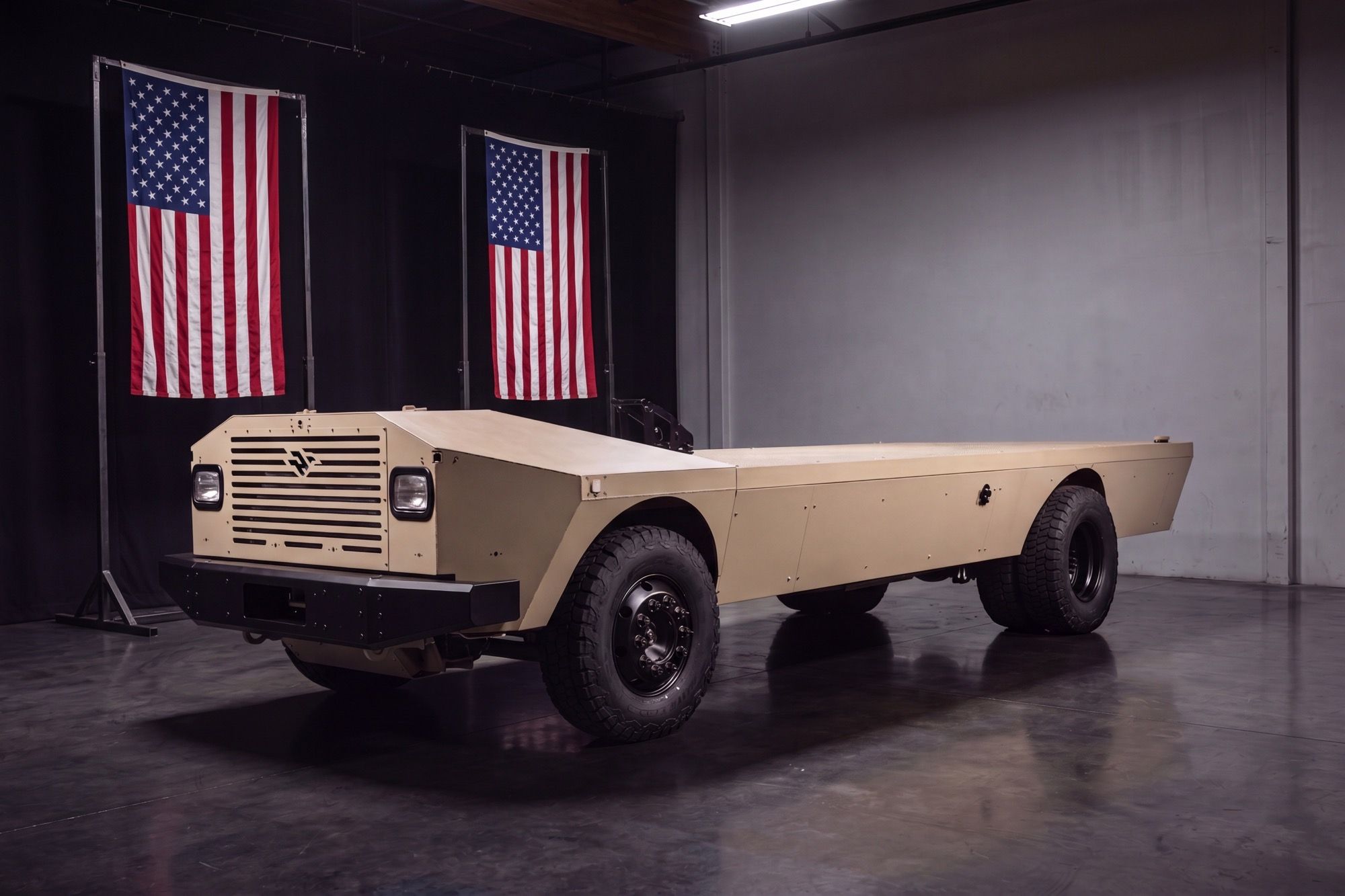
The Harbinger Praesidia hybrid-electric unmanned ground vehicle platform is an American medium-duty vehicle system designed for military logistics and other configurable missions. It combines a plug-in series-hybrid chassis with drive-by-wire controls, teleoperation equipment, onboard electrical generation, and exportable power.
Harbinger publicly introduced the platform in June 2026 through its Praesidia defense business. A prototype based on the dual-use hybrid chassis was subsequently selected for an 18-month U.S. Army Project Sustainment effort led by American Rheinmetall.
The Project Sustainment vehicles are intended to transport supplies to and from forward troops with minimal human intervention. The program remains in development and does not represent an operationally fielded vehicle fleet.
Development
In May 2026, American Rheinmetall and Harbinger announced a partnership to develop robotic and uncrewed ground vehicles. Harbinger supplies the commercially derived, autonomy-ready hybrid platform. American Rheinmetall contributes vehicle integration, mission systems, and modular architecture. The companies identified autonomous tactical vehicles, contested-logistics resupply, and other robotic platforms as initial areas of cooperation. They expected joint demonstrations to begin during the summer of 2026, according to the Rheinmetall announcement.
Harbinger formally unveiled its military platform on 10 June 2026. The design uses the same clean-sheet medium-duty plug-in hybrid chassis developed for commercial vehicles. Harbinger offered it for flat-deck logistics, field communications, troop transport, perimeter security, and counter-uncrewed-aircraft missions. The platform was presented as configurable rather than as a single fixed military vehicle.
On 31 July 2026, American Rheinmetall announced an 18-month U.S. Army contract executed through the National Advanced Mobility Consortium. The contract covers the development and delivery of autonomous hybrid-powered vehicles for Project Sustainment. American Rheinmetall serves as prime contractor, while Harbinger provides the vehicle platform. Forterra supplies autonomous-driving capabilities, and Primordial Labs supplies the Anura natural-language human-machine interface.
Design
Chassis and payload
The platform is based on a medium-duty chassis engineered and assembled by Harbinger in the United States. Three wheelbases are available, allowing the vehicle layout to be adapted for compact maneuvering or larger payloads. Gross vehicle weight ratings extend across the medium-duty range, while the highest stated payload is 8,165 kg.
The chassis uses accelerator-by-wire, brake-by-wire, and steer-by-wire controls. These systems translate electronic commands into vehicle movement without requiring direct mechanical input from a driver. Redundancy in key systems supports remote control and integration of autonomous-driving equipment.
Hybrid power system
The series-hybrid drivetrain uses an electric traction motor together with a compact gasoline engine and generator. The engine can recharge the high-voltage battery or supply power while the vehicle is moving or stationary. Energy can also be supplied through external electric-vehicle charging.
The standard configuration has a stated hybrid driving range of more than 805 km and an electric-only range of approximately 169 km. Electric operation permits quieter movement, while a Stealth Mode disables exterior lights, acoustic warning devices, and the onboard generator to reduce acoustic and thermal signatures.
The battery also functions as an energy reserve for mission equipment. Harbinger states that the vehicle can export up to 350 kW to external systems. The gasoline engine provides 48 kW of continuous power, while a 15 kW onboard inverter supplies split-phase alternating current. Bi-directional charging allows energy to move between the vehicle and compatible external systems.
Remote control and communications
A proprietary application programming interface supports teleoperation and integration with other control systems. Six cameras provide a 360-degree overhead-style view around the vehicle. Remote auxiliary controls can operate equipment such as liftgates, pallet-deployment mechanisms, and power-export systems.
The communications architecture combines radio and satellite links. Integrated mesh radios provide a stated line-of-sight teleoperation distance of up to 5 km. Satellite communications support control beyond line of sight, although actual availability and performance depend on the communications network.
For Project Sustainment, Forterra's autonomy package is intended to support distributed and mission-aware vehicle operation. Primordial Labs' Anura interface is intended to convert natural-language instructions into robotic commands, enabling voice control and reducing the number of direct control actions required from soldiers.
Program status
As of July 2026, the Harbinger-based Project Sustainment vehicle was a prototype under an 18-month development and delivery contract. Work was planned at facilities and test ranges in the United States. The Army effort focuses on autonomous load handling and supply transport for company-sized formations operating in contested environments.
The contract allows for possible follow-on orders, but no production quantity, service-entry date, or operational deployment has been confirmed. Detailed configuration data for the Army prototype may also differ from Harbinger's standard platform specifications.
Configurations
- 158-inch-wheelbase chassis: The shortest standard chassis, intended where compact maneuverability is important.
- 178-inch-wheelbase chassis: The intermediate standard chassis configuration.
- 208-inch-wheelbase chassis: The longest standard chassis, intended to accommodate larger bodies or loads.
- Project Sustainment prototype: An autonomous logistics vehicle based on the Harbinger hybrid chassis and integrated by the American Rheinmetall-led team for the U.S. Army.
Specifications (Harbinger Praesidia standard platform)
General characteristics
- Wheelbases: 4.01 m, 4.52 m, or 5.28 m (158, 178, or 208 in)
- Gross vehicle weight rating: 7,257–11,793 kg (16,000–26,000 lb)
- Maximum stated payload: 8,165 kg (18,000 lb)
- Propulsion: Series-hybrid system with an electric traction motor, gasoline engine, generator, and high-voltage battery
- Cameras: Six-camera system providing 360-degree situational awareness
Performance
- Hybrid driving range: More than 805 km (500 mi) in the standard configuration
- Electric-only driving range: Approximately 169 km (105 mi) in the standard configuration
- Maximum speed: 105 km/h (65 mph)
- Minimum turning radius: 6.4 m (21 ft)
- Gradeability: More than 30 percent
- Side-slope capability: More than 20 percent
- Operating temperature: −30°C to 55°C
- Maximum stated operating altitude: 3,658 m (12,000 ft)
- AC charging time: Approximately four hours from 10 to 80 percent
- DC fast-charging time: Approximately one hour from 10 to 80 percent
Electrical power
- Maximum stated external power: Up to 350 kW
- Continuous generator power: 48 kW from the gasoline engine
- Onboard AC inverter: 15 kW split-phase output
- Line-of-sight teleoperation distance: Up to 5 km using integrated mesh radios
 Argentina
 Armenia
 Australia
 Austria
 Austria-Hungary
 Belgium
 Brazil
 United Kingdom
 Brunei
 Bulgaria
 Canada
 Chile
Chile China
China Colonial America
 Colombia
 Confederate States
 Croatia
 Czech
Czech Denmark
 Egypt
Egypt Finland
 France
 Georgia
 Germany
 German Imperial
 Greece
 Holland
 Hungary
 India
India Indonesia
 Iran
Iran Iraq
Iraq Ireland
 Israel
 Italy
Italy Japan
Japan Japan (1940)
 Jordan
 Kingdom of Italy
 Malaysia
 Mexico
 Myanmar
 Nazi Germany
 Netherlands
 New Zealand
 North Korea
 Norway
 Pakistan
 Peru
Peru Philippines
 Poland
 Portugal
 Prussia
 Romania
 Russia
 Saudi Arabia
 Serbia
 Singapore
 Slovakia
 Slovenia
 South Africa
 South Korea
 Soviet Union
 Spain
Spain Sweden
 Switzerland
 Syria
Syria Taiwan
 Thailand
 Turkey
 UAE
UAE Ukraine
 Vietnam
 Yugoslavia