
History
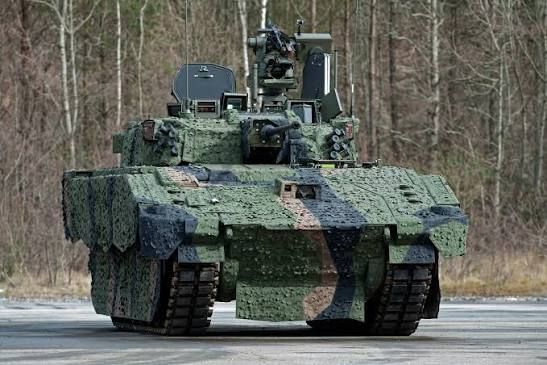
General Dynamics Ajax is a British family of tracked, digitally enabled armoured fighting vehicles developed for reconnaissance, command, engineering support, personnel transport, repair, and recovery roles. The programme is intended to replace the British Army's ageing tracked reconnaissance fleet and provide a common platform for six specialized variants.
The British Army is acquiring 589 vehicles. According to the British Army, the family consists of Ajax, Ares, Athena, Argus, Atlas, and Apollo. Ajax is the turreted reconnaissance member of the family as well as the name commonly used for the overall programme.
The programme developed from the Future Rapid Effect System Specialist Vehicle requirement and later the Scout SV project. General Dynamics UK based its proposal on the ASCOD tracked vehicle, substantially redesigned for British requirements.
Development
British work on a replacement for the Combat Vehicle Reconnaissance (Tracked) family had evolved through several programmes before the Specialist Vehicle requirement became the priority. In 2008 the Ministry of Defence placed greater emphasis on the FRES Scout element, and in 2009 General Dynamics UK and BAE Systems were selected to compete for the reconnaissance programme.
General Dynamics offered an ASCOD-derived design, while BAE Systems proposed a modified CV90. On 22 March 2010, General Dynamics announced that the Ministry of Defence had selected its ASCOD SV design for the demonstration phase. A subsequent £500 million demonstration contract covered development of Recce Block 1 and called for seven prototypes. Prototype trials were expected to begin in 2013.
In 2011 an experimental Scout test vehicle physically combined a prototype turret with a tracked mule platform. The vehicle incorporated the 1.7 m turret ring developed for Scout and a turret integrating the 40 mm Cased Telescoped Cannon System. The MTU 8V 199 engine was also selected for the programme in 2011. This early integrated test vehicle marked the emergence of a physically recognizable Scout configuration.
A manufacturing contract was awarded in 2014. In September 2015, the Ministry of Defence renamed the 589-vehicle fleet Ajax. Under this naming system, Ajax became both the programme name and the designation of the turreted reconnaissance variant. The vehicles are assembled at General Dynamics' facility in Merthyr Tydfil, Wales.
Delays and safety concerns
The programme experienced repeated delays. The House of Commons Library reported that Ajax had originally been expected to enter service around 2017, with the planned date later moving to 2020 and then to 2025.
Excessive noise and vibration became a major problem during trials. These issues raised health concerns for personnel operating the vehicles and resulted in a pause in contractor payments from December 2020. After design modifications, user trials resumed in 2023 and payments to General Dynamics Land Systems UK restarted.
The original firm-price production agreement was valued at £5.5 billion. By January 2026, the House of Commons Library described the overall programme as being estimated at £6.2 billion.
Initial Operating Capability was announced in early November 2025. On 25 November 2025, however, training and exercises with Ajax were paused after personnel reported symptoms associated with noise and vibration during a training exercise. Reliability Growth Trials were also suspended, and the programme became subject to accident, Army safety, and ministerial investigations.
During the Titan Storm exercise, 31 service personnel reportedly became unwell after travelling in 23 Ajax vehicles. The vehicles involved were subsequently withdrawn from use. Acceptance and testing activity was cautiously allowed to resume in late April 2026.
During later return-to-service testing, engineers found additional faults on vehicles that had been stored since December. Six vehicles participated in the trials. The British Army described the new faults as minor, stated that they were unrelated to the earlier noise and vibration problems, and reported that affected vehicles were repaired and returned to testing the following day.
As of 2026, the British government continued to target Full Operating Capability by the end of 2029, subject to the outcome of the ministerial review. Defence Secretary John Healey stated that the review would inform a decision on whether the programme should receive final government backing or be terminated.
Design
Ajax uses a tracked common base platform derived from ASCOD. The family was designed around common mobility, electronic architecture, and survivability features so that several battlefield roles could be supported by related vehicles.
The British Army describes Ajax as a digitally enabled platform equipped with advanced sensors and communications systems intended to gather and distribute battlefield information in real time. The family is intended to provide intelligence, surveillance, target acquisition, and reconnaissance capabilities in all weather conditions.
The original Scout design incorporated an electronic architecture intended to accommodate later equipment and technology. Development material described a drivetrain with growth capacity to a vehicle weight of up to 42 tonnes, allowing additional protection or equipment to be incorporated over the platform's service life.
Ajax reconnaissance variant
The turreted Ajax reconnaissance variant has a crew of three. Its principal weapon is the 40 mm Cased Telescoped Cannon System, supplemented by a machine gun. The vehicle is intended to serve as a reconnaissance platform in Armoured Brigade Combat Teams and Deep Recce Strike formations and to support artillery fire-support teams.
Program status
Ajax remains a British Army procurement and fielding programme. Although Initial Operating Capability was announced in November 2025, subsequent safety concerns caused training and reliability trials to be paused. Testing resumed on a limited basis in 2026 while investigations and a ministerial review continued.
The planned Full Operating Capability date remains the end of 2029, but this target is conditional on the programme successfully passing the continuing government review. The platform is expected to remain in British service until 2055 if the programme proceeds as planned.
Variants
- Ajax: Turreted reconnaissance and ISTAR variant. The British Army plans to acquire 245 vehicles.
- Ares: Common-base personnel and specialist-team carrier used to transport and support troops including anti-tank teams, snipers, and support personnel. The planned fleet is 93 vehicles.
- Athena: Command-and-control variant intended to process and manage battlefield information for commanders. The planned fleet is 112 vehicles.
- Argus: Engineer reconnaissance variant intended to collect information about natural and man-made terrain and obstacles. The planned fleet is 51 vehicles.
- Atlas: Recovery variant designed to recover disabled or damaged vehicles. The planned fleet is 38 vehicles.
- Apollo: Repair variant designed to tow damaged vehicles and handle heavy vehicle subassemblies. The planned fleet is 50 vehicles.
Operators
- British Army: Customer and intended operator of 589 vehicles across all six Ajax-family variants. Fielding, testing, and programme review activities remained ongoing in 2026.
Specifications (Ajax reconnaissance variant)
General characteristics
- Type: Tracked armoured reconnaissance vehicle
- Crew: 3
- Platform: ASCOD-derived common tracked base platform
- Drivetrain growth capacity: Up to 42 tonnes
- Engine family: MTU 8V 199
Armament
- Main armament: 40 mm Cased Telescoped Cannon System
- Secondary armament: Machine gun
Related equipment
- ASCOD: Austrian-Spanish tracked armoured vehicle family from which General Dynamics developed the British Specialist Vehicle platform.
- CVR(T): British tracked reconnaissance vehicle family that Ajax is intended to replace.
 Argentina
 Armenia
 Australia
 Austria
 Austria-Hungary
 Belgium
 Brazil
 United States
 Brunei
 Bulgaria
 Canada
 Chile
Chile China
China Colonial America
 Colombia
 Confederate States
 Croatia
 Czech
Czech Denmark
 Egypt
Egypt Finland
 France
 Georgia
 Germany
 German Imperial
 Greece
 Holland
 Hungary
 India
India Indonesia
 Iran
Iran Iraq
Iraq Ireland
 Israel
 Italy
Italy Japan
Japan Japan (1940)
 Jordan
 Kingdom of Italy
 Malaysia
 Mexico
 Myanmar
 Nazi Germany
 Netherlands
 New Zealand
 North Korea
 Norway
 Pakistan
 Peru
Peru Philippines
 Poland
 Portugal
 Prussia
 Romania
 Russia
 Saudi Arabia
 Serbia
 Singapore
 Slovakia
 Slovenia
 South Africa
 South Korea
 Soviet Union
 Spain
Spain Sweden
 Switzerland
 Syria
Syria Taiwan
 Thailand
 Turkey
 UAE
UAE Ukraine
 Vietnam
 Yugoslavia