
History
The KN-30 is a North Korean road-mobile ballistic missile reported in 2026 as part of the missile inventory supplied to Russia. Ukrainian Defence Intelligence identified it alongside the KN-23 and KN-24, while other reporting associates the designation with the Hwasong-11C.
The missile is described as a larger development of the Hwasong-11 family, intended to carry a substantially heavier payload than earlier North Korean short-range ballistic missiles. Published performance figures remain uncertain, particularly because the claimed maximum range and maximum warhead mass may not be achievable simultaneously.
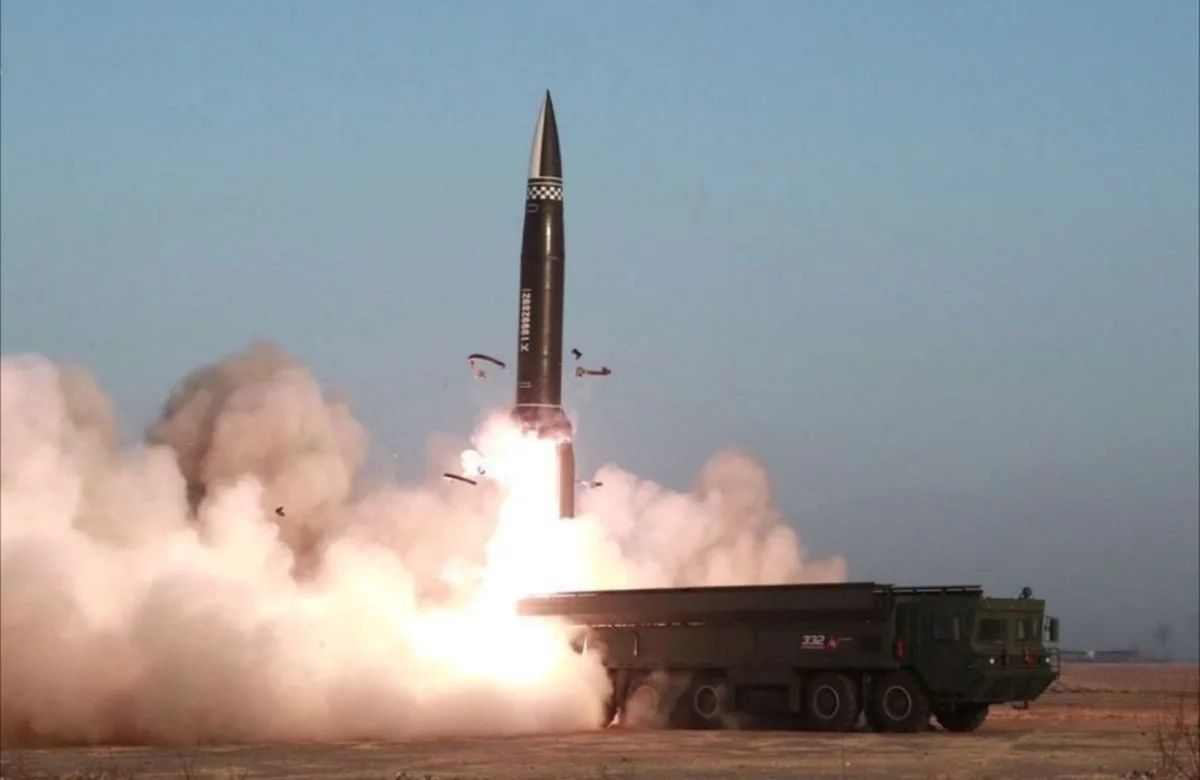
A Militarnyi report published in August 2026 identified a March 2021 image as showing a Hwasong-11C, or KN-30, launch. Other reporting states that testing of a heavy Hwasong-11 development occurred on 1 July 2024 and again on 18 September 2024, indicating continued development of heavy-payload variants.
Reported transfer to Russia
On 20 August 2026, Militarnyi reported that Ukraine's Defence Intelligence had confirmed the presence of KN-30 missiles among North Korean ballistic missiles supplied to Russia. According to that report, Russia held approximately 50 North Korean KN-23, KN-24 and KN-30 ballistic missiles as of July 2026. The report noted that KN-30 missiles had not previously been reported as transferred to Russia or used against Ukraine. Militarnyi
Additional reporting stated that approximately 90 North Korean personnel were preparing to operate up to six transporter-erector-launchers in Russia's Voronezh Oblast. Army Recognition reported that the unit could eventually receive as many as 120 missiles, although the exact number of KN-30 missiles within that inventory was not established. Army Recognition
By 20 August 2026, no confirmed KN-30 launch against Ukraine had been identified in the cited reporting. Earlier North Korean KN-23 and KN-24 missiles had already been used by Russia.
Design
The KN-30 is described as a larger member of the North Korean Hwasong-11 ballistic missile family. Army Recognition gives an estimated missile length of approximately 10.1 to 10.2 m and a diameter of 1.26 m, compared with approximately 8.77 m and 1.1 m for the KN-23. The increased dimensions provide more internal volume for propulsion, structure and payload.
The missile is reported to use a single-stage solid-propellant configuration. Solid propellant allows the missile to be transported without the field-fueling process required by liquid-fueled systems and supports rapid preparation for launch. Army Recognition reports an approximate motor thrust of 406.871 kN. Army Recognition
Published sources describe the missile as following a depressed or quasi-ballistic trajectory and as capable of maneuvering during flight. Army Recognition estimates flight altitude near 50 km and maximum speed around Mach 5 to Mach 6. These characteristics are reported rather than independently confirmed in the supplied material.
Warhead and range
The KN-30 is widely credited in the supplied reports with a warhead mass of up to 2,500 kg. Army Recognition gives an estimated range of 600 to 900 km, while Military Watch Magazine describes a range of approximately 1,000 km. Military Watch Magazine
The maximum payload and maximum range should not be treated as a single confirmed performance combination. Military expert Serhii Zghurets, quoted by Euromaidan Press, argued that a missile carrying a 2,500 kg warhead would necessarily have a shorter range than one configured to reach approximately 900 km. The supplied sources therefore support treating the figures as configuration-dependent estimates rather than simultaneously demonstrated specifications. Euromaidan Press
Launcher
The missile is associated with road-mobile transporter-erector-launchers. Reporting on the planned Voronezh deployment describes six launchers operated by approximately 90 North Korean personnel. Army Recognition notes that Hwasong-11 launchers are commonly associated with two missiles per vehicle, although the supplied material does not establish a dedicated KN-30 launcher configuration beyond this reported deployment.
Program status
As of August 2026, the KN-30 was reported as having been transferred to Russia, but the supplied sources did not confirm its combat use against Ukraine. The available reporting also does not establish a confirmed production total specifically for the KN-30.
North Korea was reported to be continuing production of Hwasong-11-family missiles. Army Recognition cited inspections showing approximately 90 Hwasong-11A airframes in December 2025 and close to 80 missile bodies in June 2026. These figures concern the broader missile family and should not be interpreted as KN-30 production numbers.
Specifications (KN-30)
General characteristics
- Type: Road-mobile ballistic missile
- Configuration: Single-stage, solid-propellant
- Length: approximately 10.1-10.2 m
- Diameter: approximately 1.26 m
- Reported motor thrust: approximately 406.871 kN
- Reported warhead mass: up to 2,500 kg
Performance
- Estimated range: approximately 600-900 km in Army Recognition reporting; approximately 1,000 km in Military Watch Magazine reporting
- Reported maximum speed: approximately Mach 5-6
- Reported flight altitude: approximately 50 km on a low quasi-ballistic trajectory
The maximum reported range and 2,500 kg warhead figure are not confirmed as achievable simultaneously. Available expert commentary indicates that increasing payload mass would reduce maximum range.
Related equipment
- KN-23: Earlier North Korean Hwasong-11-family ballistic missile that has been supplied to and used by Russia.
- KN-24: Smaller North Korean ballistic missile also reported in Russian inventories.
- Hwasong-11C-4.5: Heavy-payload Hwasong-11 development described in the supplied reporting with a claimed 4,500 kg payload.
 Argentina
 Armenia
 Australia
 Austria
 Austria-Hungary
 Belgium
 Brazil
 United Kingdom
 United States
 Brunei
 Bulgaria
 Canada
 Chile
Chile China
China Colonial America
 Colombia
 Confederate States
 Croatia
 Czech
Czech Denmark
 Egypt
Egypt Finland
 France
 Georgia
 Germany
 German Imperial
 Greece
 Holland
 Hungary
 India
India Indonesia
 Iran
Iran Iraq
Iraq Ireland
 Israel
 Italy
Italy Japan
Japan Japan (1940)
 Jordan
 Kingdom of Italy
 Malaysia
 Mexico
 Myanmar
 Nazi Germany
 Netherlands
 New Zealand
 Norway
 Pakistan
 Peru
Peru Philippines
 Poland
 Portugal
 Prussia
 Romania
 Russia
 Saudi Arabia
 Serbia
 Singapore
 Slovakia
 Slovenia
 South Africa
 South Korea
 Soviet Union
 Spain
Spain Sweden
 Switzerland
 Syria
Syria Taiwan
 Thailand
 Turkey
 UAE
UAE Ukraine
 Vietnam
 Yugoslavia