
History
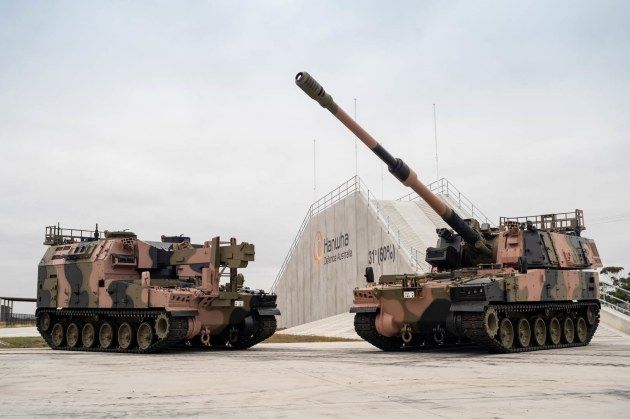
The Hanwha AS9 Huntsman is an Australian tracked 155 mm self-propelled howitzer derived from the South Korean K9 Thunder. It was developed for the Australian Army under LAND 8116 Phase 1 Protected Mobile Fires to provide protected, mobile indirect fire and to replace part of the Army's reliance on M777A2 towed howitzers.
Australia selected the system as part of a broader transition toward heavier and more mobile artillery able to operate with mechanised formations. The acquisition covers 30 AS9 Huntsman howitzers and 15 AS10 Armoured Ammunition Resupply Vehicles.
Australian-built AS9s entered live-fire training in May 2026, and the first vehicles subsequently reached 106 Battery, 4th Regiment, Royal Australian Artillery, in Townsville. By August 2026 the first Huntsman battery was being fielded with the 3rd Brigade.
Development and acquisition
The Australian government announced its intention to restore a self-propelled artillery capability in May 2019. On 13 December 2021, a contract was awarded to Hanwha Defense Australia for LAND 8116 Phase 1. The initial contract value was approximately AUD 1.017 billion, while later Defence budget documentation cited approved expenditure of about AUD 1.326 billion for the project.
The AS9 is an Australian-specific development of Hanwha's K9 Thunder. The Australian configuration incorporates changes including increased internal height, updated fire-control equipment, additional storage and air conditioning adapted to Australian operating conditions. The project also includes the AS10, an Australianised derivative of the K10 ammunition resupply vehicle.
Two AS9s and one AS10 from the initial batch were built in South Korea. The remaining vehicles are being assembled at Hanwha Defence Australia's Armoured Vehicle Centre of Excellence near Geelong. The Australian program includes participation by local companies in areas including fire-control integration, engineering, steel, maintenance and other support activities.
Production and training
Australian-built AS9s left the Geelong production line in early 2026. On 26 May 2026, crews conducted the first live firing of Australian-produced Huntsman howitzers at Puckapunyal, Victoria. Janes reported that multiple vehicles fired 150 rounds during the event. The activity followed the inaugural AS9 operator course at the School of Artillery.
The Australian Department of Defence reported on 4 June 2026 that 30 gunners from Townsville's 4th Regiment, Royal Australian Artillery, had completed a six-week course using the new system. The training covered crew operation of the tracked vehicle and culminated in live firing. Defence described the AS9 as a protected and mobile artillery system intended to deliver accurate fire at range, then relocate rapidly to reduce its vulnerability. The official report is available from the Australian Department of Defence.
Initial fielding
The first AS9 reached 106 Battery, 4th Regiment, Royal Australian Artillery, in Townsville in late May 2026. During Exercise Southern Jackaroo, conducted from 29 May to 3 July, the vehicle was shown to other elements of the 3rd Brigade while the unit prepared for broader employment of the new artillery system.
By August 2026, 106 Battery was receiving six AS9 Huntsman howitzers together with supporting AS10 ammunition resupply vehicles. Published reports differ on the number of AS10s delivered at this stage: one report described one AS10 with the first battery, while another reported three. The confirmed fleet plan remains 30 AS9s and 15 AS10s.
The 4th Regiment's remaining batteries are expected to transition to the Huntsman structure as the Army expands training from individual crew qualification to collective tactical employment. Army Recognition reported that the remaining two batteries were expected to adopt the new structure by the end of 2027. The Australian Army is working toward full operational capability for protected mobile fires in 2028. Additional reporting on the first battery fielding is available from Army Recognition.
Design
The AS9 Huntsman is a tracked and armoured self-propelled artillery system built around a 155 mm 52-calibre gun. Its design combines the gun, ammunition, fire-control equipment and crew protection in a mobile platform capable of moving with armoured formations.
Armament and loading
The main armament is a 155 mm 52-calibre gun compatible with standard NATO 155 mm ammunition. The vehicle carries 48 projectiles. The semi-automatic loading arrangement reduces the amount of manual handling required inside the vehicle and supports rapid execution of fire missions.
The AS9 can fire three rounds in approximately 15 seconds. Published figures for sustained or maximum firing rate vary with the firing sequence; available sources describe rates of approximately six rounds per minute, with some reports giving six to eight rounds per minute during intensive firing.
Defence Connect reports a maximum range of about 30 km with a standard high-explosive projectile and about 40 km with a rocket-assisted projectile. Actual engagement range depends on the ammunition and propellant charge used.
Mobility and protection
The Huntsman weighs approximately 48 tonnes and carries a five-person crew. Armour provides protection from fragmentation and some ballistic threats, allowing the crew to remain under armour during operations that would expose personnel operating a towed artillery piece.
Rapid movement into and out of firing positions is a central feature of the system. Published Australian reporting states that an AS9 already stationary can come into action in about 30 seconds, while a vehicle arriving on the move can halt and be ready to fire in under one minute. After completing a fire mission it can leave the position immediately. This short firing cycle is intended to reduce vulnerability to counter-battery detection and attack.
Fire control
The Australian configuration uses updated fire-control equipment. Trials have included integration of Australian 155 mm ammunition and compatibility with the Advanced Field Artillery Tactical Data System, which is used to calculate and coordinate artillery fire missions. During operator training, Australian soldiers described the system as automatically laying the gun after firing data had been entered, reducing manual preparation compared with the M777A2.
Ammunition resupply
The AS9 operates with the AS10 Armoured Ammunition Resupply Vehicle, which is derived from the South Korean K10 and uses a related tracked chassis. The AS10 can carry up to 104 projectiles and transfers ammunition through a conveyor system connecting the resupply vehicle to the howitzer.
The protected transfer arrangement allows ammunition replenishment without requiring crews to remain exposed for prolonged periods. Australian reporting states that an AS9 can be fully resupplied by an AS10 in approximately 20 minutes.
Operational history
The Australian Army began introducing the AS9 into 4th Regiment, Royal Australian Artillery, during 2026. Thirty personnel completed the first operator course at Puckapunyal, followed by live firing with Australian-built vehicles in May.
106 Battery became the first battery to receive the Huntsman for regular unit use. The transition replaces a battery structure based principally on four M777A2 towed 155 mm guns with a planned structure of six AS9 self-propelled howitzers. The change gives the unit a heavier but protected tracked artillery system able to relocate rapidly and operate alongside the mechanised elements of the 3rd Brigade.
The M777A2 remains substantially lighter and offers advantages where air transport and strategic mobility are priorities. The AS9 instead emphasises crew protection, tactical mobility, faster emplacement and displacement, and a higher degree of automation. It is intended to provide brigade and divisional artillery support rather than the longer-range strike role associated with systems such as HIMARS.
Following individual training, Army units are progressing toward collective training involving tactical movement, ammunition resupply, maintenance, recovery and integration with brigade operations. Full operational capability for Australia's protected mobile fires capability is targeted for 2028.
Operators
- Australia: Australian Army. The LAND 8116 Phase 1 acquisition covers 30 AS9 Huntsman self-propelled howitzers and 15 AS10 Armoured Ammunition Resupply Vehicles. The first AS9s were fielded with 106 Battery, 4th Regiment, Royal Australian Artillery, in 2026.
Specifications (AS9 Huntsman)
General characteristics
- Type: Tracked self-propelled howitzer
- Combat weight: Approximately 48 tonnes
- Crew: Five
- Main armament: 155 mm 52-calibre gun
- Projectile capacity: 48 rounds
Performance
- Burst firing rate: Three rounds in approximately 15 seconds
- Maximum firing rate: Approximately six rounds per minute; some published reporting describes six to eight rounds per minute during intensive sequences
- Range with standard high-explosive ammunition: Approximately 30 km
- Range with rocket-assisted ammunition: Approximately 40 km
- Time to fire from stationary condition: About 30 seconds
- Time to fire after halting from movement: Under one minute
Ammunition support
- Associated resupply vehicle: AS10 Armoured Ammunition Resupply Vehicle
- AS10 projectile capacity: Up to 104 rounds
- Approximate full resupply time: 20 minutes
Related equipment
- K9 Thunder: South Korean self-propelled howitzer on which the AS9 Huntsman is based.
- AS10: Australian armoured ammunition resupply vehicle derived from the South Korean K10 and acquired as part of the Huntsman system.
- M777A2: Towed 155 mm howitzer previously forming the principal artillery equipment of the 4th Regiment before its transition to the AS9.
 Argentina
 Armenia
 Austria
 Austria-Hungary
 Belgium
 Brazil
 United Kingdom
 United States
 Brunei
 Bulgaria
 Canada
 Chile
Chile China
China Colonial America
 Colombia
 Confederate States
 Croatia
 Czech
Czech Denmark
 Egypt
Egypt Finland
 France
 Georgia
 Germany
 German Imperial
 Greece
 Holland
 Hungary
 India
India Indonesia
 Iran
Iran Iraq
Iraq Ireland
 Israel
 Italy
Italy Japan
Japan Japan (1940)
 Jordan
 Kingdom of Italy
 Malaysia
 Mexico
 Myanmar
 Nazi Germany
 Netherlands
 New Zealand
 North Korea
 Norway
 Pakistan
 Peru
Peru Philippines
 Poland
 Portugal
 Prussia
 Romania
 Russia
 Saudi Arabia
 Serbia
 Singapore
 Slovakia
 Slovenia
 South Africa
 South Korea
 Soviet Union
 Spain
Spain Sweden
 Switzerland
 Syria
Syria Taiwan
 Thailand
 Turkey
 UAE
UAE Ukraine
 Vietnam
 Yugoslavia