
History
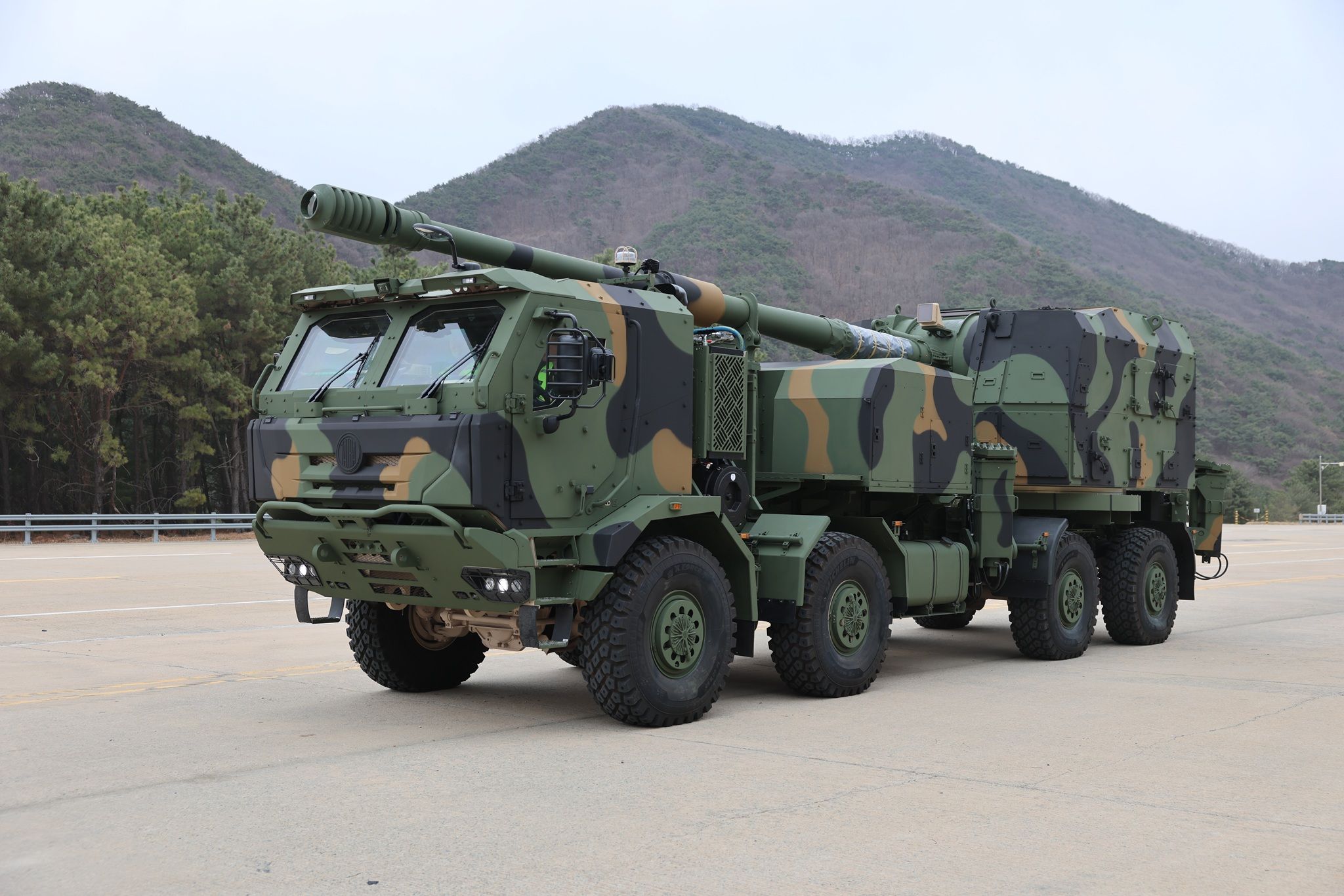
The Hanwha K9 Mobile Howitzer (MH), also known as K9MH, is a South Korean 155 mm wheeled self-propelled howitzer developed as a mobile branch of the K9 artillery family. It combines a K9-derived 155 mm/52-caliber weapon and automated artillery system with a heavy 8×8 wheeled chassis.
The system was developed for users seeking greater road mobility and faster displacement than a tracked self-propelled howitzer while retaining the firepower and automation associated with later K9 variants. The demonstrated prototype uses a Tatra Force 8×8 chassis, an armored forward crew cab, an uncrewed rear artillery module, and four firing stabilizers.
On August 18, 2026, the U.S. Army selected Hanwha Defense USA to supply K9MH-based prototypes for its Mobile Tactical Cannon program. The agreement covers six initial prototype systems and an option for 12 more, but it does not constitute a production or operational fielding decision.
Development
The wheeled K9 concept was publicly discussed by 2024. According to MILMAG, initial information about the wheeled howitzer appeared in July 2024. A later technical profile from Army Recognition reports that formal development began in December 2024 under a 30-month program scheduled for completion in June 2027.
A model of the concept was displayed at AUSA 2025 in Washington, D.C. The first complete prototype was publicly unveiled on March 26, 2026. The prototype demonstrated the combination of an automated K9A2-derived artillery module with a Tatra Force 8×8 wheeled carrier. This completed prototype makes 2026 the earliest supported year in which the K9MH became physically recognizable in its present form.
Hanwha positioned the K9MH for U.S. Army artillery modernization efforts. The Army had been examining wheeled self-propelled 155 mm systems as a potential replacement for M777 towed howitzers in selected formations. The K9MH competed against other wheeled artillery systems, including proposals based on SIGMA, CAESAR, RCH 155, and Archer.
U.S. Mobile Tactical Cannon selection
On August 18, 2026, the U.S. Army announced an agreement with Hanwha Defense USA for Mobile Tactical Cannon rapid prototyping. As quoted by The War Zone, the firm-fixed-price Other Transaction Authority agreement provides for up to 18 wheeled self-propelled howitzer systems over an estimated four-year period. The initial action was stated as $100,302,961, with a total cumulative face value of $262,903,274.
The first phase calls for accelerated delivery of six prototype systems, with an option for 12 additional vehicles. Soldiers are to use the prototypes in operational experiments intended to assess performance, reliability, and supportability under realistic conditions. The resulting data is intended to inform later decisions on fielding rather than confirm procurement in advance.
Breaking Defense reported that Hanwha expected the first Army prototype to be delivered by early fall 2026 and the remaining five within less than a year. The same report described the award as Hanwha Defense USA's first major U.S. Army contract and noted the company's effort to establish a howitzer integration and test facility in Opelika, Alabama.
The Army's immediate MTC focus is the replacement of M777 towed 155 mm howitzers in selected formations if the system is eventually approved for fielding. Some broader Army artillery modernization discussions have also concerned future alternatives to M109-series tracked systems, but the August 2026 MTC award itself is an experimentation program and does not establish the K9MH as an operational M109 replacement.
Design
The K9MH is a heavy 8×8 wheeled self-propelled howitzer with an armored crew cab at the front and an automated artillery module over the rear axles. The arrangement differs substantially from the tracked K9 Thunder layout because the crew is concentrated in the forward cab while the rear gun module is uncrewed during normal firing operations.
Chassis and crew arrangement
The demonstrated prototype uses a third-generation Tatra Force 8×8 chassis. Hanwha has described the artillery installation as adaptable to other sufficiently capable heavy wheeled carriers, although any alternative chassis must support the mass, recoil loads, stabilizers, braking requirements, hydraulic systems, electrical demand, and structural interfaces of the complete artillery system.
The K9MH has a three-person crew. All three crew members remain in the armored forward cab during the normal automated firing sequence. This reduces the onboard gun crew compared with the five-person arrangement associated with the original tracked K9.
Four stabilizers are deployed around the rear section before firing. They provide a stable firing base and transfer major recoil loads from the 155 mm gun through the vehicle structure into the ground rather than leaving the suspension and tires to absorb the full firing impulse.
Published estimates place the demonstrated prototype at close to 40 tonnes, approximately 12 m long, 3.4 m wide, and 2.73 m high. These dimensions and the mass should be treated as prototype estimates because the K9MH architecture is intended to accommodate different heavy 8×8 chassis.
Mobility
According to the detailed technical profile published by Army Recognition, the Tatra-based prototype has a stated maximum road speed of 100 km/h and a road range of 700 km. A maximum gradient capability of up to 50 percent is also reported. The specific engine installed in the prototype has not been identified in the supplied sources.
The wheeled layout is intended to provide high road speed and long-distance mobility without requiring the same type of heavy transporter support commonly associated with tracked artillery. The trade-off is that the K9MH does not have the same continuous ground-contact area as a tracked chassis, which affects mobility characteristics on very soft or heavily broken terrain.
Artillery module and automation
The rear artillery module incorporates technology derived from the K9A2 automation concept. Projectile selection, projectile transfer, propellant selection, charge handling, loading, and gun laying are automated so the crew does not have to occupy the gun module during a normal firing mission.
Projectiles and modular propellant charges are stored and handled through separate automated paths. The system carries 40 projectiles. Army Recognition additionally reports capacity for up to 192 modular propellant charges.
Hanwha associates the K9MH with a wheeled ammunition resupply concept derived from the tracked K10 Ammunition Resupply Vehicle. The available sources do not establish a final designation or complete specification for this wheeled resupply vehicle.
Armament
The baseline K9MH is armed with the Hyundai WIA CN98 155 mm/52-caliber gun used within the tracked K9 family. The weapon complies with Joint Ballistics Memorandum of Understanding requirements for NATO-standard 155 mm artillery interfaces.
The demonstrated system has a reported maximum firing rate of approximately eight to nine rounds per minute. During a 2026 firing demonstration in South Korea, the prototype fired nine rounds in 59 seconds. MILMAG likewise reported a firing rate of eight to nine rounds per minute.
With conventional ammunition, reported maximum range is approximately 40 km. Rocket-assisted or other extended-range ammunition can extend this beyond 60 km. Some technical reporting, including Defence Security Asia and Army Recognition, gives upper figures approaching 70 km depending on the projectile and ballistic configuration. The supplied material does not establish 70 km as the range of all ammunition types.
A 155 mm/58-caliber weapon has been discussed as a possible future option, but it is not part of the demonstrated baseline K9MH configuration.
Firing and displacement
The K9MH is designed for rapid firing-position occupation and departure. Hanwha states that emplacement and displacement can each be completed in under 30 seconds, supporting shoot-and-scoot tactics intended to reduce exposure to counter-battery fire and surveillance.
Published reporting also states that the system can fire its first round roughly 20 seconds after reaching a firing position. These rapid sequences depend on the automated gun system and the deployment and recovery of the stabilizers.
Program status
As of August 2026, the K9MH remains a development and prototype system. It has not entered operational service with the U.S. Army or another armed force.
The U.S. Army agreement covers six initial Mobile Tactical Cannon prototypes with an option for 12 additional systems. The prototype fleet will be used for Soldier experimentation and evaluation. Selection for this phase does not guarantee serial production or operational adoption.
If the Mobile Tactical Cannon program proceeds to fielding, the Army has stated that the capability is intended to replace M777 towed howitzers in selected formations. The Army plans to use experimental results to determine whether and how a future system should be fielded.
Hanwha is also establishing a U.S.-based industrial presence for integration and testing in Opelika, Alabama. The company's broader objective is to support local integration and potential future production if the Army advances beyond the prototype phase.
Variants
- K9MH 155 mm/52-caliber: Demonstrated baseline configuration using the CN98 155 mm/52-caliber gun, K9A2-derived automated ammunition handling, an uncrewed artillery module, and a heavy 8×8 wheeled chassis. This is the configuration associated with the U.S. Mobile Tactical Cannon prototype effort.
- Alternative-chassis configurations: Hanwha has presented the artillery module as adaptable to other heavy 8×8 carriers. A Mack Defense-based concept has been shown, but the demonstrated complete prototype uses the Tatra Force chassis.
- 155 mm/58-caliber concept: A longer 58-caliber weapon has been considered as a possible future configuration, but it is not confirmed as the baseline U.S. prototype armament.
Operators
- United States: U.S. Army prototype and experimentation customer. Six systems are included in the initial Mobile Tactical Cannon agreement, with an option for 12 more. The K9MH is not in operational service.
Specifications (K9MH 155 mm/52-caliber prototype)
General characteristics
- Type: Wheeled self-propelled howitzer
- Crew: 3
- Chassis: Tatra Force 8×8 on the demonstrated prototype
- Weight: Close to 40 tonnes, estimated
- Length: Close to 12 m, estimated
- Width: Approximately 3.4 m, estimated
- Height: Approximately 2.73 m, estimated
- Ammunition capacity: 40 projectiles; up to 192 modular propellant charges reported
- Firing stabilizers: 4
Performance
- Maximum road speed: 100 km/h, reported for the Tatra-based prototype
- Road range: 700 km, reported for the Tatra-based prototype
- Maximum gradient: Up to 50 percent, reported
- Emplacement time: Under 30 seconds
- Displacement time: Under 30 seconds
- Maximum firing rate: Approximately 8–9 rounds per minute
- Range with conventional ammunition: Approximately 40 km
- Range with extended-range or rocket-assisted ammunition: More than 60 km, with some published figures approaching 70 km depending on ammunition and ballistic configuration
Armament
- Main armament: 1 × Hyundai WIA CN98 155 mm/52-caliber howitzer
- Loading system: Fully automated projectile and modular propellant handling
- Gun laying: Automated
 Argentina
 Armenia
 Australia
 Austria
 Austria-Hungary
 Belgium
 Brazil
 United Kingdom
 United States
 Brunei
 Bulgaria
 Canada
 Chile
Chile China
China Colonial America
 Colombia
 Confederate States
 Croatia
 Czech
Czech Denmark
 Egypt
Egypt Finland
 France
 Georgia
 Germany
 German Imperial
 Greece
 Holland
 Hungary
 India
India Indonesia
 Iran
Iran Iraq
Iraq Ireland
 Israel
 Italy
Italy Japan
Japan Japan (1940)
 Jordan
 Kingdom of Italy
 Malaysia
 Mexico
 Myanmar
 Nazi Germany
 Netherlands
 New Zealand
 North Korea
 Norway
 Pakistan
 Peru
Peru Philippines
 Poland
 Portugal
 Prussia
 Romania
 Russia
 Saudi Arabia
 Serbia
 Singapore
 Slovakia
 Slovenia
 South Africa
 Soviet Union
 Spain
Spain Sweden
 Switzerland
 Syria
Syria Taiwan
 Thailand
 Turkey
 UAE
UAE Ukraine
 Vietnam
 Yugoslavia