
History
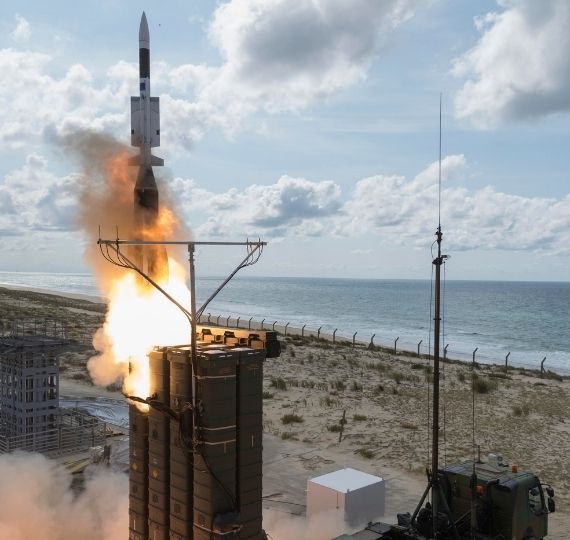
Eurosam Aster 30 is a Franco-Italian long-range surface-to-air interceptor developed as part of the Aster missile family for land-based and naval air defense. The family was created to counter aircraft and a range of missile threats, while later Aster 30 versions added an emphasis on ballistic-missile defense.
France and Italy signed a memorandum of understanding in May 1989 for a new family of surface-to-air missiles. Eurosam was subsequently formed by MBDA France, MBDA Italy and Thales to develop and produce the associated missiles and weapon systems.
Aster 30 combines the common terminal interceptor used by the Aster family with a larger booster than the shorter-range Aster 15. It is associated with the SAMP/T land-based air-defense system and with naval air-defense installations using compatible vertical launch systems.
Development and testing
The Franco-Italian program emerged from a requirement for a domestic medium- and long-range surface-to-air weapon capable of replacing or supplementing shorter-range systems then used by France and Italy. By July 1995, development had progressed to the first test firing of an Aster 30. According to the available historical account, the missile intercepted a target at an altitude of 15,000 m and a speed of 1,000 km/h. Development trials during the 1990s validated the missile family's flight sequences and the Aster 30 launch sequence. A Phase 2 contract followed in 1997 for further development and pre-production of French and Italian land and naval systems. A detailed chronology is available in the Aster missile family history.
In November 2003, Eurosam received a major Phase 3 production contract covering the Aster program. The resulting family was intended to satisfy French, Italian and British requirements across land and naval applications. Testing also included Aster 30 firings from the Italian experimental frigate Carabiniere using Sylver A50 launchers and the PAAMS(E) combat system.
France and Italy continued procurement after the missile entered production. In January 2023, their defense ministries signed a contract with MBDA covering 700 Aster missiles across the family. Production was subsequently scheduled for a substantial increase, with French authorities targeting an annual output exceeding 300 Aster missiles of all versions by 2028.
Ukraine-related developments
In August 2026, reports stated that Italy was preparing to transfer additional Aster 30 interceptor missiles from its own stocks to Ukraine as part of its 13th military-aid package. The missiles were intended for use with the Franco-Italian SAMP/T air-defense system, and delivery from Italian stocks was reported as planned by October 2026. The reported package was described by The New Voice of Ukraine and Militarnyi.
Italy and France were also reported to be preparing licensed localized production of the newer Aster 30 B1NT in Ukraine. Separate reporting described Ukrainian plans to order SAMP/T NG systems and linked future production and procurement of Aster missiles with European financing. RBC-Ukraine reported that licensed Aster production in Ukraine was planned to begin by the end of 2026.
Design
The Aster missile family was designed around a common terminal interceptor, or dart, combined with different boosters. Aster 30 uses a substantially larger booster than Aster 15, giving the longer-range missile greater overall mass and length and enabling its medium- to long-range air-defense role.
Aster missiles are vertically launched. Naval installations using Aster 30 require launch cells long enough for the larger missile, including Sylver A50 or A70 vertical launch systems. The family is integrated into both land-based and shipborne air-defense architectures rather than functioning as a stand-alone weapon.
The missile family's stated target set includes combat aircraft, helicopters, unmanned aircraft, cruise missiles, anti-radiation missiles and sea-skimming supersonic anti-ship missiles. Aster 30 Block 1 and Block 1 NT were developed with additional capability against ballistic-missile threats.
Program status
Aster 30 is a production missile used within established Franco-Italian and allied air-defense architectures. Continuing procurement and planned production expansion indicate that the Aster family remains an active European air- and missile-defense program.
The Aster 30 B1NT represents a newer development intended for improved missile-defense requirements and is associated with the next-generation SAMP/T NG system. In 2026, France and Italy were also reported to be expanding the missile's industrial base through planned licensed production in Ukraine.
Variants
- Aster 30: Long-range member of the Aster surface-to-air missile family, distinguished from Aster 15 by its substantially larger booster.
- Aster 30 Block 1: Aster 30 version designed to add capability against ballistic-missile threats.
- Aster 30 B1NT: Block 1 New Technology development intended to provide an upgraded interceptor for newer air- and missile-defense systems, including SAMP/T NG.
Operators
- France: Uses Aster missiles in land-based SAMP/T and naval air-defense applications and participates in continuing Aster procurement and production.
- Italy: Uses Aster missiles in land and naval air-defense applications and was reported in 2026 to be preparing a transfer of additional Aster 30 missiles from national stocks to Ukraine.
- United Kingdom: Uses Aster missiles as part of the Sea Viper naval air-defense system fitted to Type 45 destroyers.
- Ukraine: Operates the SAMP/T air-defense system. Italy was reported in August 2026 to be preparing an additional transfer of Aster 30 interceptors by October, while France and Italy were also planning licensed production of Aster 30 B1NT missiles in Ukraine.
Specifications (Aster 30)
General characteristics
- Type: Surface-to-air interceptor missile
- Manufacturer: Eurosam consortium
- Development: Franco-Italian program
- Mass: Approximately 450 kg (990 lb)
- Length: Just under 5 m (16 ft 5 in)
- Launch method: Vertical launch
- Configuration: Common Aster terminal interceptor with the larger Aster 30 booster
Role
- Primary role: Medium- to long-range air defense
- Target types: Aircraft, helicopters, unmanned aircraft and several classes of missile threat
- Ballistic-missile defense: Supported by the Block 1 and Block 1 NT developments
Source package:
 Argentina
 Armenia
 Australia
 Austria
 Austria-Hungary
 Belgium
 Brazil
 United Kingdom
 United States
 Brunei
 Bulgaria
 Canada
 Chile
Chile China
China Colonial America
 Colombia
 Confederate States
 Croatia
 Czech
Czech Denmark
 Egypt
Egypt Finland
 Georgia
 Germany
 German Imperial
 Greece
 Holland
 Hungary
 India
India Indonesia
 Iran
Iran Iraq
Iraq Ireland
 Israel
 Italy
Italy Japan
Japan Japan (1940)
 Jordan
 Kingdom of Italy
 Malaysia
 Mexico
 Myanmar
 Nazi Germany
 Netherlands
 New Zealand
 North Korea
 Norway
 Pakistan
 Peru
Peru Philippines
 Poland
 Portugal
 Prussia
 Romania
 Russia
 Saudi Arabia
 Serbia
 Singapore
 Slovakia
 Slovenia
 South Africa
 South Korea
 Soviet Union
 Spain
Spain Sweden
 Switzerland
 Syria
Syria Taiwan
 Thailand
 Turkey
 UAE
UAE Ukraine
 Vietnam
 Yugoslavia