
History
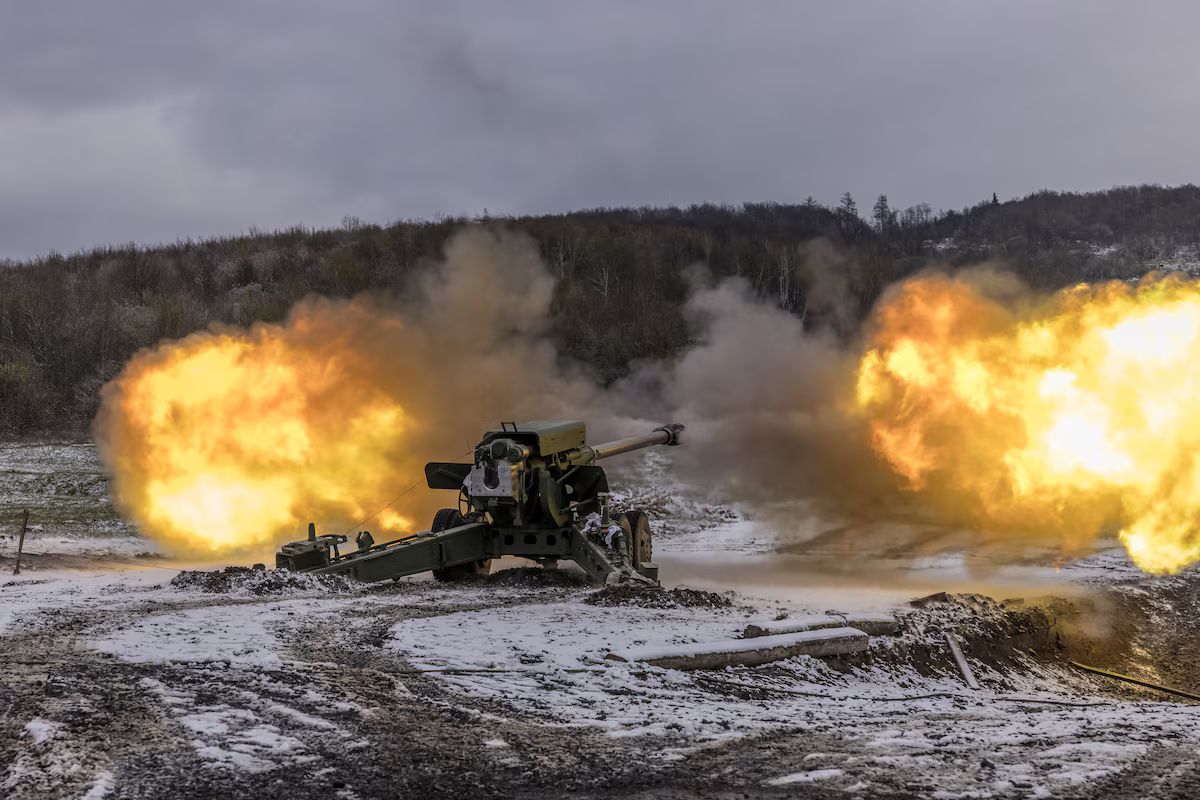
The 2P22 Bohdana-B is a Ukrainian 155 mm towed howitzer developed as a less chassis-dependent counterpart to the wheeled 2S22 Bohdana family. It uses the Bohdana 155 mm, 52-caliber artillery unit on a separate towed carriage, allowing Ukraine to employ artillery modules that could not immediately be installed on self-propelled truck chassis.
Development of the towed configuration was reported by late 2023. A prototype was publicly shown in late 2024, and the first operational examples entered Ukrainian service in early 2025. Initial production used modified carriages from stored Soviet 2A36 Giatsint-B guns, while a new Ukrainian-designed carriage was subsequently developed.
The system is intended to complement rather than replace the self-propelled Bohdana. Its simpler towed configuration reduces dependence on suitable heavy truck chassis and provides a way to expand production of 155 mm artillery using domestically manufactured gun components.
Development
The development of the towed Bohdana was driven partly by a mismatch between production of artillery components and the availability of suitable vehicle chassis. Ukrainian industry could manufacture more artillery units than could be installed on available self-propelled platforms. A towed version therefore provided another route for bringing completed gun assemblies into service. Militarnyi reported that development had been underway since at least December 2023.
The first configuration combined the Bohdana artillery unit with a modified carriage from the Soviet 152 mm 2A36 Giatsint-B. Ukraine possessed stored Giatsint-B systems whose original barrels had become less useful because of wear and shortages of their specific ammunition. Reusing their carriages reduced the need to manufacture an entirely new carriage and lowered the cost of producing each towed Bohdana.
A prototype was publicly presented in late 2024. The first Bohdana-B was delivered to the 47th Separate Artillery Brigade in March 2025, and photographs showed Ukrainian crews deploying and firing the weapon. 2P22 Bohdana reference also records the first operational use by the 47th Artillery Brigade in early 2025.
By 2025 the Giatsint-based configuration was commonly identified as Bohdana-BG or 2P22 Bohdana-BG. Reporting in September 2025 stated that more than 100 Bohdana-BG systems had been produced. Army Recognition described the towed model as a response to shortages of truck platforms for the self-propelled Bohdana.
In parallel, the Kramatorsk Heavy Machine Tool Plant developed a new Ukrainian carriage specifically for the towed 2P22 Bohdana-B. Earlier information in April 2025 indicated that the new carriage was expected by the end of that year. By September 2026 the new carriage had been developed, while codification and an official presentation were expected in the following months. The transition to the newly manufactured carriage was expected to increase the cost of the complete towed system compared with examples built from stored Soviet carriages.
Design
The Bohdana-B combines a NATO-standard 155 mm artillery unit with a towed carriage. The initial Bohdana-BG configuration uses a modified Soviet 2A36 Giatsint-B carriage, while the later Bohdana-B configuration is intended to use a newly developed Ukrainian carriage. The weapon retains the 52-caliber barrel associated with the Bohdana artillery system.
Artillery unit
The 155 mm, 52-caliber barrel gives the weapon compatibility with NATO-standard 155 mm ammunition. Reported maximum range depends on the projectile and is approximately 40 to 41 km with ammunition described in operational reporting. The system can achieve a maximum firing rate of about six rounds per minute, although frontline crews may deliberately fire more slowly when sustained correction and accuracy are prioritized.
The weapon uses bagged propellant charges. Reports from Ukrainian artillery crews note that propellant and ambient temperature influence ballistic performance and the number of rounds that can be fired before barrel heating becomes significant.
Carriage and mobility
The initial Bohdana-BG carriage is derived from the Soviet 2A36 Giatsint-B. This approach allowed Ukraine to reuse stored carriage assemblies while replacing the original Soviet 152 mm gun with the Ukrainian 155 mm Bohdana artillery unit. The resulting weapon weighs approximately 9.8 tonnes according to artillerymen interviewed by Oboronka, while earlier reporting estimated the weight at more than 10 tonnes.
The weapon measures approximately 13.5 to 13.6 m in the travelling configuration. Heavy trucks are required for towing. Daewoo Novus and KrAZ-6322 trucks have both been reported in this role, and tracked MT-LB vehicles have also been used in some circumstances.
The towed configuration has no integral automotive powertrain and is mechanically simpler than the self-propelled Bohdana. Ukrainian crews have described this simplicity as useful for repair and survivability near the front. The smaller emplacement compared with a complete truck-mounted self-propelled system also allows the gun position to be dug into a comparatively compact protected position.
Operation
The Bohdana-BG is operated by a four-person crew according to 2026 frontline reporting. Crews have reported about six minutes from receiving target coordinates to firing the first round under operational conditions. Although the mechanical system can reach a higher short-term rate of fire, crews often use one or two rounds per minute while making repeated corrections from unmanned aircraft observation. UNITED24 Media reported these operational details from the 147th Separate Artillery Brigade.
Operational history
The first known operational unit to receive the towed Bohdana was the 47th Separate Artillery Brigade in March 2025. Photographs released by the brigade showed the weapon being deployed and fired.
By 2026 Bohdana-BG howitzers were also operating with the 147th Separate Artillery Brigade of the Ukrainian Air Assault Forces in eastern Ukraine. Frontline crews reported using the system for conventional indirect fire and emphasized its accuracy, relatively simple mechanical construction, and ability to be repaired after damage.
Variants
- 2P22 Bohdana-BG: Initial production configuration using the Ukrainian 155 mm, 52-caliber Bohdana artillery unit on a modified carriage derived from the Soviet 2A36 Giatsint-B.
- 2P22 Bohdana-B: Configuration intended to use a newly developed Ukrainian carriage from the Kramatorsk Heavy Machine Tool Plant. The carriage had been developed by September 2026, while codification and official presentation were still expected.
Operators
- Ukraine: The Armed Forces of Ukraine operate the Bohdana-BG. Confirmed users include the 47th Separate Artillery Brigade and the 147th Separate Artillery Brigade.
Specifications (2P22 Bohdana-BG)
General characteristics
- Type: Towed howitzer
- Caliber: 155 mm
- Barrel length: 52 calibers
- Carriage: Modified Soviet 2A36 Giatsint-B carriage
- Weight: Approximately 9.8 tonnes; some earlier estimates placed it above 10 tonnes
- Length in travelling configuration: Approximately 13.5 to 13.6 m
- Crew: 4
Performance
- Maximum range: Up to approximately 40 to 41 km, depending on ammunition
- Maximum rate of fire: Up to 6 rounds per minute
Armament
- Main weapon: 155 mm, 52-caliber Bohdana artillery unit
- Ammunition: NATO-standard 155 mm artillery ammunition
- Propellant: Bagged propellant charges
 Argentina
 Armenia
 Australia
 Austria
 Austria-Hungary
 Belgium
 Brazil
 United Kingdom
 United States
 Brunei
 Bulgaria
 Canada
 Chile
Chile China
China Colonial America
 Colombia
 Confederate States
 Croatia
 Czech
Czech Denmark
 Egypt
Egypt Finland
 France
 Georgia
 Germany
 German Imperial
 Greece
 Holland
 Hungary
 India
India Indonesia
 Iran
Iran Iraq
Iraq Ireland
 Israel
 Italy
Italy Japan
Japan Japan (1940)
 Jordan
 Kingdom of Italy
 Malaysia
 Mexico
 Myanmar
 Nazi Germany
 Netherlands
 New Zealand
 North Korea
 Norway
 Pakistan
 Peru
Peru Philippines
 Poland
 Portugal
 Prussia
 Romania
 Russia
 Saudi Arabia
 Serbia
 Singapore
 Slovakia
 Slovenia
 South Africa
 South Korea
 Soviet Union
 Spain
Spain Sweden
 Switzerland
 Syria
Syria Taiwan
 Thailand
 Turkey
 UAE
UAE Vietnam
 Yugoslavia