
History
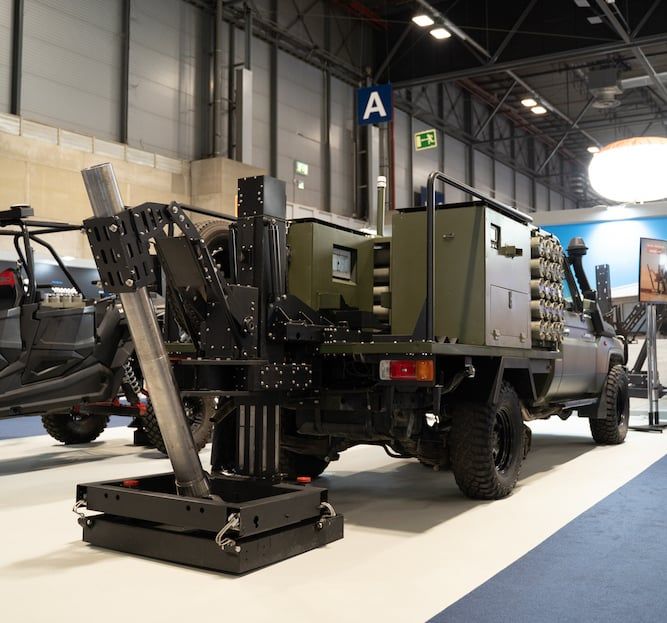
The Milanion NTGS Scorpion Light is a vehicle-mounted 81 mm mortar system designed to provide mobile indirect fire support. It combines a ground-contacting mortar mount with digital fire control while retaining manual ammunition loading.
The system is intended to shorten the time between vehicle movement, mortar deployment, firing, and displacement. Its ground-contacting baseplate transfers firing loads into the ground rather than through the host vehicle chassis, allowing integration on relatively light tactical vehicles.
The U.S. Army tested Scorpion Light systems before awarding Global Military Products a $12.9 million contract in September 2026 to procure and integrate the 81 mm system on Infantry Squad Vehicle-Utility platforms.
A 2022 account of the broader Scorpion system identified Spain-based NTGS as its developer and manufacturer and Global Military Products as its international adaptation and distribution partner. That system could accept interchangeable 81 mm and 120 mm mortar tubes and was demonstrated on several light vehicle types. The earlier configuration is described by RECOIL Offgrid.
By AUSA 2024, the dedicated Scorpion Light 81 mm configuration was publicly shown on an Infantry Squad Vehicle. Coverage identified Milanion NTGS as the manufacturer and described a compact 408 kg mortar package with digital fire control, a 72-round 81 mm ammunition capacity, and automatic re-aiming. The displayed configuration is documented by Army Recognition.
From October 20 to 25, 2025, the U.S. Army's 2nd Battalion, 35th Infantry Regiment tested Scorpion-equipped Infantry Squad Vehicles during Transformation in Contact 2.0 at Schofield Barracks, Hawaii. The tested vehicles carried 72 rounds while the unit retained its existing organization and concept of operations. Two systems subsequently remained in Hawaii for additional activity.
During Exercise Balikatan 2026, two Scorpion Autonomous Engagement Systems fired a total of 20 rounds in less than two minutes. The test demonstrated the rapid deployment and firing cycle sought for light infantry mortar support.
On September 3, 2026, the U.S. Army awarded Global Military Products a $12.9 million contract under a Department of Defense Ordnance Technology Consortium Other Transaction Authority agreement. The work covers procurement and integration of Scorpion Light 81 mm mobile mortars with Army-furnished M253 mortar barrels, digital fire control, Nett Warrior networking, and five-seat Infantry Squad Vehicle-Utility platforms. The Army had not disclosed the contracted quantity, unit cost, delivery schedule, first receiving unit, or total procurement objective when the award was reported. The contract and integration details are described by Army Recognition, Defense Express, and Armada International.
Design
Mortar mount
Scorpion Light uses a folding mortar installation that lowers a baseplate onto the ground behind the host vehicle. The baseplate transfers firing loads directly into the ground. This reduces the need for a reinforced vehicle suspension or a heavy recoil-management structure.
The broader Scorpion architecture can be adapted to wheeled or tracked vehicles above approximately 1.5 tonnes. Demonstrated host platforms have included Land Rover Defender, URO VAMTAC, Toyota Land Cruiser, HMMWV, Polaris vehicles, Flyer 72, Sherpa, G-Wagon, and Infantry Squad Vehicle platforms. The U.S. Army configuration centers on the five-seat ISV-U.
Depending on configuration, the Scorpion mortar package has been reported at approximately 408 to 426 kg. The Scorpion Light can move from a halt to firing readiness in less than 30 seconds. Recovery and displacement can also be completed rapidly, with the U.S. Army-oriented Scorpion Light reported as capable of moving within 30 seconds after the final shot.
Fire control
The system automates navigation, ballistic calculation, and mortar laying. Two GPS receivers, an inertial navigation system, and an inclinometer establish position, direction, and elevation. A fire-control computer calculates the firing solution, and electromechanical actuators lay the mortar tube.
The digital fire-control system can store up to 1,000 target positions. Supported functions described for the system include preplanned targets, zonal fire, multiple-round missions, and multiple-round simultaneous-impact-type sequences. Automatic re-aiming has been reported at approximately 3 to 5 seconds.
For the U.S. Army configuration, Nett Warrior provides digital transfer of target and mission information. The system is therefore automated in aiming and fire-control functions but is not an autoloading mortar.
Ammunition handling
The crew manually selects each mortar round, prepares its propellant charge, and drops the round into the barrel. A manual backup mode is retained.
The Army's ISV-U configuration has been tested with 72 rounds of 81 mm ammunition carried onboard. This allows the mortar, crew, ammunition, and carrier to move together rather than distributing the ammunition load among dismounted soldiers or additional vehicles.
Air transport
The integrated ISV-U and Scorpion Light configuration is designed for internal transport by CH-47 Chinook helicopter. This allows a helicopter-inserted infantry element to deploy with its mobile mortar carrier and ammunition.
Program status
The September 2026 U.S. Army contract moves the Scorpion Light from Army experimentation into contracted procurement and integration. Available reporting does not specify how many Army systems will be delivered or when operational fielding will begin.
The U.S. Marine Corps is pursuing a separate lighter configuration on the Polaris MRZR Alpha 6×6 under a February 24, 2026 contract with a reported ceiling of $4.9 million. The Marine configuration carries 48 rounds and is intended to fit within the smaller transport footprint required for internal carriage by V-22 aircraft. It should not be treated as identical to the Army ISV-U configuration.
Variants
- Scorpion Light 81 mm on ISV-U: U.S. Army configuration using an Army-furnished M253 81 mm mortar barrel, digital fire control, Nett Warrior networking, a five-seat ISV-U host vehicle, and a tested onboard load of 72 rounds.
- Scorpion Light 81 mm on MRZR Alpha 6×6: U.S. Marine Corps-oriented light configuration with a reported 48-round ammunition load and a transport footprint suitable for internal V-22 carriage.
- Scorpion or Alakran family: Broader architecture capable of accepting 81 mm or 120 mm smoothbore mortar tubes and installation on multiple wheeled or tracked host vehicles.
Specifications (Scorpion Light 81 mm on ISV-U)
General characteristics
- Type: Vehicle-mounted mobile mortar system
- Caliber: 81 mm
- Mortar barrel: U.S. Army-furnished M253 in the Army integration
- Mortar package mass: Approximately 408 to 426 kg depending on configuration
- Host vehicle: Five-seat Infantry Squad Vehicle-Utility
- Onboard ammunition: 72 rounds in the tested U.S. Army configuration
- Loading: Manual
- Baseplate: Ground-contacting
- Air transport: Internally transportable by CH-47 in the ISV-U configuration
Fire control and mobility
- Deployment from halt: Less than 30 seconds
- Automatic re-aiming: Approximately 3 to 5 seconds
- Post-fire displacement: Within approximately 30 seconds of the final shot for the Scorpion Light configuration
- Target storage: Up to 1,000 target positions
- Navigation and orientation: Two GPS receivers, inertial navigation system, and inclinometer
- Networking: Nett Warrior in the U.S. Army integration
Armament
- Primary weapon: One 81 mm M253 mortar barrel in the U.S. Army configuration
 Argentina
 Armenia
 Australia
 Austria
 Austria-Hungary
 Belgium
 Brazil
 United Kingdom
 United States
 Brunei
 Bulgaria
 Canada
 Chile
Chile China
China Colonial America
 Colombia
 Confederate States
 Croatia
 Czech
Czech Denmark
 Egypt
Egypt Finland
 France
 Georgia
 Germany
 German Imperial
 Greece
 Holland
 Hungary
 India
India Indonesia
 Iran
Iran Iraq
Iraq Ireland
 Israel
 Italy
Italy Japan
Japan Japan (1940)
 Jordan
 Kingdom of Italy
 Malaysia
 Mexico
 Myanmar
 Nazi Germany
 Netherlands
 New Zealand
 North Korea
 Norway
 Pakistan
 Peru
Peru Philippines
 Poland
 Portugal
 Prussia
 Romania
 Russia
 Saudi Arabia
 Serbia
 Singapore
 Slovakia
 Slovenia
 South Africa
 South Korea
 Soviet Union
 Sweden
 Switzerland
 Syria
Syria Taiwan
 Thailand
 Turkey
 UAE
UAE Ukraine
 Vietnam
 Yugoslavia