
History
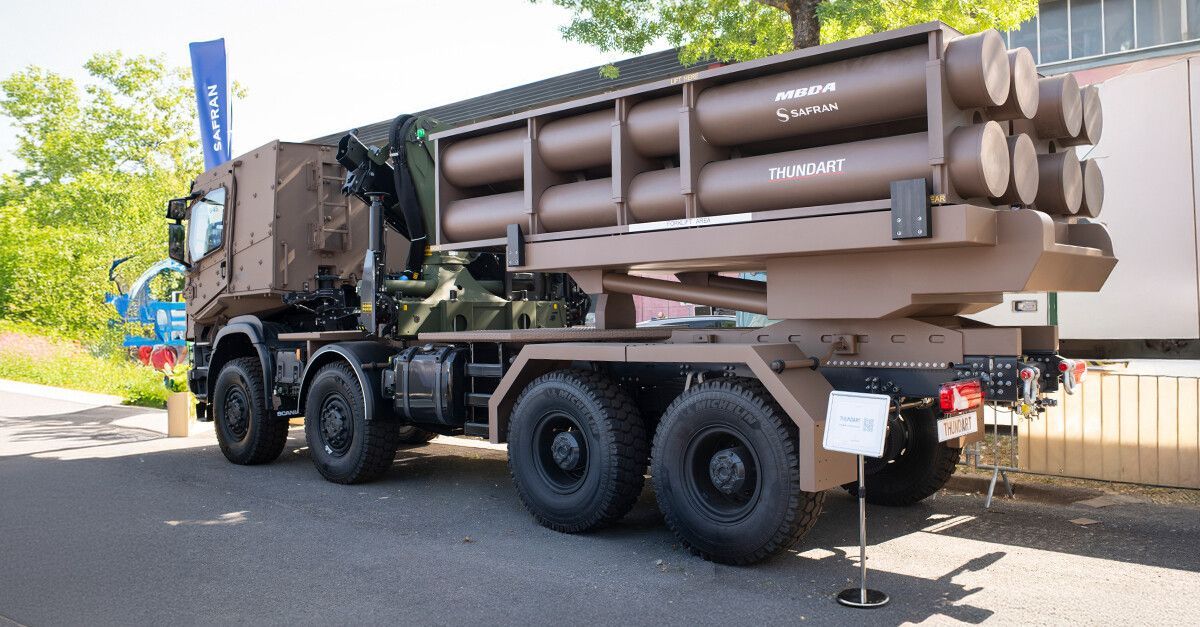
THUNDART is a French long-range precision rocket artillery system developed by MBDA and Safran Electronics & Defense for the French Frappe Longue Portée Terrestre (FLP-T) program. It is intended to replace the French Army's Lance-Roquettes Unitaire (LRU) systems and extend ground-based strike range to 150 km.
The system combines an eight-round launcher with guided rockets designed for accurate strikes in contested environments, including conditions in which satellite navigation is jammed or unavailable. MBDA describes THUNDART as an autonomous, off-road-capable system with rapid shoot-and-scoot operation, while Safran lists high-supersonic speed, metric accuracy and resilient navigation among its principal characteristics.
THUNDART remains under development. France selected the MBDA-Safran proposal in 2026, and the companies aim to provide the French armed forces with sovereign long-range strike capability and full freedom of use by 2030.
Development
The French Defence Procurement Agency, DGA, launched the FLP-T program in 2023 as France prepared to replace its remaining LRU multiple rocket launchers. Safran stated that THUNDART was first presented publicly at Eurosatory in 2024. The proposal draws on technologies already developed by both companies, including MBDA expertise in battlefield strike systems and Safran guidance technology related to the AASM Hammer precision-guided weapon. Safran's 2025 program description identified a demonstration firing as the next major development milestone.
The first THUNDART firing took place on 14 April 2026 at the DGA Île du Levant test range in southern France, earlier than the previously stated mid-2026 schedule. According to Janes, the test was intended to validate the rocket design and propulsion system. The propulsion system is supplied by Roxel, an MBDA subsidiary.
During Eurosatory 2026, France entered exclusive negotiations with the MBDA-Safran team. In September 2026, the DGA notified the companies of the contract for THUNDART, formalizing its selection over the competing FLP-T 150 proposal from ArianeGroup and Thales. AeroTime reported that the contract value and quantities of launchers and rockets were not disclosed. French planning documents cited by the publication call for at least 13 long-range systems by 2030 and 26 by 2035, but these figures are planning objectives rather than disclosed THUNDART contract quantities.
MBDA and Safran plan to establish a 50/50 joint venture in the Paris region to manage further development, production, in-service support and future adaptations of THUNDART. The joint venture was reported as expected to be created in January 2027. Several dozen engineers were already working on the program in 2026, with development and industrial activities distributed across multiple French regions.
Design
THUNDART is a complete ground-based artillery system consisting of a mobile launcher, integrated turret and fire-control equipment. The launcher carries two munition pods, each containing four guided rockets, for a total ready load of eight rounds. According to the MBDA THUNDART description, the system is designed for rapid firing followed by withdrawal from the firing position to reduce exposure to counter-battery attack.
Launcher and fire control
The launcher uses a two-axis turret and is described as autonomous and off-road capable. THUNDART is intended to connect with existing French Army command, control and artillery systems, including the ATLAS artillery fire-management system. Safran has stated that its fire-control architecture is adapted from technology used with the CAESAR artillery system.
Rocket and guidance
The baseline guided rocket has a stated maximum range of 150 km and travels at high-supersonic speed. MBDA and Safran describe the guidance architecture as resilient INS/GNSS navigation intended to retain effectiveness in jammed or GNSS-denied environments. Safran states that the system is designed for metric accuracy. Secondary reporting from AeroTime also describes an optronic guidance element associated with Safran technology derived from the AASM Hammer family.
The system is intended to engage fixed and moving targets. MBDA identifies possible targets including light and moderately hardened infrastructure, ground-based weapon systems and surface targets. THUNDART is designed to provide long-range precision fire as well as the ability to launch multiple rounds for greater fire concentration.
Sovereignty and production
MBDA and Safran intend to design, develop and manufacture THUNDART in France. The companies describe the system as ITAR-free and emphasize French control over production, use, export and future development. Production sites have been identified in France, while the companies are preparing industrial capacity for larger-scale manufacture if required.
Program status
As of September 2026, THUNDART had completed its first demonstration firing and had been selected by the DGA for France's future long-range land-strike capability. It was still in development and had not yet entered operational French Army service. The program objective is to provide operational capability and sovereign freedom of use by 2030 as the LRU fleet approaches retirement.
Variants
- THUNDART baseline ground system: the selected land-based configuration with a 150 km guided rocket and an eight-round launcher.
- Extended-range concept: Safran displayed a possible future ground-launched development with a range of up to 300 km at Eurosatory 2026. It remains a proposed development rather than an operational variant.
- Air-launched concept: a possible future version intended for carriage by combat aircraft was presented as part of the broader THUNDART development roadmap.
- Naval concept: a proposed ship-launched adaptation was shown for possible use from FREMM and FDI frigates and PHA amphibious helicopter carriers. No operational naval variant has been confirmed.
Specifications (THUNDART baseline system)
General characteristics
- Type: Long-range precision guided rocket artillery system
- Launcher: Mobile launcher with integrated two-axis turret and fire-control system
- Ready ammunition: 8 guided rockets
- Pod arrangement: 2 pods with 4 rockets each
- Mobility: Road-mobile and off-road capable
- Fire-management integration: Compatible with the ATLAS artillery fire-management system
Performance
- Maximum range: Up to 150 km
- Speed: High supersonic
- Accuracy: Metric accuracy stated by Safran
Guidance
- Navigation: Resilient INS/GNSS guidance
- Contested-environment capability: Designed to operate when GNSS signals are jammed or denied
- Guidance heritage: Guidance technology derived from the Safran AASM Hammer family
 Argentina
 Armenia
 Australia
 Austria
 Austria-Hungary
 Belgium
 Brazil
 United Kingdom
 United States
 Brunei
 Bulgaria
 Canada
 Chile
Chile China
China Colonial America
 Colombia
 Confederate States
 Croatia
 Czech
Czech Denmark
 Egypt
Egypt Finland
 Georgia
 Germany
 German Imperial
 Greece
 Holland
 Hungary
 India
India Indonesia
 Iran
Iran Iraq
Iraq Ireland
 Israel
 Italy
Italy Japan
Japan Japan (1940)
 Jordan
 Kingdom of Italy
 Malaysia
 Mexico
 Myanmar
 Nazi Germany
 Netherlands
 New Zealand
 North Korea
 Norway
 Pakistan
 Peru
Peru Philippines
 Poland
 Portugal
 Prussia
 Romania
 Russia
 Saudi Arabia
 Serbia
 Singapore
 Slovakia
 Slovenia
 South Africa
 South Korea
 Soviet Union
 Spain
Spain Sweden
 Switzerland
 Syria
Syria Taiwan
 Thailand
 Turkey
 UAE
UAE Ukraine
 Vietnam
 Yugoslavia