
History
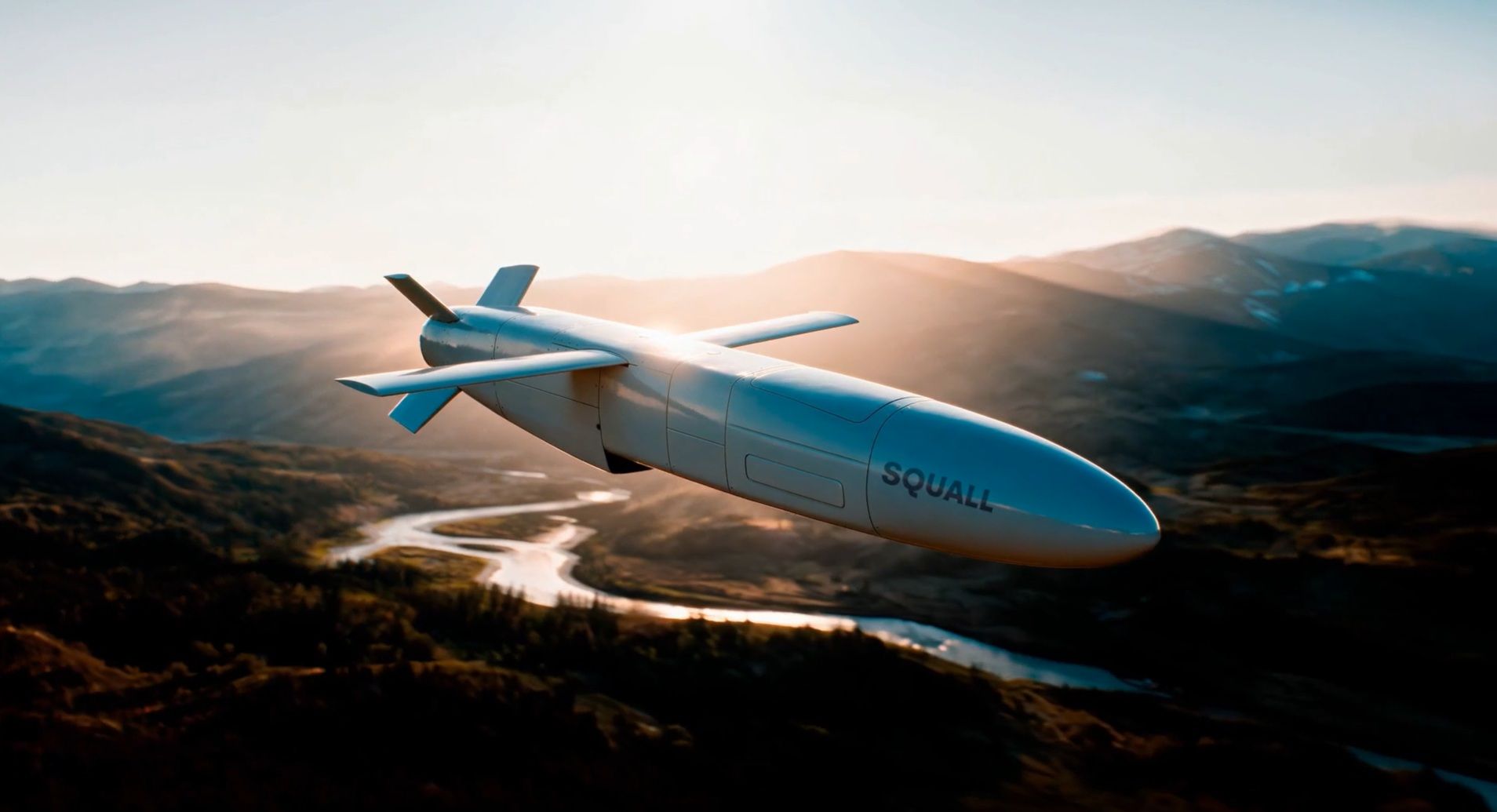
Indra Squall is a Spanish low-cost cruise missile concept intended for precision strikes against high-value targets at ranges exceeding 300 km. The weapon is being developed for launch from land and naval platforms and is intended to combine long-range precision attack with a procurement cost suitable for coordinated mass employment.
Indra unveiled Squall on September 16, 2026, at the UNVEX exhibition in San Javier, Murcia. The program represents Indra's first complete cruise missile and Spain's first domestically developed complete land- and sea-launched cruise missile.
Squall is intended to attack targets including command-and-control centers, air defense systems, and high-value military infrastructure. Its design emphasizes low-altitude flight, resistance to navigation jamming and spoofing, flexible launcher integration, and a nationally controlled supply chain.
Development
Squall was developed within Indra's Weapons & Ammunition activities as part of an expansion into complete strike weapons. Production is planned in Spain with participation from other industrial partners. The program is intended to give Spanish industry greater control over the complete missile system, including its airframe, propulsion, navigation, flight controls, power supply, payload, warhead, and launcher interfaces.
The program follows earlier Spanish involvement with the Taurus KEPD 350, a German-Swedish air-launched cruise missile operated by Spain. Spanish companies have previously participated in the manufacture of Taurus components and in integration, testing, maintenance, and support, but Squall is intended as a nationally controlled complete missile.
Indra designed Squall around a low-cost procurement concept. The company intends the missile to be usable both for individual precision attacks and for coordinated launches involving larger numbers of weapons. An Indra representative stated that the target pricing concept was intended to permit approximately ten Squall missiles to be acquired for the price of one high-end conventional missile. No firm unit price has been released.
The industrial concept also emphasizes a Spanish supply chain using components under national control. This approach is intended to support increased production during crises when international supply chains or access to critical materials may be disrupted.
Design
Squall is a powered, winged cruise missile designed to remain in aerodynamic flight after launch. It is approximately 3.4 m long and has a reported launch mass of about 150 kg. A reported warhead mass of 50 to 60 kg gives the weapon a substantial payload relative to its overall mass.
Propulsion and performance
Squall is turbojet-powered and is intended to fly at approximately Mach 0.8. Its stated range exceeds 300 km. The missile is designed for low-altitude flight to reduce exposure to enemy radar and air-defense systems during the approach to its target.
Guidance and navigation
Squall uses multiple guidance and navigation methods intended to maintain accuracy when satellite-navigation signals are jammed or spoofed. Indra has not disclosed the individual navigation sensors, terrain-reference methods, terminal seeker, or detailed accuracy figures. The missile is nevertheless intended to retain precision-strike capability against fixed and high-value targets in an electronically contested environment.
Launch platforms
The missile is designed for integration with both land and naval platforms. Supported launch arrangements include ramps, containers, and tactical vehicles. Naval integration is also planned, allowing ships to employ the missile without dependence on combat aircraft.
Containerized and vehicle-based launch options are intended to provide flexibility in deployment and permit dispersed land batteries. The exact launcher capacity, reload arrangement, canister dimensions, and naval integration configuration have not been disclosed.
Warhead and targets
Squall is reported to carry a 50 to 60 kg warhead. The precise warhead type, fuze, and penetration characteristics have not been disclosed. Intended targets include command-and-control facilities, air-defense systems, and other high-value military infrastructure.
Program status
Squall was publicly unveiled in September 2026 and remains a development program. Available information describes the missile's intended configuration and performance, but no completed prototype, flight-test milestone, serial-production date, or operational service entry has been confirmed.
Indra has not disclosed detailed production rates, launcher capacity, exact unit cost, navigation accuracy, terminal seeker configuration, or a schedule for operational deployment. The company has stated that the missile is designed around a scalable national supply chain and that its relatively low cost is intended to support both limited precision attacks and coordinated saturation missions.
Specifications (Squall)
General characteristics
- Type: Low-cost cruise missile
- Developer: Indra
- Country of development: Spain
- Length: Approximately 3.4 m
- Launch mass: Approximately 150 kg
- Warhead mass: 50-60 kg
- Propulsion: Turbojet
- Launch platforms: Land and naval platforms, including ramps, containers, and tactical vehicles
Performance
- Range: More than 300 km
- Speed: Approximately Mach 0.8
- Flight profile: Low-altitude cruise
Guidance and control
- Navigation: Multiple guidance and navigation systems designed to resist jamming and spoofing
- Targeting role: Precision attack against command-and-control centers, air-defense systems, and other high-value military infrastructure
 Argentina
 Armenia
 Australia
 Austria
 Austria-Hungary
 Belgium
 Brazil
 United Kingdom
 United States
 Brunei
 Bulgaria
 Canada
 Chile
Chile China
China Colonial America
 Colombia
 Confederate States
 Croatia
 Czech
Czech Denmark
 Egypt
Egypt Finland
 France
 Georgia
 Germany
 German Imperial
 Greece
 Holland
 Hungary
 India
India Indonesia
 Iran
Iran Iraq
Iraq Ireland
 Israel
 Italy
Italy Japan
Japan Japan (1940)
 Jordan
 Kingdom of Italy
 Malaysia
 Mexico
 Myanmar
 Nazi Germany
 Netherlands
 New Zealand
 North Korea
 Norway
 Pakistan
 Peru
Peru Philippines
 Poland
 Portugal
 Prussia
 Romania
 Russia
 Saudi Arabia
 Serbia
 Singapore
 Slovakia
 Slovenia
 South Africa
 South Korea
 Soviet Union
 Sweden
 Switzerland
 Syria
Syria Taiwan
 Thailand
 Turkey
 UAE
UAE Ukraine
 Vietnam
 Yugoslavia