
History
The Pionierpanzer 3 Kodiak (AEV3) was developed jointly by Rheinmetall Landsysteme GmbH in Kiel, Germany, and RUAG Land Systems AG in Switzerland. The Swiss Army initiated the project in April 2002 to field a new heavy armored engineering vehicle. The prototype was completed in May 2003 using a surplus Leopard 2 chassis provided by Armasuisse, the Swiss procurement agency, and successfully passed a two-month trial with the Swiss Army. The vehicle was publicly shown at Eurosatory in 2004, attracting interest from several Leopard 2 operating nations. Trials followed in Spain in 2004 and in Boden, Sweden, in early 2005 under winter conditions.
Switzerland signed its first contract for twelve Kodiaks on 9 January 2007. In January 2008, Sweden and the Netherlands placed a combined order for sixteen vehicles at a total cost of approximately 100 million euros. Singapore ordered fourteen Kodiaks, delivered in 2014–2015. Germany initiated its procurement of 44 Pionierpanzer 3 Kodiak in November 2019 to replace a portion of its Leopard 1-based Pionierpanzer Dachs fleet. BAAINBw awarded the contract to Rheinmetall Landsysteme in May 2021 for approximately 295 million euros. Two trial vehicles were delivered to the Bundeswehr in late August 2026, approximately three years behind the original schedule, and state testing began at German technical centers. The vehicles were delivered without the remotely controlled Natter combat module that was initially planned for the German configuration.
Design
Excavator and tools
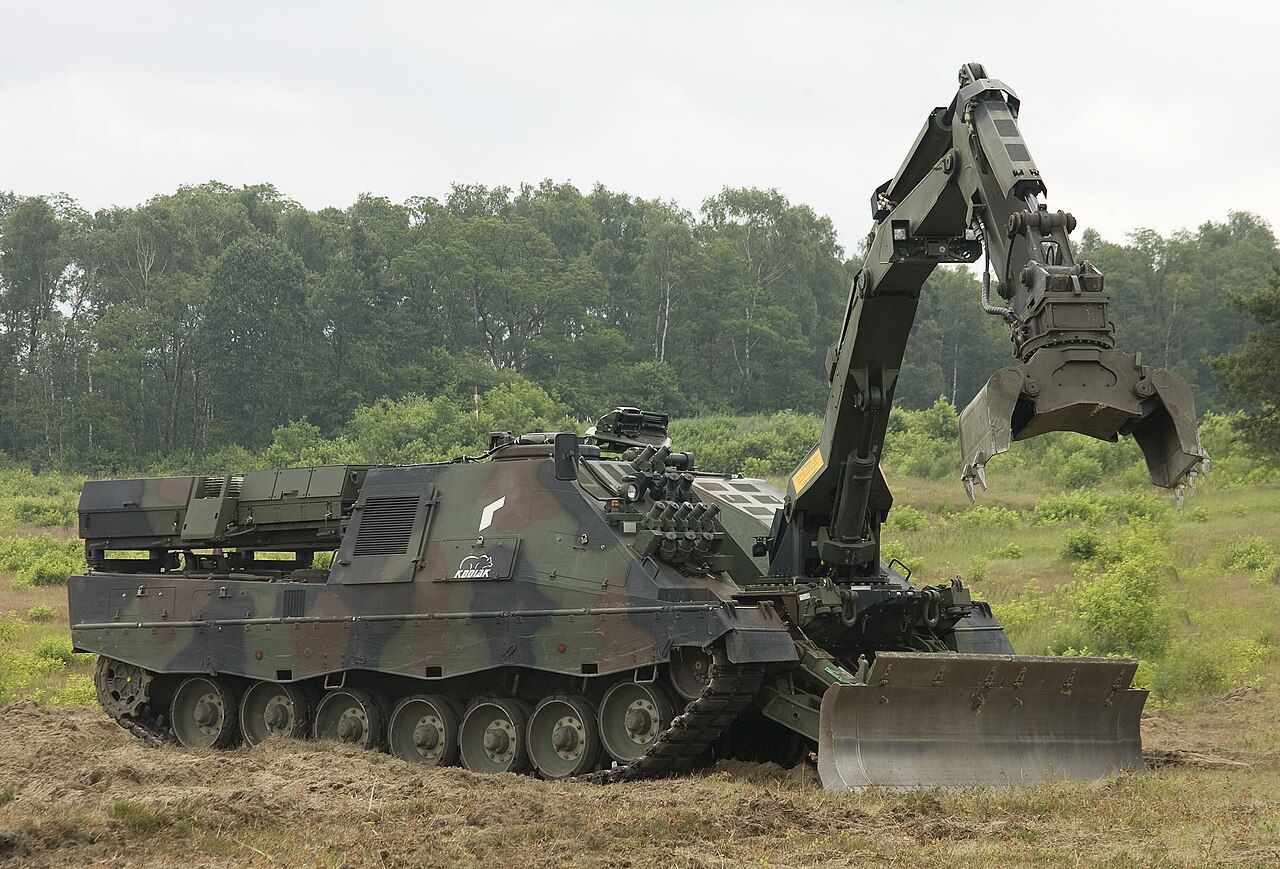
The Kodiak features a centrally mounted articulated-arm excavator in the vehicle midsection, providing the crew with a clear view of operations and easier work in confined spaces. The excavator bucket has a volume of one cubic meter and can move up to 200 cubic meters of heavy earth per hour in continuous operation. The arm reaches a horizontal operational range of 9 m and a vertical range of 8.2 m, and can lift approximately 3.5 tonnes at maximum reach. Interchangeable tools include a bucket, universal gripper, hydraulic hammer for concrete breaking, earth drill, and fascine launcher. Tool changes are performed under full armored protection. Two additional tools can be carried on the rear rack above the engine deck, while further tools can be transported separately by truck.
Winches and blade
Two Rotzler capstan winches provide a pulling capacity of 9 tonnes each at a line speed up to 90 m/min, with cable lengths up to 200 m. Using the winch blocks together, the vehicle can move loads exceeding 60 tonnes. An adjustable bulldozer blade is mounted at the front, with a width of 3.42 m (4.02 m with side extensions). A mine breakthrough kit converts the front configuration into a mine clearance system with a mine plough, signature duplicator, and lane marking equipment, adding 4 m to the total vehicle length.
Protection and crew
The Kodiak carries a two- or three-person crew: commander, driver, and engineer. The vehicle is fully operable with only the commander and driver. The crew compartment is divided into two halves, with seats mounted on the roof to reduce blast force transmission from mine or IED detonations. The vehicle provides ballistic protection to STANAG 4569 Level 4, mine protection to STANAG 4569 Level 3B and 4A, and NBC-protective ventilation. Six exterior cameras provide a panoramic view enabling fully protected remote operation of the vehicle. A heating and cooling system maintains crew comfort. The vehicle can also supply electrical and hydraulic energy to external tools such as additional work lights or hydraulically powered hand tools.
Armament
For self-defense, the Kodiak carries a remotely operated weapons station on the right side of the superstructure. The station can be operated both manually and remotely and can be fitted with a 12.7 mm machine gun or a 40 mm automatic grenade launcher. A smoke grenade launcher system is mounted at the front. The weapons station is offered as an optional fit-to-customer specification.
Operational history
Switzerland received twelve Kodiaks (designated Geniepanzer) with the last vehicle delivered just before the end of 2011 after a hydraulic arm overheating issue delayed the production schedule. They are operated by the Panzersappeurbataillon 11 (11th Combat Engineer Battalion). Sweden received six vehicles (Ingenjörbandvagn 120) starting in November 2011, distributed between two Engineering Battalions. The Netherlands received ten vehicles that entered active service on 31 May 2018 after resolving hydraulic teething problems, replacing fourteen worn-out Leopard 1 engineer vehicles. Singapore received fourteen vehicles (L2-AEV) in 2014–2015, replacing M728 CEVs, operated by the 38th Battalion Singapore Combat Engineers.
The German Bundeswehr program for 44 Pionierpanzer 3 Kodiak has experienced a delay of approximately three years. The original plan called for trial vehicle delivery in 2023–2024 and first serial deliveries in 2026. The two trial vehicles were delivered in late August 2026. BAAINBw confirmed the vehicles were delivered without the remotely controlled Natter combat module originally planned for the German Kodiak. The reasons for the configuration change were not disclosed; BAAINBw cited ongoing negotiations. Rheinmetall declined to comment due to procurement procedure restrictions. Alternative remotely operated modules under discussion include the FLW 200 from KNDS Deutschland and the Protector RS4 from Kongsberg, both already in Bundeswehr service on other tracked platforms. No official decision has been made on a replacement module. BAAINBw has not stated whether the Natter omission affects delivery timelines, program cost, or the test schedule. The planned serial delivery schedule at the time of contract signing called for five vehicles in 2026, fourteen in 2027, seventeen in 2028, and six in 2029.
Variants
- AEV3 / Geniepanzer (Switzerland): Swiss Army production variant built by RUAG with Rheinmetall assistance. Twelve vehicles, six equipped with Pearson mine-clearing modules.
- AEV3 S / Ingenjörbandvagn 120 (Sweden): Six vehicles based on Stridsvagn 122-upgraded chassis. Operated by two Engineering Battalions.
- AEV3 (Netherlands): Ten vehicles based on Leopard 2A4 chassis. Includes a bomblet protection package. Replaced fourteen Leopard 1 engineer vehicles.
- L2-AEV (Singapore): Fourteen vehicles replacing M728 CEVs. Operated by the 38th Battalion Singapore Combat Engineers.
- Pionierpanzer 3 Kodiak (Germany): 44 vehicles based on Leopard 2A4 chassis. Two trial vehicles delivered in August 2026 without the Natter combat module. Serial delivery planned 2026–2029.
Operators
- Germany: Bundeswehr, 44 ordered; 2 trial vehicles delivered August 2026; serial delivery planned 2026–2029.
- Netherlands: 10 in service since May 2018.
- Singapore: 14 in service since 2014–2015, 38th Battalion Singapore Combat Engineers.
- Sweden: 6 in service since 2011, two Engineering Battalions.
- Switzerland: 12 in service since 2011, Panzersappeurbataillon 11.
Specifications
The following specifications apply to the standard AEV3 Kodiak configuration.
General characteristics
- Crew: 2–3 (commander, driver, engineer)
- Battle-ready weight: 62 t (MLC 70)
- Dimensions: 10.2 m length (14.02 m with mine plough; 11 m with dozer blade), 3.54 m width, 2.6 m height
- Powerplant: MTU MB 873 V-12 twin-turbo diesel, 1,100 kW (1,475 hp)
- Maximum speed: 68 km/h (42 mph)
- Protection: Ballistic STANAG 4569 Level 4; mine STANAG 4569 Level 3B and 4A
Engineering equipment
- Excavator: Central articulated arm; bucket volume 1 m³; earth-moving rate up to 200 m³/h; lifting capacity approx. 3.5 t at 9 m maximum reach
- Winches: 2 × Rotzler capstan, 9 t pulling capacity each, 90 m/min line speed, 200 m cable length; combined load capacity over 60 t
- Blade: 3.42 m width (4.02 m with side extensions); mine plough kit adds 4 m to vehicle length
Armament
- Weapons station: 12.7 mm machine gun or 40 mm automatic grenade launcher (remotely operated, optional)
- Smoke grenades: Front-mounted launcher system
Related equipment
- Leopard 2: Main battle tank providing the chassis platform for the Kodiak.
- Buffalo (BPz3): Rheinmetall armored recovery vehicle on the Leopard 2 chassis, used alongside Kodiak by the Bundeswehr.
- WiSENT 2: FFG armored engineering/recovery vehicle on a Leopard 2 chassis; primary competitor to Kodiak in the Bundeswehr tender.
 Argentina
 Armenia
 Australia
 Austria
 Austria-Hungary
 Belgium
 Brazil
 United Kingdom
 United States
 Brunei
 Bulgaria
 Canada
 Chile
 China
 Colonial America
 Colombia
 Confederate States
 Croatia
 Czech
 Denmark
 Egypt
 Finland
 France
 Georgia
 German Imperial
 Greece
 Holland
 Hungary
 India
 Indonesia
 Iran
 Iraq
 Ireland
 Israel
 Italy
 Japan
 Japan (1940)
 Jordan
 Kingdom of Italy
 Malaysia
 Mexico
 Myanmar
 Nazi Germany
 Netherlands
 New Zealand
 North Korea
 Norway
 Pakistan
 Peru
 Philippines
 Poland
 Portugal
 Prussia
 Romania

 Russia
 Saudi Arabia
 Serbia
 Singapore
 Slovakia
 Slovenia
 South Africa
 South Korea
 Soviet Union
 Spain
 Sweden
 Switzerland
 Syria
 Taiwan
 Thailand
 Turkey
 UAE
 Ukraine
 Vietnam
 Yugoslavia