
History
The concept of a Polish multiple launch rocket system traces back to 2001, when the Polish Army began analysing the introduction of a polonised MLRS designated MLRS-P. A feasibility study was produced by the Military Institute of Armament Technology and the Military University of Technology in 2004–2006. In 2008, Homar rocket launchers were included in the Armed Forces Development Programme 2007–2012. In 2015, the Armament Inspectorate invited Huta Stalowa Wola to participate in a procedure for three Homar fire battalions. Protracted negotiations and complications led the Ministry of National Defence to break off talks with the Polish Armaments Group in 2018.
After the Russian invasion of Ukraine accelerated procurement, on 19 October 2022 the Minister of National Defence concluded a framework agreement for the Homar-K system in the form of a polonised K239 Chunmoo launcher. The first Homar-K launchers arrived in Poland in 2023. In April 2024, Poland ordered an additional 72 launch modules with several thousand rockets; the contract with Hanwha Aerospace was worth approximately $1.6 billion. On 24 April 2024, the first successful test launch of the CTM-290 ballistic missile from a Homar-K launcher took place at the Agency for Defense Development test site in Anhin, South Korea, in the presence of representatives from the Polish Ministry of Defence. On 7 October 2024, four Homar-K launchers were delivered as part of the 2022 order, with eight additional modules expected by the end of that year. The overall programme calls for a total of 290 Homar-K launch modules.
At the 2024 KADEX International Defense Exhibition, Poland's WB Group and Hanwha Aerospace signed an agreement to establish a joint venture for local production of CGR-080 rockets. In April 2025, WB Electronics and Hanwha Aerospace confirmed their agreement to jointly produce 239-mm guided missiles. In December 2025, the Polish Armaments Agency signed a contract with the Hanwha WB Advanced System and Hanwha Aerospace consortium for the supply of Polish-made CGR-080 rockets, with deliveries scheduled to begin in 2030. In July 2026, preparatory work began on the Hanwha WB Advanced System plant in Gożów Wielkopolski.
Design
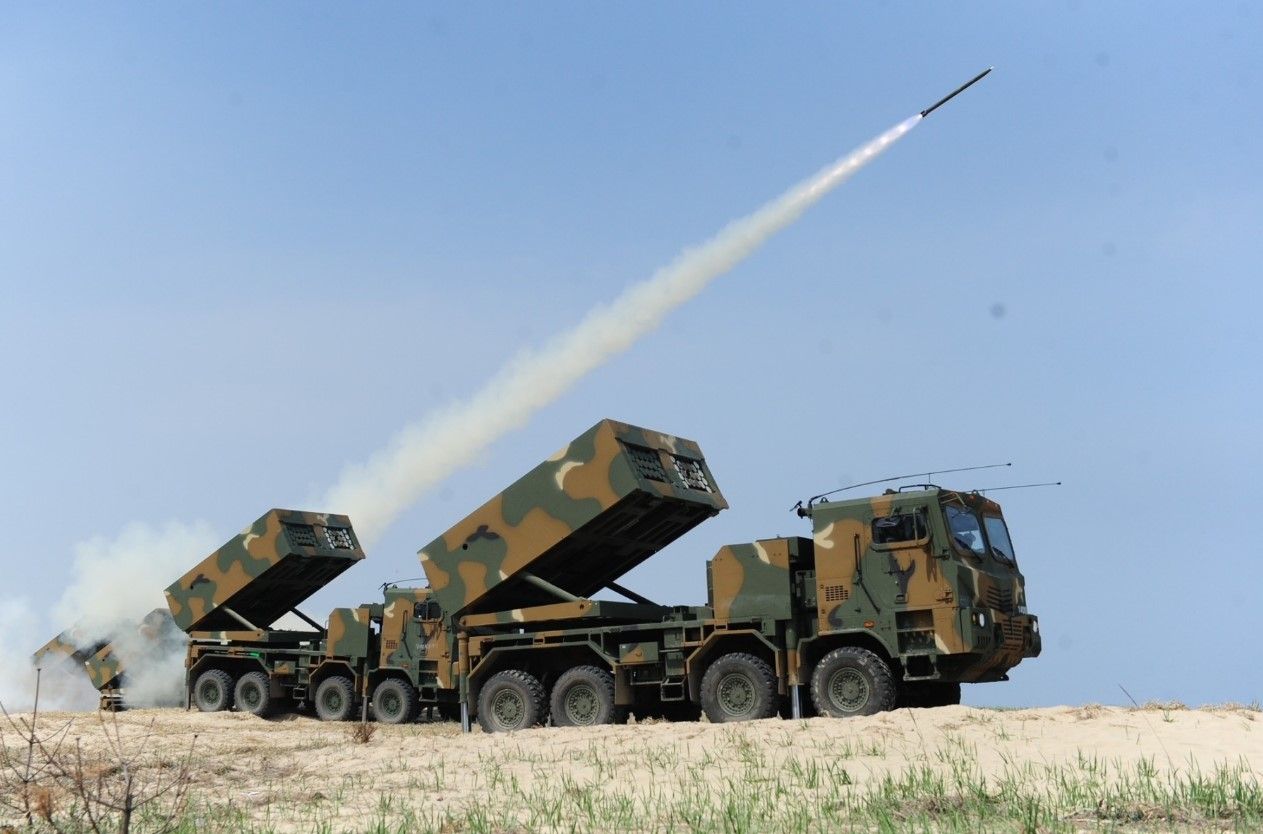
The Homar-K is a Polish adaptation of the South Korean K239 Chunmoo multiple launch rocket system, manufactured by Hanwha Aerospace and in production since 2014. The K239 combines the wheeled chassis mobility of the M142 HIMARS with the two-pod configuration of the M270 MLRS, giving the launcher twice the firepower of a single-pod system. In its Polish form, the launcher is mounted on an eight-wheeled Jelcz chassis and integrated with the TOPAZ automated fire control system, replacing the original South Korean Doosan chassis to reflect Poland's intent to localise production.
Each launcher carries two transport-launch containers. Each container can hold either six CGR-080 guided rockets or one CTM-290 ballistic missile, giving the system a maximum load of twelve guided rockets or two ballistic missiles. The launcher can also fire unguided 122 mm rockets compatible with systems such as the WR-40 Langusta or BM-21 Grad. Developments are underway to integrate rockets with ranges up to 200 km and 400 mm rockets in a future configuration. Work is also under way to adapt the K239 launcher to fire naval strike missiles designed to engage ships.
Munitions
The CGR-080 is a 239 mm guided rocket with a range of up to 80 km and a warhead weighing approximately 90 kg. It can be fitted with two warhead types: a high-explosive warhead with bunker-buster capability and a cluster munition warhead. GPS-assisted navigation gives it an accuracy of approximately 15 m. The CGR-080 is broadly comparable in role to the U.S.-made GMLRS.
The CTM-290 is a 600 mm short-range ballistic missile with a stated range of 80 to 290 km. It is the export version of the Korean Tactical Surface-to-Surface Missile (KTSSM), known by its Korean name "Ure" (thunder). It carries a high-explosive warhead weighing approximately 500 kg and is designed primarily to destroy fortifications and strategic facilities. It uses satellite-assisted and inertial navigation; reported CEP values range from 2 m to up to 9 m depending on the source. The Block I version is currently in use, with a Block II ("Ure-II") expected by 2027 that will feature an increased range and a flight path designed to be difficult to intercept. Poland will receive the second-generation version.
Specifications
Two Jelcz chassis variants are used: the Jelcz P882.57 TS T45 (first batch, a converted carrier from the Wisła programme) and the new-generation Jelcz P883.57 TS T85. The P882.57 has an empty weight of approximately 22,500 kg and a total weight of approximately 32,000 kg, is powered by a 578 hp MTU 6R1500V40 engine, and has a maximum speed of approximately 85 km/h with a range of approximately 650 km. The new-generation P883.57 is approximately 11 m long, uses firing supports that must be extended before firing, and is powered by the same 578 hp engine. A separate source gives the system's weight as 31 t, length as 9 m, width as 2.9 m, height as 3.3 m, a 450 hp HD Hyundai Infracore DV11K diesel engine, a maximum speed of 80 km/h, and a range of 450 km, with an Allison Transmission automatic gearbox.
The crew of three is protected by armour compliant with STANAG 4569 Level 2, using a combination of steel, ceramics, and polymer composites to resist ballistic threats and shrapnel. The P882.57 cab armour is classified as Level 2 according to STANAG 4569A and Level 2a for mine protection according to STANAG 4569B. Each launcher can fire six 239 mm rockets in 30 seconds.
Production
The Homar-K modules are integrated at the Huta Stalowa Wola (HSW) factory in Poland. Under the 2022 agreement, 218 launchers are to be manufactured in South Korea and mounted on Polish-made Jelcz carriers in Poland, while a further batch is to be manufactured entirely in Poland through technology transfer. One source describes the 2022 agreement as covering 288 launchers. As of the October 2024 delivery, the Korean side had produced and delivered 42 units, one of which, mounted on a Jelcz chassis, remained in South Korea for testing. Under the April 2024 contract for 72 additional modules, 60 are to be fully constructed in Poland.
Poland is localising production of the CGR-080 rockets domestically. The first Polish-made CGR-080 missiles are expected from the production line as early as 2028, while deliveries under the December 2025 contract are scheduled to begin in 2030. A separate contract covers domestic production of 10,000 rockets and missiles.
Operators
The Homar-K is operated by the Polish Armed Forces. The 1st Artillery Regiment and the 18th Artillery Brigade have received Homar-K launchers integrated at HSW. A Rocket Brigade is being formed and artillery regiments and brigades are being rearmed with Homar-K launchers as part of the broader Homar programme, which also includes the Homar-A system based on the polonised U.S. M142 HIMARS.
 Argentina
 Armenia
 Australia
 Austria
 Austria-Hungary
 Belgium
 Brazil
 United Kingdom
 United States
 Brunei
 Bulgaria
 Canada
 Chile
 China
 Colonial America
 Colombia
 Confederate States
 Croatia
 Czech
 Denmark
 Egypt
 Finland
 France
 Georgia
 Germany
 German Imperial
 Greece
 Holland
 Hungary
 India
 Indonesia
 Iran
 Iraq
 Ireland
 Israel
 Italy
 Japan
 Japan (1940)
 Jordan
 Kingdom of Italy
 Malaysia
 Mexico
 Myanmar
 Nazi Germany
 Netherlands
 New Zealand
 North Korea
 Norway
 Pakistan
 Peru
 Philippines
 Portugal
 Prussia
 Romania

 Russia
 Saudi Arabia
 Serbia
 Singapore
 Slovakia
 Slovenia
 South Africa
 South Korea
 Soviet Union
 Spain
 Sweden
 Switzerland
 Syria
 Taiwan
 Thailand
 Turkey
 UAE
 Ukraine
 Vietnam
 Yugoslavia