
History
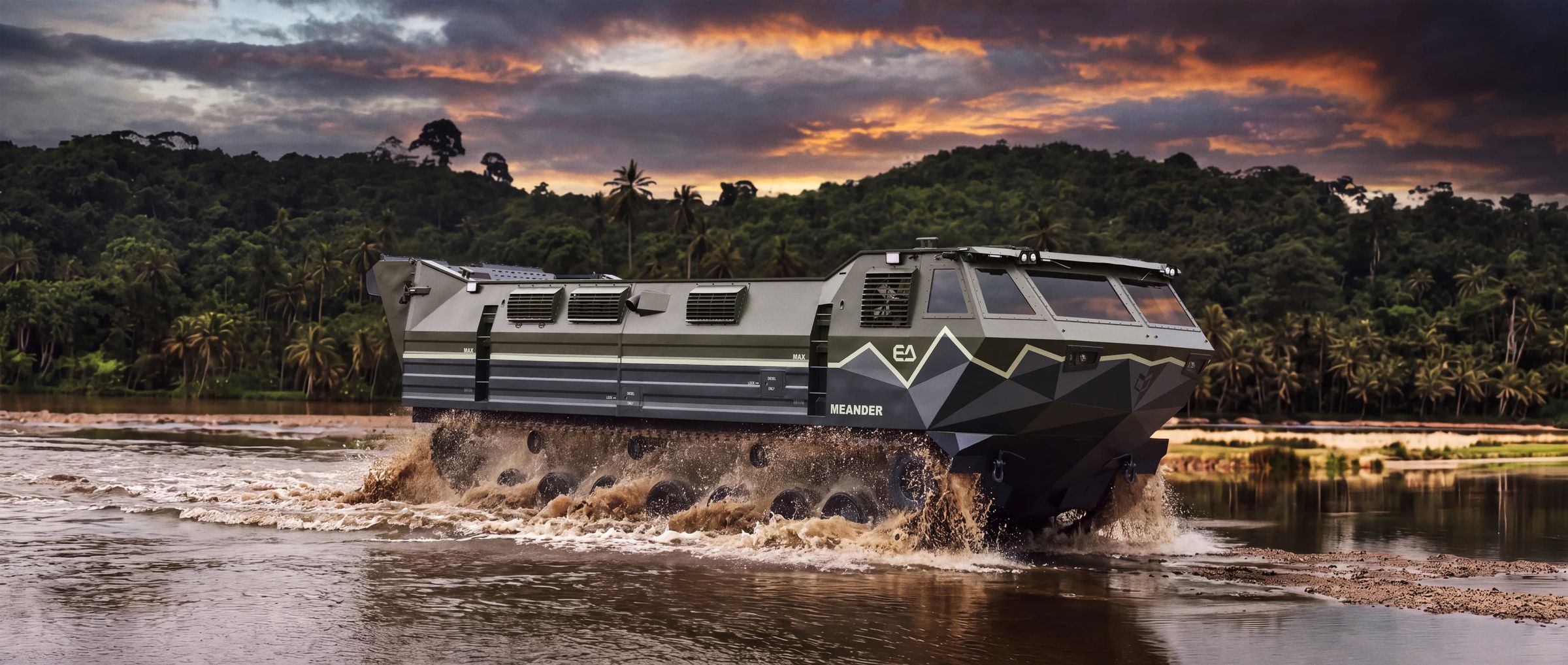
The MEANDER is a tracked military amphibious vehicle developed jointly by Excalibur Army, a member of the Czechoslovak Group (CSG), and New Space Technologies (NST), a company within the Krill Business Partners group. The vehicle is derived from the KALAN amphibious tracked utility vehicle, which NST initially designed for rescue services; Czech firefighters were trialling the KALAN at the time of MEANDER's development. Excalibur Army and NST formalised their cooperation with a memorandum signed at the Eurosatory 2026 defence exhibition. The first MEANDER prototype was presented at the Future Forces Forum 2026 in Prague a few months later. Under the three-year cooperation framework, Excalibur Army is responsible for defining military, operational, and end-user requirements, while NST handles technical design, engineering, and production including the first prototype. CSG spokesperson Andrej Chirtek stated that the vehicle is suitable for use in Ukraine because it specialises in crossing swamps, rivers, and other difficult terrain.
Design
The MEANDER features a ship-like lower hull designed to minimise hydrodynamic drag during water operations. On land it moves on wide metal tracks with rubber pads and a modern suspension system that reduces vibration and noise. The vehicle's electronic steer-by-wire system allows the driver to steer with a conventional steering wheel and pedals both on land and in the water. On water, a waterjet propulsion system with two propellers provides efficient reverse thrust and enables the vehicle to turn in place. An electrically operated rear ramp rated for 13 tonnes facilitates loading. CSG states that the majority of the vehicle's assemblies and components are based on readily available parts meeting military standards, and the design can be modified to meet specific customer requirements. The platform is intended to allow armed forces to carry troops, materiel, or smaller vehicles across watercourses or marshy terrain without constructing pontoon or engineer bridges. CSG notes that the design also allows specialised and combat variants capable of carrying weapon systems, although the vehicle cannot defend itself against drones or aircraft systems.
Specifications
The following parameters apply to the basic transport variant presented at Future Forces Forum 2026.
- Dimensions: 11,290 mm long × 3,314 mm wide × 3,220 mm high; cargo platform 2,800 × 7,900 mm (22 m²)
- Gross weight: 20 tonnes (as stated by CSG to one reporting outlet) or up to 33 tonnes (as stated in CSG's official announcement); the configuration difference is not specified
- Payload: 13 tonnes (13,000 kg)
- Engine: TATRA V12 diesel, 440 kW (590 hp), air-cooled
- Top speed: 48 km/h on road (per most reports) or 50 km/h (per one report); 35 km/h off-road; approximately 12 km/h (6.5 knots) on water
- Range: 380 km on highway; 300 km off-road
- Obstacle crossing: vertical obstacles up to 650 mm high; trenches up to 2.5 m wide
- Cargo capacity: up to 70 standing troops, 12 stretchers, a medium-sized military truck, or a standard 20-foot container
- Crew: 1 driver + 2 (operator, with a third crew member added when required)
 Argentina
 Armenia
 Australia
 Austria
 Austria-Hungary
 Belgium
 Brazil
 United Kingdom
 United States
 Brunei
 Bulgaria
 Canada
 Chile
 China
 Colonial America
 Colombia
 Confederate States
 Croatia
 Denmark
 Egypt
 Finland
 France
 Georgia
 Germany
 German Imperial
 Greece
 Holland
 Hungary
 India
 Indonesia
 Iran
 Iraq
 Ireland
 Israel
 Italy
 Japan
 Japan (1940)
 Jordan
 Kingdom of Italy
 Malaysia
 Mexico
 Myanmar
 Nazi Germany
 Netherlands
 New Zealand
 North Korea
 Norway
 Pakistan
 Peru
 Philippines
 Poland
 Portugal
 Prussia
 Romania

 Russia
 Saudi Arabia
 Serbia
 Singapore
 Slovakia
 Slovenia
 South Africa
 South Korea
 Soviet Union
 Spain
 Sweden
 Switzerland
 Syria
 Taiwan
 Thailand
 Turkey
 UAE
 Ukraine
 Vietnam
 Yugoslavia