
History
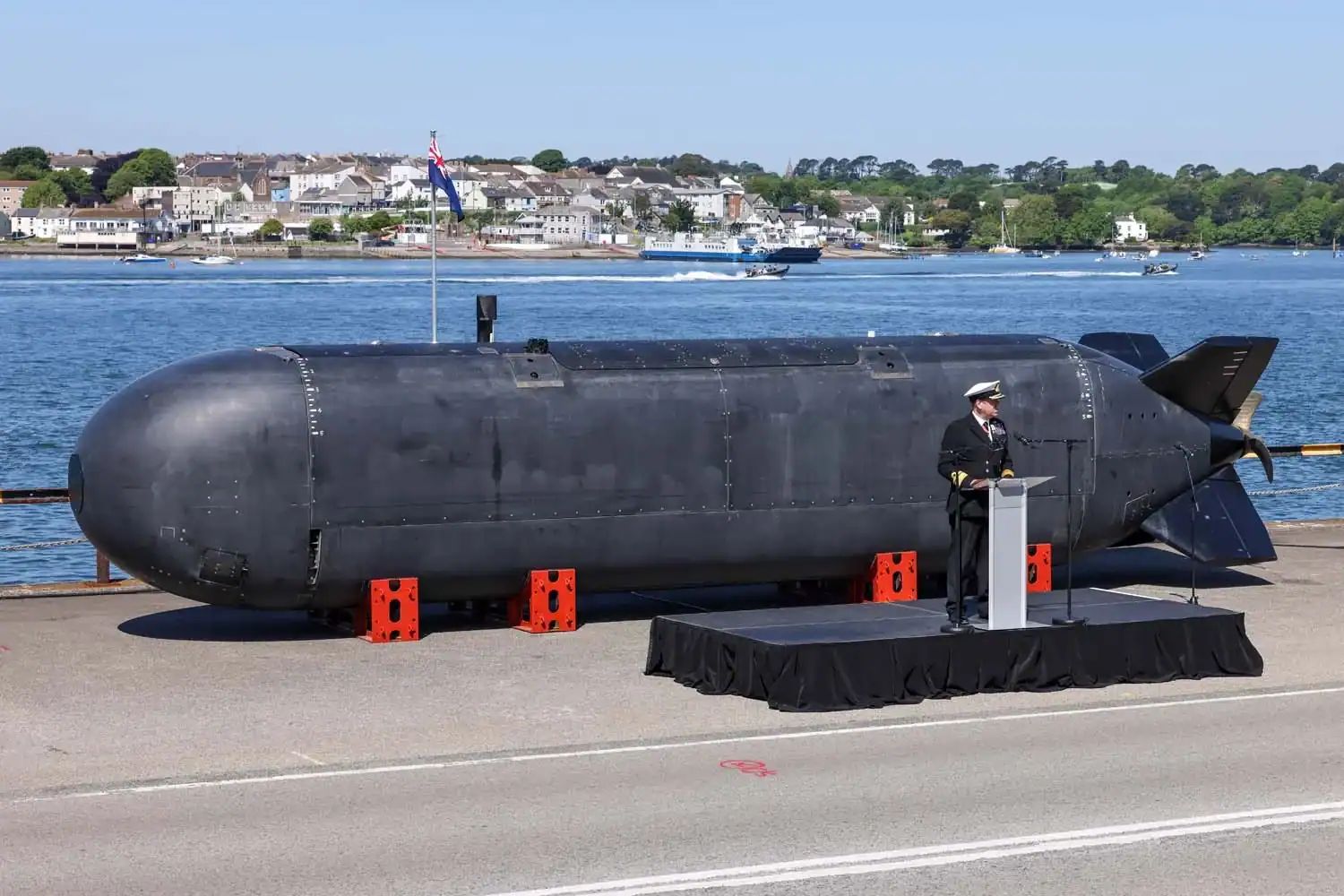
MSubs XV Excalibur is an experimental extra-large uncrewed underwater vehicle (XLUUV) developed under the Royal Navy's Project CETUS. The 12 m, 19-tonne vessel is intended as a technology demonstrator rather than an operational submarine.
MSubs developed the vehicle over roughly three years and delivered it to the Royal Navy in 2025. It was unveiled and named XV Excalibur at HMNB Devonport on 15 May 2025 after harbour and sea acceptance trials.
Excalibur serves as a testbed for autonomous undersea operations, intelligence, surveillance and reconnaissance, stealth-oriented missions, and modular payload integration. In September 2026 it became the platform for a proof-of-concept launch of a U.S. Mk 48 heavyweight torpedo.
Development and trials
After its 2025 unveiling, Excalibur joined the Royal Navy's Fleet Experimentation Squadron under the Disruptive Capabilities and Technologies Office. The vehicle was assigned to experimental work intended to inform future combinations of crewed and uncrewed naval systems.
Project Broadsword was approved in February 2026 and was executed in less than seven months. On 13 September 2026, Excalibur launched a U.S. Mk 48 Heavyweight Torpedo at the British Underwater Test and Evaluation Centre in Scotland during a proof-of-concept activity associated with Project Broadsword and Trial Iron. The demonstration supported AUKUS Pillar 2 work on interoperable payload systems for U.S., British and Australian uncrewed underwater vehicles.
The trial validated the mechanical, electrical and software integration required to connect a U.S. kinetic payload with an allied autonomous underwater vehicle. It demonstrated weapon interchangeability at the proof-of-concept level but did not make Excalibur an operational armed submarine.
Design
Excalibur is 12 m long, 2 m wide and displaces 19 tonnes. Its structure is divided into ten modular sections intended to simplify access to equipment and reduce maintenance downtime during experimental work.
Payload system
The vehicle has a large central payload bay built around a carbon-fibre chassis. The bay can accommodate up to 5 tonnes of payload mass and provides approximately 9 cubic metres of payload volume. Its modular arrangement is intended to support trials of different sensors and mission equipment.
Excalibur is not fitted with conventional torpedo tubes. The central payload bay has openings at the top and bottom, but the Mk 48 heavyweight torpedo is too long to fit within the standard bay. Imagery of the September 2026 demonstration indicates that the torpedo was carried in an external cradle beneath the vehicle for the launch trial.
Propulsion and electrical systems
MSubs designed the battery system in-house. Its engineers also designed the main motor, while other components were produced by suppliers in the United Kingdom. Detailed endurance, speed, operating depth and propulsion-output figures have not been disclosed in the supplied material.
Program status
XV Excalibur remains an experimental Royal Navy platform and is not assigned operational duties. Its role is to test autonomous underwater technologies, sensors, payloads and concepts that may influence future uncrewed undersea systems.
Following the Mk 48 demonstration, AUKUS partners planned further work under Project Cutlass using the Anduril Dive-XL platform. That follow-on effort is intended to examine advanced payload integration data, command-and-control architectures and tactical employment concepts rather than convert Excalibur itself into an operational combat platform.
Operators
- Royal Navy: Operates XV Excalibur as an experimental XLUUV and technology demonstrator within the Fleet Experimentation Squadron.
Specifications (XV Excalibur)
General characteristics
- Type: Experimental extra-large uncrewed underwater vehicle
- Length: 12 m
- Width: 2 m
- Displacement: 19 tonnes
- Modular sections: 10
Payload
- Maximum payload mass: 5 tonnes
- Payload volume: approximately 9 m³
- Payload bay structure: carbon-fibre chassis with upper and lower access
- Demonstrated weapon payload: U.S. Mk 48 Heavyweight Torpedo, launched in a September 2026 proof-of-concept trial using an external carriage arrangement
 Argentina
 Armenia
 Australia
 Austria
 Austria-Hungary
 Belgium
 Brazil
 United States
 Brunei
 Bulgaria
 Canada
 Chile
Chile China
China Colonial America
 Colombia
 Confederate States
 Croatia
 Czech
Czech Denmark
 Egypt
Egypt Finland
 France
 Georgia
 Germany
 German Imperial
 Greece
 Holland
 Hungary
 India
India Indonesia
 Iran
Iran Iraq
Iraq Ireland
 Israel
 Italy
Italy Japan
Japan Japan (1940)
 Jordan
 Kingdom of Italy
 Malaysia
 Mexico
 Myanmar
 Nazi Germany
 Netherlands
 New Zealand
 North Korea
 Norway
 Pakistan
 Peru
Peru Philippines
 Poland
 Portugal
 Prussia
 Romania
 Russia
 Saudi Arabia
 Serbia
 Singapore
 Slovakia
 Slovenia
 South Africa
 South Korea
 Soviet Union
 Spain
Spain Sweden
 Switzerland
 Syria
Syria Taiwan
 Thailand
 Turkey
 UAE
UAE Ukraine
 Vietnam
 Yugoslavia