
History
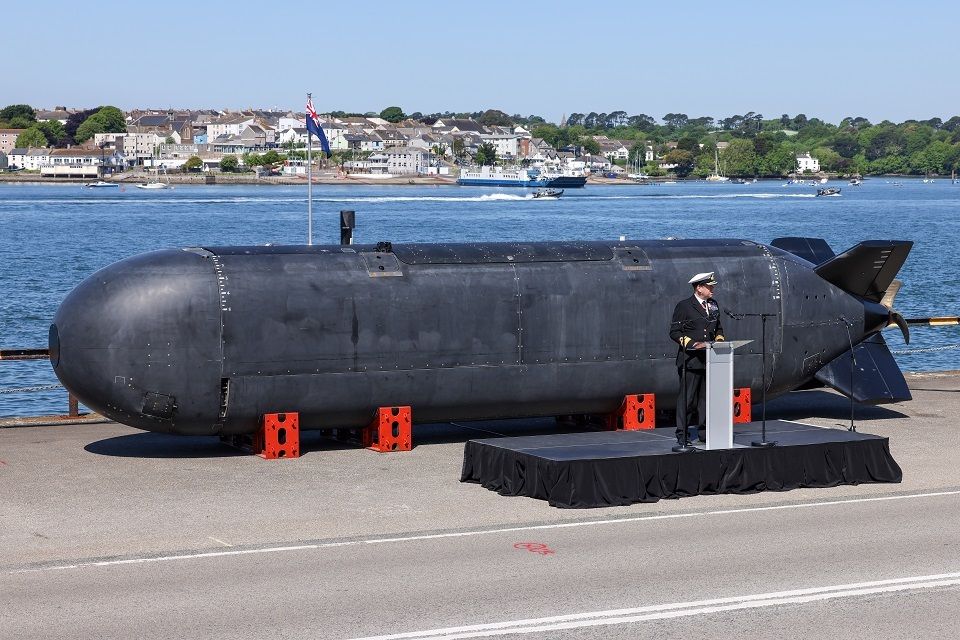
XV Excalibur is a British experimental Extra-Large Uncrewed Underwater Vehicle developed under Project Cetus for the Royal Navy. The 12-metre, 19-tonne vessel was built by MSubs in Plymouth as a technology demonstrator for large autonomous underwater systems, military payloads and new methods of operating crewed and uncrewed naval platforms together.
Excalibur is not an operational combat submarine. Its role is to provide a full-scale test platform for underwater autonomy, surveillance, payload integration, remote command, navigation technology and other concepts that could be incorporated into future Royal Navy and AUKUS systems.
The vehicle became an important AUKUS experimental platform in 2025 and 2026. Tests included remote control from Australia while operating in British waters and, on 13 September 2026, the first joint UK-US launch of a heavyweight torpedo from an uncrewed underwater vehicle.
Project Cetus
Project Cetus began in 2022 and brought together the UK Submarine Delivery Agency, the Royal Navy and MSubs. The programme was intended to build confidence in autonomous underwater technology and provide a testbed for military missions and payloads. Development took less than three years.
Excalibur was first launched at Turnchapel Wharf in Plymouth in February 2025. The vessel subsequently underwent Harbour Acceptance Trials and Sea Acceptance Trials in Devonport. It was formally named and unveiled at HMNB Devonport in May 2025.
The Submarine Delivery Agency announced the formal handover of Excalibur to the Royal Navy in December 2025. The programme then entered an extended period of sea trials and experimentation intended to examine the opportunities and limitations associated with operating an uncrewed underwater vehicle of this size.
AUKUS experimentation
During Exercise Talisman Sabre in August 2025, the Royal Navy demonstrated long-distance command interoperability with Excalibur. Personnel at a remote operating centre in Australia controlled the vehicle while it operated in British waters more than 16,000 km away. The activity formed part of AUKUS Pillar 2 work on advanced capabilities and demonstrated the transfer of control of a large autonomous underwater system across national command infrastructure.
Excalibur also carried a Tiqker quantum optical atomic clock during an underwater trial. The experiment examined technology intended to provide highly stable timing for navigation when a submerged vehicle cannot continuously rely on satellite navigation signals.
Heavyweight torpedo trial
On 13 September 2026, XV Excalibur launched a US Mk 48 heavyweight torpedo during a proof-of-concept trial at the British Underwater Test and Evaluation Centre in Scotland. The test was conducted under Project Broadsword and Trial Iron as part of AUKUS Pillar 2 cooperation between the United Kingdom and United States.
The demonstration validated mechanical, electrical and software integration of a US weapon with the British autonomous underwater platform. It represented the first joint UK-US heavyweight torpedo launch from an uncrewed underwater vehicle. The available evidence identifies the weapon as an Mk 48 heavyweight torpedo but does not establish the exact modification used.
The precise carriage arrangement has not been publicly confirmed. Excalibur has a central payload area with upper and lower access doors, but the demonstrated torpedo integration may have used additional experimental mounting hardware. The trial established weapon carriage and release from the vehicle without demonstrating autonomous authority to select or engage a target.
Project Broadsword was approved in February 2026 and executed in less than seven months. The programme involved the US Department of the Navy Rapid Capabilities Office, US Navy organizations, the Royal Navy, the Defense Innovation Unit and industry partners. Follow-on AUKUS work is planned under Project Cutlass using the Anduril Dive-XL platform to investigate additional payload integration, command-and-control architectures and tactical employment concepts.
Design
XV Excalibur is an Extra-Large Uncrewed Underwater Vehicle with a length of 12 metres, a diameter of approximately 2.2 metres and a displacement of about 19 tonnes. Its size provides substantially more endurance and payload volume than smaller autonomous underwater vehicles while remaining uncrewed.
The vessel was designed as a modular experimental platform rather than as a production combat submarine. Its architecture supports trials of autonomous control, sensors, bespoke payloads and interfaces for future underwater systems. The Royal Navy has used it to investigate intelligence, surveillance and reconnaissance missions, long-endurance underwater operations and concepts associated with seabed warfare.
Payloads and weapons
A large payload section allows Excalibur to carry experimental equipment and mission payloads. The platform has been used to assess how large uncrewed underwater vehicles could transport sensors and other systems into denied or contested areas.
The September 2026 trial extended this experimental role to heavyweight weapon integration. A US Mk 48 torpedo was mechanically, electrically and digitally integrated with the vehicle and successfully released during the test. Excalibur remains a demonstrator, and the test does not establish a standard operational armament fit.
Control and autonomy
Excalibur is intended to examine both autonomous operation and remote control. Its participation in Talisman Sabre demonstrated that command of the vehicle could be exercised from an operating centre on another continent while the craft remained in British waters. This work supports AUKUS efforts to develop compatible control architectures and common procedures for allied uncrewed systems.
Underwater autonomy imposes particular requirements for navigation, communications and mission management because submerged vehicles cannot maintain continuous high-bandwidth communications or uninterrupted access to satellite navigation. Trials with the Tiqker atomic clock examined one method of improving timing stability for navigation during prolonged submerged operations.
Program status
XV Excalibur remains an experimental Royal Navy vehicle rather than an operational combat asset. Its test programme is intended to generate technical and operational knowledge for future large autonomous underwater systems and for cooperation between crewed submarines and uncrewed vehicles.
AUKUS experimentation has expanded the programme from basic autonomy and remote control to allied payload integration and heavyweight weapon release. Work associated with AUKUS is also examining common payloads, command architectures and interfaces that could allow equipment to be transferred between different national uncrewed underwater vehicle types.
Operator
- United Kingdom: Royal Navy. XV Excalibur is operated as an experimental XLUUV and technology demonstrator.
Specifications (XV Excalibur)
General characteristics
- Type: Extra-Large Uncrewed Underwater Vehicle
- Role: Experimental autonomous underwater technology and payload demonstrator
- Length: 12 m
- Diameter: approximately 2.2 m
- Displacement: approximately 19 tonnes
- Crew: Uncrewed
- Builder: MSubs, Plymouth
- Programme: Project Cetus
Payload and armament trials
- Payload provision: Modular payload area for experimental sensors and mission equipment
- Demonstrated weapon: US Mk 48 heavyweight torpedo, launched during the September 2026 AUKUS trial
 Argentina
 Armenia
 Australia
 Austria
 Austria-Hungary
 Belgium
 Brazil
 United States
 Brunei
 Bulgaria
 Canada
 Chile
Chile China
China Colonial America
 Colombia
 Confederate States
 Croatia
 Czech
Czech Denmark
 Egypt
Egypt Finland
 France
 Georgia
 Germany
 German Imperial
 Greece
 Holland
 Hungary
 India
India Indonesia
 Iran
Iran Iraq
Iraq Ireland
 Israel
 Italy
Italy Japan
Japan Japan (1940)
 Jordan
 Kingdom of Italy
 Malaysia
 Mexico
 Myanmar
 Nazi Germany
 Netherlands
 New Zealand
 North Korea
 Norway
 Pakistan
 Peru
Peru Philippines
 Poland
 Portugal
 Prussia
 Romania
 Russia
 Saudi Arabia
 Serbia
 Singapore
 Slovakia
 Slovenia
 South Africa
 South Korea
 Soviet Union
 Spain
Spain Sweden
 Switzerland
 Syria
Syria Taiwan
 Thailand
 Turkey
 UAE
UAE Ukraine
 Vietnam
 Yugoslavia