
History
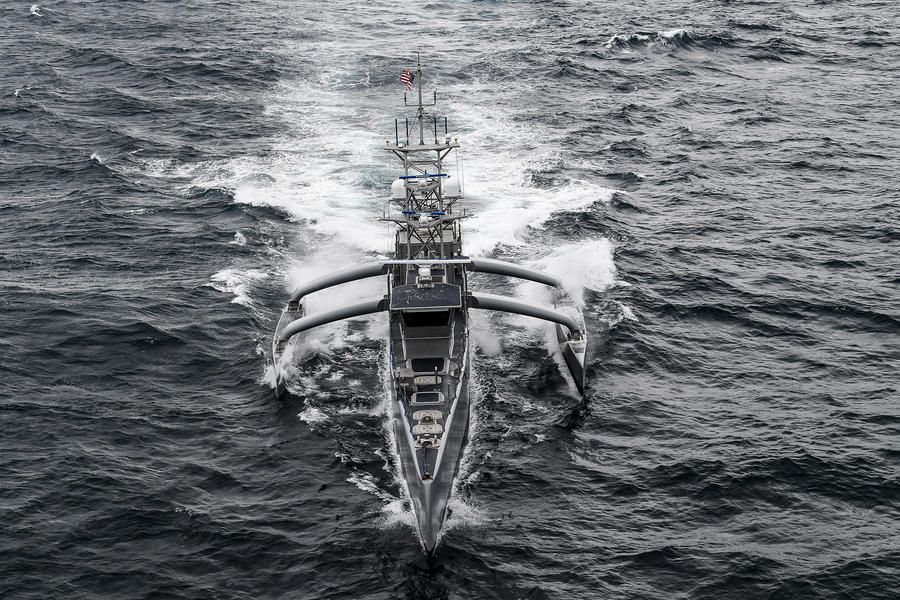
Seahawk is an autonomous medium unmanned surface vessel developed in the United States as a prototype for long-range unmanned maritime operations. The vessel was built by Leidos and originated from work led by the Defense Advanced Research Projects Agency and the Office of Naval Research.
Seahawk and the related Sea Hunter are used by the U.S. Navy for research, experimentation, and fleet integration of unmanned surface vessels. Their roles include operation as distributed sensor platforms supporting maritime domain awareness and anti-submarine warfare.
The vessel is approximately 41 m long and has a full-load displacement of about 142.3 metric tonnes. Seahawk was transferred to the U.S. Navy in 2021 and has subsequently participated in exercises and operational experimentation, including tests of at-sea refueling.
Development and transfer
Seahawk was developed as a purpose-built unmanned maritime platform for testing autonomous vessel technologies and demonstrating long-range, high-endurance unmanned operations. The program was associated with DARPA and the Office of Naval Research before the vessel was transferred to the U.S. Navy in 2021.
The Navy has used Seahawk alongside Sea Hunter as a prototype to study how unmanned surface vessels can be employed in naval operations and integrated with conventional fleet units. Both vessels have provided practical experience with autonomous operations and distributed sensing.
Fleet experimentation
Seahawk has participated in U.S. Navy fleet exercises, including RIMPAC 2022 and Integrated Battle Problem 23.1 and 23.2. These activities supported experimentation with unmanned vessels operating alongside crewed naval forces.
In April 2026, Seahawk participated in an astern refueling trial with the fleet replenishment oiler USNS Guadalupe. The procedure required personnel to board the unmanned vessel during refueling, illustrating one of the practical challenges associated with sustaining an otherwise uncrewed platform at sea.
On September 11, 2026, the guided-missile destroyer USS Chafee refueled Seahawk at sea. The event continued U.S. Navy work on procedures for sustaining unmanned surface vessels without requiring them to return to port.
Design
Seahawk is a medium unmanned surface vessel designed around autonomous, long-duration operation. It was built as an experimental platform rather than as a conventional crewed warship. Its development emphasized testing unmanned maritime technologies, autonomous navigation, fleet integration, and endurance.
The vessel can function as a distributed sensor platform supporting crewed ships. Its stated mission applications include extending the fleet's operational view, contributing to maritime domain awareness, and supporting anti-submarine warfare.
Although Seahawk normally operates without a permanent crew, current at-sea refueling procedures may require personnel to board the vessel. This requirement introduces safety and design considerations because personnel must sometimes be transferred to the unmanned platform in potentially difficult sea and wind conditions.
Program status
Seahawk remains an experimental and fleet-integration platform used by the U.S. Navy to develop concepts for future unmanned surface vessels. Together with Sea Hunter, it provides operational experience with autonomous vessels and supports development of tactics, procedures, and integration methods for unmanned systems within the fleet.
The Navy has also been evaluating at-sea sustainment procedures for unmanned vessels. The 2026 refueling trials with USNS Guadalupe and USS Chafee demonstrated practical methods for replenishing Seahawk while also highlighting the need to reduce or eliminate personnel involvement in future unmanned refueling operations.
Specifications (Seahawk)
General characteristics
- Type: Medium unmanned surface vessel
- Builder: Leidos
- Length: approximately 41 m (135 ft)
- Full-load displacement: approximately 142.3 metric tonnes
- Operating organization: U.S. Navy
- Primary experimental roles: autonomous operations, distributed sensing, maritime domain awareness, anti-submarine warfare support, and unmanned surface vessel fleet integration
 Argentina
 Armenia
 Australia
 Austria
 Austria-Hungary
 Belgium
 Brazil
 United Kingdom
 Brunei
 Bulgaria
 Canada
 Chile
Chile China
China Colonial America
 Colombia
 Confederate States
 Croatia
 Czech
Czech Denmark
 Egypt
Egypt Finland
 France
 Georgia
 Germany
 German Imperial
 Greece
 Holland
 Hungary
 India
India Indonesia
 Iran
Iran Iraq
Iraq Ireland
 Israel
 Italy
Italy Japan
Japan Japan (1940)
 Jordan
 Kingdom of Italy
 Malaysia
 Mexico
 Myanmar
 Nazi Germany
 Netherlands
 New Zealand
 North Korea
 Norway
 Pakistan
 Peru
Peru Philippines
 Poland
 Portugal
 Prussia
 Romania
 Russia
 Saudi Arabia
 Serbia
 Singapore
 Slovakia
 Slovenia
 South Africa
 South Korea
 Soviet Union
 Spain
Spain Sweden
 Switzerland
 Syria
Syria Taiwan
 Thailand
 Turkey
 UAE
UAE Ukraine
 Vietnam
 Yugoslavia