
History
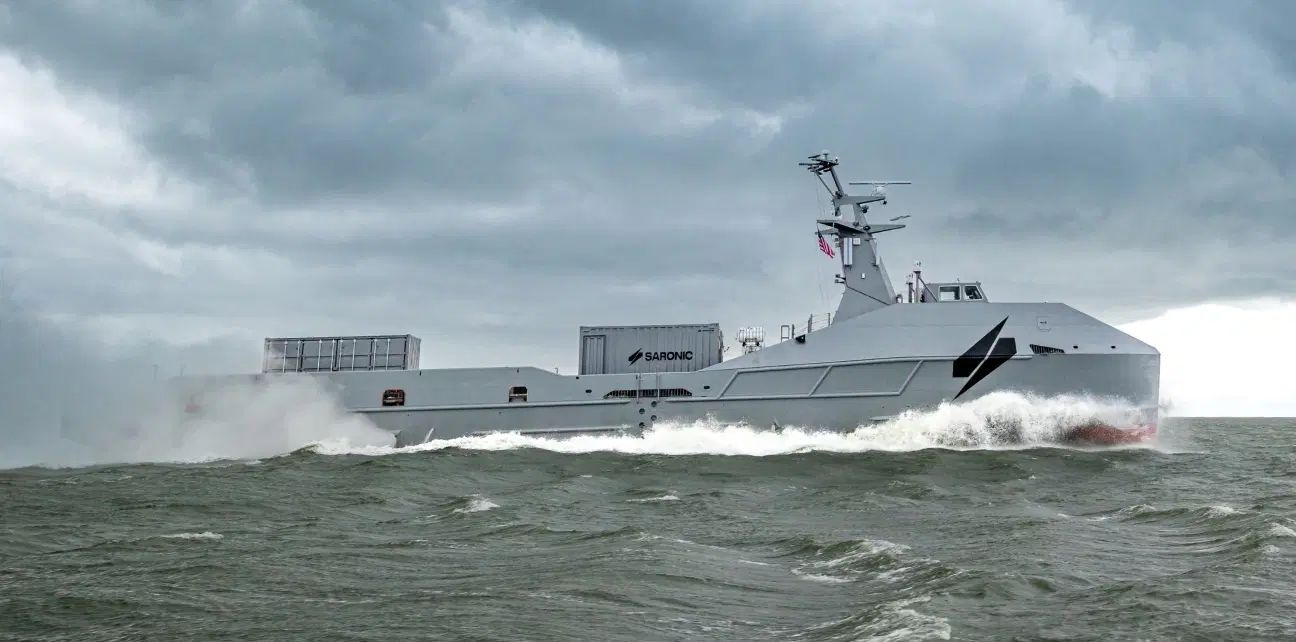
The Saronic Marauder is an American medium unmanned surface vessel developed for long-range naval, government, research, and commercial missions. It can operate autonomously or under remote human supervision without an onboard crew.
The vessel has an aluminum hull measuring 54.9 m (180 ft) in length. Its modular payload area can carry up to 150 tonnes and accommodate standard ISO containers.
Saronic developed and built the first Marauder at its shipyard in Franklin, Louisiana. The vessel progressed from its initial design to launch and on-water trials in less than one year.
Development and launch
The keel of the first Marauder was reportedly laid in August 2025. Saronic integrated ship design, manufacturing, and autonomy development at the Franklin facility. The company used modular construction, production-oriented subassemblies, and commercial off-the-shelf components to shorten construction time and support repeatable production.
The first Marauder was launched in late May 2026. The launch marked the beginning of on-water trials, as reported by WorkBoat. At that time, a second hull had been completed and was receiving mechanical, electrical, and autonomy systems. Third and fourth vessels were also under construction.
Testing
By August 2026, Saronic was operating the first vessel for more than 12 hours per day, seven days per week. The trials examined autonomous operation at extended range and under changing environmental conditions. According to the sea-trial report, the company used this intensive schedule to test the reliability of the vessel and its autonomy system.
The United States Department of the Navy selected Saronic as one of seven companies advancing to the at-sea testing stage of the Medium Unmanned Surface Vessel Marketplace. This initiative evaluates available unmanned maritime platforms. The selection did not constitute a Marauder production contract.
Design
Hull and payload arrangement
Marauder uses an aluminum hull intended for extended operations far from shore. Its payload space supports modular mission equipment without requiring changes to the underlying vessel platform. The maximum stated payload is 150 tonnes.
The payload area can accommodate as many as four 12.2 m (40 ft) ISO containers or eight 6.1 m (20 ft) ISO containers. Possible payloads and missions include logistics support, resupply, maritime domain awareness, intelligence, surveillance and reconnaissance, communications relay, scientific research, seabed monitoring, and decoy operations.
Autonomy and supervision
The vessel is designed to sail fully autonomously or under remote human supervision. Saronic's software-based fleet intelligence system presents operators with vessel telemetry, subsystem status, operating conditions, and mission information. It also permits remote intervention when required.
The management software records operational information and supports alerts, logging, troubleshooting, and historical playback. These functions provide human oversight while the onboard autonomy system controls the vessel during uncrewed operation.
Program status
As of August 2026, the first Marauder remained in on-water testing and had not entered operational service. No production contract for the vessel had been reported. Additional hulls were nevertheless in different stages of construction and outfitting at Franklin.
Saronic was expanding the Franklin shipyard with a stated goal of reaching capacity for up to 20 Marauder vessels per year by the end of 2026. This figure represented planned manufacturing capacity rather than confirmed annual orders or deliveries.
Specifications (Marauder)
General characteristics
- Type: Medium unmanned surface vessel
- Length: 54.9 m (180 ft)
- Hull material: Aluminum
- Onboard crew: None during uncrewed operation
- Control: Autonomous operation or remote human supervision
- Maximum payload: 150 tonnes
- Container capacity: Up to four 12.2 m (40 ft) ISO containers or eight 6.1 m (20 ft) ISO containers
Performance
- Maximum speed: More than 25 knots (46 km/h)
- Maximum stated range: Up to 5,400 nautical miles (10,000 km) at 12 knots with a 25-tonne payload
- Reported range at maximum payload: Approximately 4,100 nautical miles (7,600 km)
 Argentina
 Armenia
 Australia
 Austria
 Austria-Hungary
 Belgium
 Brazil
 United Kingdom
 Brunei
 Bulgaria
 Canada
 Chile
Chile China
China Colonial America
 Colombia
 Confederate States
 Croatia
 Czech
Czech Denmark
 Egypt
Egypt Finland
 France
 Georgia
 Germany
 German Imperial
 Greece
 Holland
 Hungary
 India
India Indonesia
 Iran
Iran Iraq
Iraq Ireland
 Israel
 Italy
Italy Japan
Japan Japan (1940)
 Jordan
 Kingdom of Italy
 Malaysia
 Mexico
 Myanmar
 Nazi Germany
 Netherlands
 New Zealand
 North Korea
 Norway
 Pakistan
 Peru
Peru Philippines
 Poland
 Portugal
 Prussia
 Romania
 Russia
 Saudi Arabia
 Serbia
 Singapore
 Slovakia
 Slovenia
 South Africa
 South Korea
 Soviet Union
 Spain
Spain Sweden
 Switzerland
 Syria
Syria Taiwan
 Thailand
 Turkey
 UAE
UAE Ukraine
 Vietnam
 Yugoslavia