
History
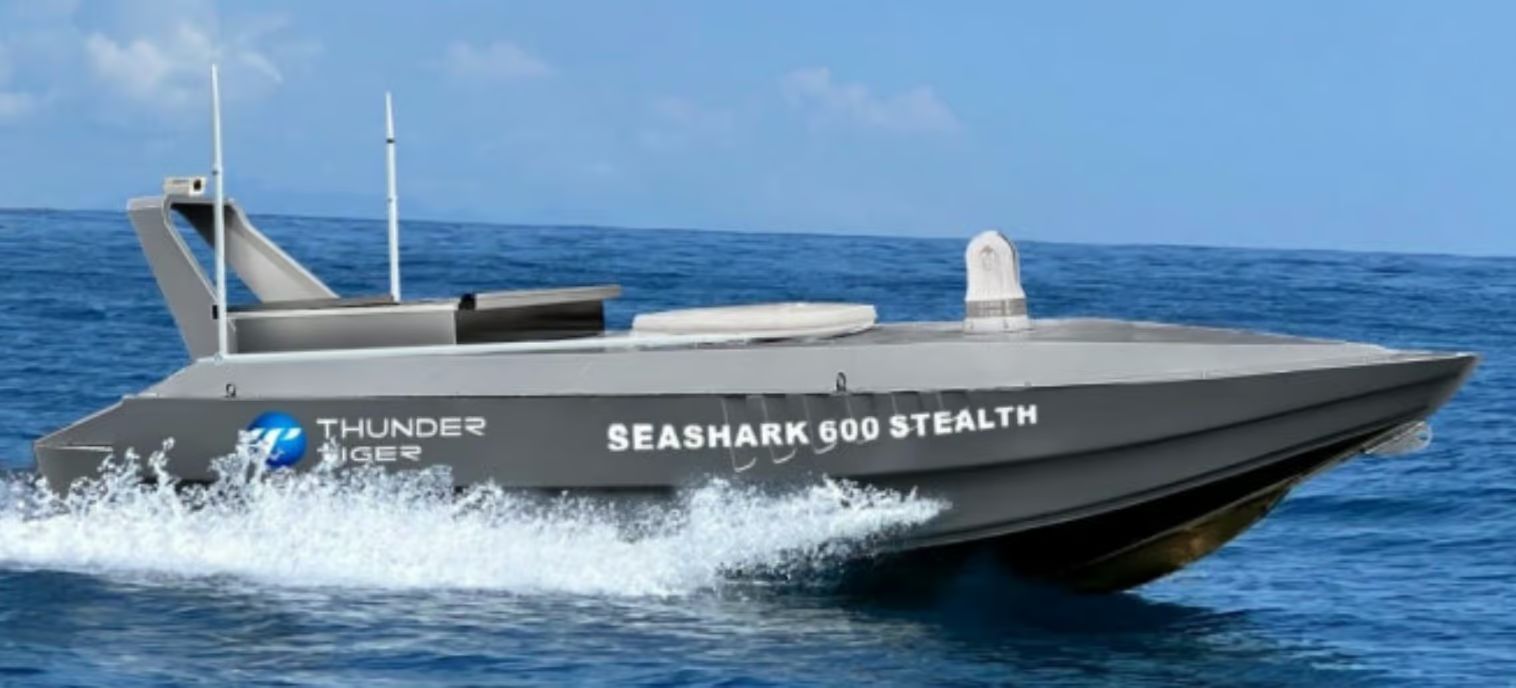
The Thunder Tiger SeaShark is a Taiwanese family of unmanned surface vessels developed for maritime surveillance and other remotely operated or autonomous missions. Known models include the SeaShark 400, SeaShark 600, and SeaShark 800.
The family ranges from the 4 m SeaShark 400 to the larger SeaShark 800. Available configurations use cameras, maritime radar, imagery, and Automatic Identification System data according to the mission and installed equipment.
In July 2026, a SeaShark 600 and SeaShark 800 demonstrated coordinated maritime operations with Shield AI's Hivemind autonomy software. The vessels autonomously searched an assigned area, identified a target vessel, and coordinated an escort maneuver.
Development
Thunder Tiger introduced the SeaShark 400 in Taiwan in 2023. The company was operating from the Ocean Tech Hub in Kaohsiung and working with the Metal Industries Research and Development Centre's IVC Laboratory on artificial-intelligence technology for unmanned vehicles. The 4 m craft was presented as a remotely managed platform capable of transmitting live camera footage. Contemporary specifications were reported by Army Recognition.
The larger SeaShark 800 was unveiled in April 2025. It was described as an 8.1 m vessel with a low-radar-cross-section hull, a full displacement of 2.7 tonnes, a stated range of 600 km, and a maximum speed above 50 knots.
In February 2026, Shield AI received a contract from Taiwan's National Chung-Shan Institute of Science and Technology covering the Hivemind software development kit for indigenous platforms and turnkey Hivemind integration for multi-role unmanned systems. Shield AI and Thunder Tiger then signed an agreement on 13 May 2026 to explore integration of Hivemind with Thunder Tiger's unmanned systems.
Autonomy integration and testing
The companies progressed through simulation, hardware-in-the-loop testing, and live-vehicle work. Integration onto the SeaShark vessels was completed in approximately six weeks. On 29 July 2026, they conducted a live demonstration at Dapeng Bay in Pingtung County. Personnel from the National Chung-Shan Institute of Science and Technology and Taiwan's Coast Guard Administration attended the event.
A SeaShark 600 and SeaShark 800 participated in the test. Hivemind divided the search area into two sectors, assigned a vessel to each sector, generated mission waypoints, and coordinated the onboard sensors. After one vessel detected the crewed target, the platforms shared tracking information and the second vessel approached along a calculated interception route. The two craft then escorted the target from the designated zone without direct human navigation. The test area covered approximately 2 km², according to the account published by Quwa.
The companies described the event as Hivemind's first multi-platform autonomous teaming demonstration on water and its first integration of maritime radar and AIS. Accounts of the demonstration were also published by Naval News and Army Recognition.
Design
The SeaShark family consists of unmanned surface craft of different sizes. The available sources do not establish a common hull, propulsion system, or payload specification for every model. The SeaShark 400 is a compact remotely controlled platform, while the SeaShark 800 is a larger design with a hull intended to reduce radar signature.
Mission equipment
The SeaShark 400 carries a camera capable of transmitting live imagery. The 2026 SeaShark 600 and SeaShark 800 demonstration used maritime radar, imagery, and AIS information. Hivemind combined these inputs into a shared maritime picture used by both vessels.
Autonomy
Hivemind provides mission-level autonomy rather than only following a fixed remotely controlled route. During the 2026 test, the software planned waypoints, allocated search sectors, processed sensor information, shared target data, and coordinated vessel movements. An operator supplied the overall mission objective, while the vessels conducted the demonstrated navigation and coordination tasks autonomously.
A report distributed through The Military Channel stated that a five-vessel group using autonomous route planning could search more than eight times the area covered by conventional patrol methods. This figure was not demonstrated by the two-vessel Dapeng Bay trial.
Program status
The July 2026 activity was a technology demonstration involving two SeaShark variants. The available evidence does not establish that a Hivemind-equipped SeaShark fleet has entered operational service or that it has received authorization for autonomous weapon employment.
Shield AI and Thunder Tiger plan to continue development through open-ocean trials, larger vessel teams, additional sensor integration, and more advanced autonomous behavior. These future tests are intended to examine operation beyond the protected demonstration area. Available reports identify endurance, collision avoidance, sensor performance, communications resilience, behavior in heavy seas, and operation in contested electromagnetic conditions as areas requiring further evaluation.
Variants
- SeaShark 400: A 4 m remotely managed unmanned surface vessel introduced in 2023. It carries a camera for transmitting live imagery.
- SeaShark 600: An unmanned surface vessel used with the SeaShark 800 during the July 2026 Hivemind maritime teaming demonstration. Detailed dimensions and performance figures were not supplied.
- SeaShark 800: A larger 8.1 m unmanned surface vessel unveiled in April 2025. It has a stated low-radar-cross-section hull and participated in the 2026 autonomous teaming demonstration.
Specifications (SeaShark 400)
General characteristics
- Length: 4 m
- Control: Remote operation
- Mission equipment: Camera with real-time video transmission
Performance
- Maximum speed: 65 km/h
- Range: 300 km
Specifications (SeaShark 800)
General characteristics
- Length: 8.1 m
- Full displacement: 2.7 tonnes
- Hull: Low-radar-cross-section design
Performance
- Maximum speed: More than 50 knots
- Range: 600 km
 Argentina
 Armenia
 Australia
 Austria
 Austria-Hungary
 Belgium
 Brazil
 United Kingdom
 United States
 Brunei
 Bulgaria
 Canada
 Chile
Chile China
China Colonial America
 Colombia
 Confederate States
 Croatia
 Czech
Czech Denmark
 Egypt
Egypt Finland
 France
 Georgia
 Germany
 German Imperial
 Greece
 Holland
 Hungary
 India
India Indonesia
 Iran
Iran Iraq
Iraq Ireland
 Israel
 Italy
Italy Japan
Japan Japan (1940)
 Jordan
 Kingdom of Italy
 Malaysia
 Mexico
 Myanmar
 Nazi Germany
 Netherlands
 New Zealand
 North Korea
 Norway
 Pakistan
 Peru
Peru Philippines
 Poland
 Portugal
 Prussia
 Romania
 Russia
 Saudi Arabia
 Serbia
 Singapore
 Slovakia
 Slovenia
 South Africa
 South Korea
 Soviet Union
 Spain
Spain Sweden
 Switzerland
 Syria
Syria Thailand
 Turkey
 UAE
UAE Ukraine
 Vietnam
 Yugoslavia