
History
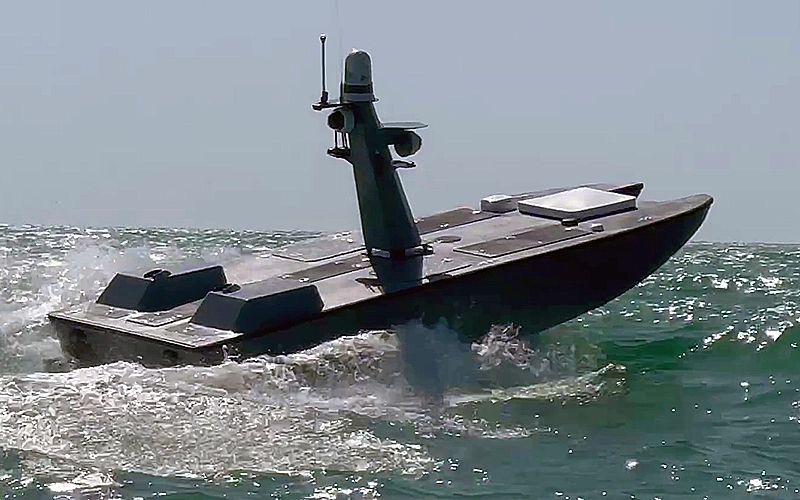
The MARTAC T38 Devil Ray is an American unmanned surface vessel developed by Maritime Tactical Systems Inc. as a medium member of the company's high-speed unmanned boat family. The 11.1 m craft combines a dual-sponson hull, modular payload architecture and selectable levels of operator and autonomous control.
The T38 has been used by U.S. Navy organizations for autonomous maritime testing, instrumentation and endurance demonstrations. Its supported mission set includes intelligence, surveillance and reconnaissance, maritime domain awareness, logistics support, electronic warfare, mine countermeasures and other modular-payload tasks.
In 2026 the vessel became the receiving platform for a U.S. Navy robotic at-sea refueling demonstration. The test was intended to address a major limitation of unmanned surface vessels by allowing them to replenish fuel without routinely returning to port.
Development
MARTAC announced its medium MANTAS vessel category in July 2020, including the T24, T38 and T50. A 2023 account of U.S. Navy testing identified the T38 as an American MARTAC unmanned surface vessel and described the 38-foot craft as part of this medium category.
The T38 evolved around a high-performance dual-sponson platform derived from designs associated with high-speed powerboats. Product information from BlueZone Group and Telestra Technologies describes a modular medium USV with inboard or outboard propulsion options, diesel or gasoline engines, high payload capacity and multiple autonomy modes.
The vessel architecture is intended to accept different payloads without requiring a new hull for each mission. Published descriptions identify applications including intelligence, surveillance and reconnaissance, electronic warfare, mine countermeasures, interdiction, subsurface sensor management and maritime logistics.
U.S. Navy testing
The T38 has been used in U.S. Navy experimentation with unmanned maritime operations. Reporting on testing in the Middle East in 2023 described the vessel as part of efforts to combine unmanned surface, aerial and underwater systems with remotely operated platforms during larger naval activities.
In May 2026, a Navy-owned T38 operated by the Naval Air Warfare Center Weapons Division Point Mugu Sea Range completed an eight-day autonomous mission off California. According to a Seapower report reproducing MARTAC information, the 192-hour demonstration was conducted without chase boats or escorts and included autonomous navigation around static and moving contacts.
The vessel averaged just over 4 knots during the endurance-focused mission and used short periods above 50 knots when higher speed was required. It also completed a deliberate two-day period of alternating single-engine operation approximately 400 nautical miles offshore. The test was intended to evaluate endurance and loiter performance rather than recover from a propulsion failure.
Sea conditions averaged Sea State 3 and reached Sea State 5. The vessel continued station keeping, data collection and mission execution during the trial. The demonstration also confirmed an operational range exceeding 2,400 nautical miles when the T38 was operated with a full fuel load under an endurance-focused profile.
Robotic at-sea refueling
On 11 August 2026, the U.S. Navy conducted a robotic at-sea refueling demonstration off Joint Expeditionary Base Little Creek-Fort Story in Virginia. The Navy-owned T38 was repeatedly captured, refueled and released through a towable capture and connection device developed by Sealartec.
The training support vessel USNS Vindicator, designated TSV 5, towed the refueling device while the T38 approached from astern. Across several days of work, including supporting trials, the team completed approximately 100 connection cycles and transferred a total of 400 U.S. gallons of fuel. An independent report on the demonstration also identifies the Naval Air Warfare Center Weapons Division Blue Water Instrumentation program, MARTAC and Sealartec as participants.
The Navy-industry team moved from concept development to at-sea testing in approximately seven months. The repeated connection cycles were used to evaluate capture geometry, vessel maneuvering, connection reliability and the ability to repeat the process under realistic sea conditions.
The demonstrated process was not yet fully autonomous. Approach and capture still included remote human control. The next stated milestone is an end-to-end autonomous sequence covering rendezvous, terminal approach, capture, fuel transfer, disconnection and return to mission. Development work is also focused on reducing command-and-control latency and improving local positioning accuracy for the terminal maneuver.
Design
Hull and structure
The T38 is approximately 11.1 m long and uses a dual-sponson catamaran-type hull. BlueZone describes the structure as carbon fiber with a gelcoat finish. The twin-hull layout provides a wide beam and reduced roll, characteristics that supported stable operation during the vessel's 2026 endurance demonstration in conditions reaching Sea State 5.
The hull is designed around high-speed operation while retaining enough payload volume for mission equipment. Published product material gives a maximum payload capacity of about 1,814 kg. The platform is also described as having shock-resistant internal architecture and a hull rated for loads up to 10 g.
Propulsion
The T38 can be configured with inboard or outboard propulsion and with diesel or gasoline engines. BlueZone identifies twin-screw inboard gasoline or diesel propulsion as one available configuration. The selectable powertrain allows the vessel to be tailored for different combinations of speed, endurance and payload.
Published performance figures vary with configuration. BlueZone lists cruise speeds of approximately 30 to 40 knots and burst speeds of approximately 60 to 80 knots in its specification data, while other MARTAC-associated descriptions state that some combinations of powertrain and payload can reach 70 to more than 100 knots. A more conservative 80-knot burst figure was also reported during earlier U.S. Navy coverage. Actual speed therefore depends on the installed propulsion system, payload and operating profile.
For conventional higher-speed operation, BlueZone lists a range of approximately 900 to 1,200 nautical miles at 25 knots. The 2026 endurance test demonstrated a different operating profile in which the vessel exceeded 2,400 nautical miles of operational range by emphasizing low-speed persistence and efficient propulsion management.
Autonomy and control
The T38 supports several control modes ranging from direct operator control to autonomous operation and shared control. The architecture can allow multiple operators to share control of the vessel and its payloads.
The platform uses an open interface intended to simplify integration with third-party command-and-control and common operational picture software. BlueZone product information lists four concurrent communications channels and redundant command-and-control, payload and communications modules.
The 2026 California endurance mission demonstrated continuous autonomous operation over eight days. During the voyage, the vessel navigated around static and moving contacts, maintained assigned stations and continued data collection without an escort vessel. The reported autonomy stack was described as compliant with the International Regulations for Preventing Collisions at Sea.
Payloads and missions
The T38's open architecture supports modular payload integration. The 1,814 kg maximum payload figure allows the vessel to carry comparatively large sensor or mission packages for its size.
Supported mission descriptions include intelligence, surveillance and reconnaissance, electronic warfare, mine countermeasures, maritime domain awareness, logistics support, interdiction and subsurface sensor management. Naval Air Warfare Center Weapons Division has also used the T38 as a distributed instrumentation platform for test and evaluation activities.
Blue Water Instrumentation is examining unmanned vessels for sensor coverage during hypersonic weapon and precision long-range fires testing. Such weapons can travel far beyond fixed test-range boundaries, requiring telemetry and tracking systems to be distributed across large ocean areas. A long-endurance T38 can act as a mobile sensor carrier along these extended test corridors.
Testing and demonstrations
The 2026 autonomous endurance mission and robotic refueling demonstration addressed two related aspects of persistent unmanned operations. The California mission showed that a T38 could remain autonomous at sea for eight days while operating hundreds of nautical miles offshore. The Virginia refueling experiment tested a way to extend such missions further by replenishing fuel without sending the USV back to port.
During the endurance test, the T38 intentionally operated at low average speed and temporarily alternated between engines to conserve fuel. During the later refueling demonstration, the vessel repeatedly approached and connected with a moving refueling device towed behind a support ship. These tests indicate that endurance is being addressed through both efficient vessel operation and external replenishment.
Robotic refueling remains under development. The August 2026 demonstration still depended on operator-assisted maneuvering, and the Navy's stated next step is a completely autonomous rendezvous-to-return-to-mission sequence. Until that milestone is demonstrated, the refueling capability should be regarded as an experimental sustainment system rather than a routine operational feature of the T38.
Specifications (T38 Devil Ray)
General characteristics
- Type: Unmanned surface vessel
- Manufacturer: Maritime Tactical Systems Inc. (MARTAC)
- Length: 11.1 m (38 ft)
- Hull: Carbon-fiber dual-sponson catamaran with gelcoat finish
- Maximum payload: Approximately 1,814 kg (4,000 lb)
- Powertrain options: Inboard or outboard; diesel or gasoline
- Inboard propulsion option: Twin-screw diesel or gasoline engines
- Communications: Four concurrent communications channels
Performance
- Cruise speed: Approximately 30–40 knots in published BlueZone specification data
- Burst speed: Approximately 60–80 knots in published BlueZone specification data; higher figures are cited for some powertrain and payload configurations
- Published range: Approximately 900–1,200 nautical miles at 25 knots
- Demonstrated endurance-profile range: More than 2,400 nautical miles with full fuel capacity during the 2026 endurance demonstration
- Demonstrated autonomous endurance: 192 hours during the May 2026 California mission
- Demonstrated sea conditions: Sea State 3 average, reaching Sea State 5 during the 2026 endurance mission
Mission systems
- Control modes: Operator-controlled, autonomous and shared-control modes
- Architecture: Open and modular payload architecture with third-party command-and-control integration through an application programming interface
- Supported mission roles: Intelligence, surveillance and reconnaissance, maritime domain awareness, electronic warfare, mine countermeasures, logistics support, interdiction and subsurface sensor management
 Argentina
 Armenia
 Australia
 Austria
 Austria-Hungary
 Belgium
 Brazil
 United Kingdom
 Brunei
 Bulgaria
 Canada
 Chile
Chile China
China Colonial America
 Colombia
 Confederate States
 Croatia
 Czech
Czech Denmark
 Egypt
Egypt Finland
 France
 Georgia
 Germany
 German Imperial
 Greece
 Holland
 Hungary
 India
India Indonesia
 Iran
Iran Iraq
Iraq Ireland
 Israel
 Italy
Italy Japan
Japan Japan (1940)
 Jordan
 Kingdom of Italy
 Malaysia
 Mexico
 Myanmar
 Nazi Germany
 Netherlands
 New Zealand
 North Korea
 Norway
 Pakistan
 Peru
Peru Philippines
 Poland
 Portugal
 Prussia
 Romania
 Russia
 Saudi Arabia
 Serbia
 Singapore
 Slovakia
 Slovenia
 South Africa
 South Korea
 Soviet Union
 Spain
Spain Sweden
 Switzerland
 Syria
Syria Taiwan
 Thailand
 Turkey
 UAE
UAE Ukraine
 Vietnam
 Yugoslavia