
History
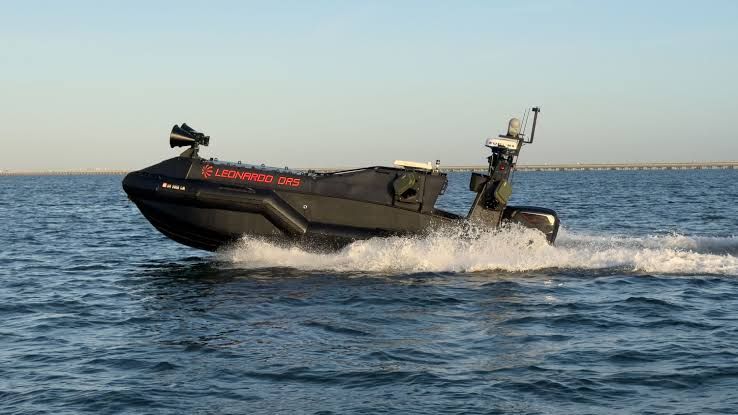
The Leonardo DRS Maritime-Mission Equipment Package, abbreviated M-MEP, is a maritime Counter-UAS system developed to detect, identify, track and defeat unmanned aerial systems threatening naval and other surface vessels. Leonardo DRS adapted technology from its ground-based counter-drone work for operation in the maritime environment.
The system uses a modular, open and scalable architecture intended to support different vessel sizes and mission requirements. Leonardo DRS describes the package as platform-agnostic and designed around integration of sensors, electronic warfare equipment and, when required, kinetic weapon systems.
Leonardo DRS publicly described the M-MEP in 2026 as part of its maritime C-UAS portfolio. The company's M-MEP product information presents the system as an adaptation of ground-based C-UAS technology for sea-based operations, particularly on autonomous unmanned surface vessels.
Development
The development approach centers on adapting existing Counter-UAS technology rather than creating a completely separate maritime architecture. Leonardo DRS states that its experience with Mission Equipment Package systems is used to integrate platform-independent combinations of sensors and effectors for unmanned surface vessels.
On 1 September 2026, Defence Blog reported that Leonardo DRS had packaged its maritime counter-drone capability as the Maritime-Mission Equipment Package. The report said the system was intended for manned or unmanned surface vessels measuring about 4.3 m (14 ft) or longer. Leonardo DRS's own material emphasizes autonomous vessel applications and scalable integration across different platform sizes.
Design
M-MEP is designed as an integrated maritime force-protection package rather than a single sensor or weapon. Leonardo DRS describes the architecture as modular, open and scalable, allowing different combinations of detection, tracking and engagement equipment to be selected according to platform size and mission requirements.
Sensors and detection
The detection layer can use active and passive radar systems together with electro-optical and infrared sensors. These sensors are intended to detect individual unmanned aircraft as well as multiple simultaneous low-flying threats. Leonardo DRS states that real-time processing and threat assessment support situational awareness and operator decision-making.
A secondary M-MEP product listing likewise describes radar and sensor integration for detection and tracking of aerial threats. Its description is broadly consistent with the manufacturer information on modular maritime Counter-UAS sensor integration.
Electronic warfare
Leonardo DRS describes non-kinetic configurations incorporating electronic warfare systems directed against GPS and 4G/5G-dependent drone functions. These systems are intended to disrupt or neutralize UAS guidance after a threat has been confirmed. Electronic warfare can provide repeated engagements without consuming kinetic ammunition.
Kinetic engagement
M-MEP can also be integrated with kinetic weapon systems. Leonardo DRS does not identify a single mandatory weapon in the supplied material, instead describing the package as adaptable to different kinetic effectors according to platform size and force-protection requirements. This modular approach is intended to permit later addition or replacement of weapon systems.
Automation and processing
Leonardo DRS states that machine learning and artificial intelligence can be incorporated for threat assessment and prediction. The company also identifies autonomous collaborative behavior as an element of its maritime Mission Equipment Package concept, although the supplied information does not define a specific autonomous engagement sequence for M-MEP.
Program status
As described in 2026, M-MEP was being presented by Leonardo DRS as a maritime Counter-UAS solution derived from its ground-based technology. The available sources describe integration on autonomous vessels and broader compatibility with surface-vessel platforms, but they do not provide a confirmed production quantity, formal service-entry date or named operational operator.
The design is intended to remain configurable as sensors, electronic warfare systems and kinetic effectors evolve. Leonardo DRS presents this modularity as a way to support different vessel sizes and changing Counter-UAS requirements without replacing the complete mission package.
Specifications (M-MEP)
General characteristics
- Type: Maritime Counter-UAS mission equipment package.
- Primary role: Detection, identification, tracking and defeat of unmanned aerial systems threatening surface vessels.
- Architecture: Open, modular, scalable and platform-agnostic mission equipment package.
- Platform compatibility: Designed for maritime surface vessels, with Leonardo DRS emphasizing autonomous unmanned surface vessels; secondary reporting states compatibility with manned and unmanned vessels from about 4.3 m (14 ft) in length.
- Detection equipment: Active and passive radars and electro-optical/infrared systems.
- Threat handling: Intended to detect individual UAS and multiple simultaneous threats.
Counter-UAS effectors
- Electronic warfare: GPS and 4G/5G-oriented non-kinetic electronic warfare systems.
- Kinetic capability: Modular integration of kinetic weapon systems when fitted.
- Processing: Real-time data processing and threat assessment, with Leonardo DRS describing integration of machine learning and artificial intelligence.
 Argentina
 Armenia
 Australia
 Austria
 Austria-Hungary
 Belgium
 Brazil
 United Kingdom
 Brunei
 Bulgaria
 Canada
 Chile
Chile China
China Colonial America
 Colombia
 Confederate States
 Croatia
 Czech
Czech Denmark
 Egypt
Egypt Finland
 France
 Georgia
 Germany
 German Imperial
 Greece
 Holland
 Hungary
 India
India Indonesia
 Iran
Iran Iraq
Iraq Ireland
 Israel
 Italy
Italy Japan
Japan Japan (1940)
 Jordan
 Kingdom of Italy
 Malaysia
 Mexico
 Myanmar
 Nazi Germany
 Netherlands
 New Zealand
 North Korea
 Norway
 Pakistan
 Peru
Peru Philippines
 Poland
 Portugal
 Prussia
 Romania
 Russia
 Saudi Arabia
 Serbia
 Singapore
 Slovakia
 Slovenia
 South Africa
 South Korea
 Soviet Union
 Spain
Spain Sweden
 Switzerland
 Syria
Syria Taiwan
 Thailand
 Turkey
 UAE
UAE Ukraine
 Vietnam
 Yugoslavia