
History
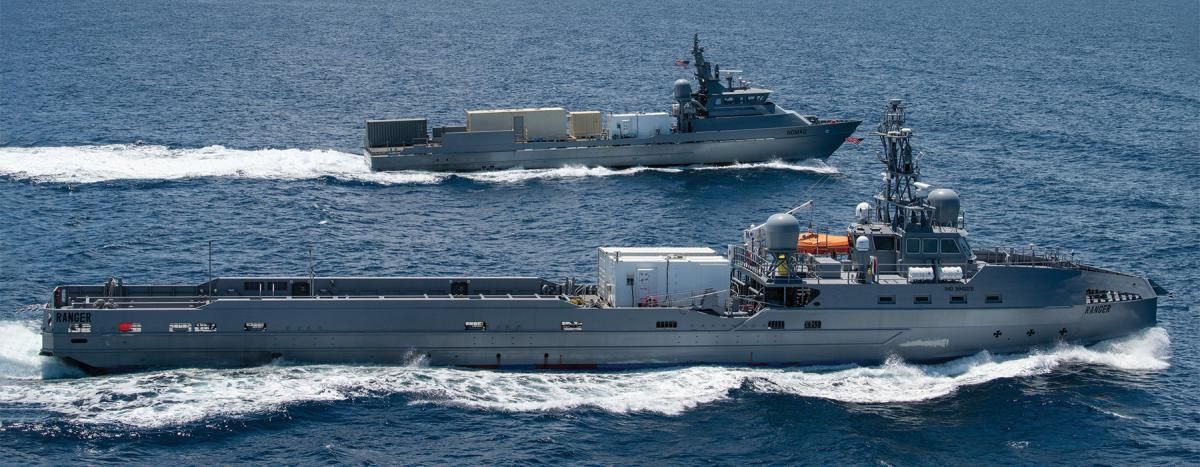
The Medium Unmanned Surface Vessel (MUSV) Family of Systems is a U.S. Navy program for autonomous vessels with interchangeable containerized payloads. It is intended to support several naval mission types rather than a single fixed role.
The Navy established the current MUSV acquisition program in March 2026 after ending the Modular Attack Surface Craft program. The service sought production-ready vessels that could demonstrate their performance at sea and proceed rapidly toward production or leasing.
Seven companies advanced to the at-sea evaluation phase: Sea Machines, Leidos, Saronic Technologies, Galliano Marine Services, PacMar Technologies, Birdon, and Huntington Ingalls Industries. The Navy planned to complete demonstrations before October 2026 and make vessels available for leasing or procurement in fiscal year 2027.
Development
The preceding Modular Attack Surface Craft program began in 2025. It concentrated on an unmanned vessel for a specific mission and a large containerized payload comparable in weight to the Mark 70 Mod 1 Payload Delivery System. The Navy replaced it with the broader MUSV Family of Systems because fleet requirements covered more missions and configurations.
The new program uses a marketplace acquisition model. Companies provide mature vessel designs, manufacturing plans, business plans, test plans, and technical information. The approach places responsibility for initial development and production readiness on industry while allowing the Navy to compare several vessels through practical demonstrations. The program announcement stated that successful participants could move to a fixed-price production or leasing arrangement after testing.
Prototype evaluation
Approximately two dozen proposals were reportedly submitted. The seven selected companies were instructed to demonstrate their systems at sea during 2026. Designs that satisfy the requirements may receive $15 million and become eligible for follow-on production. The prototype-phase report described the demonstrations as a test of system maturity before planned fiscal 2027 availability.
Blue Water Autonomy and Saildrone were not included among the seven companies. Both filed complaints in the U.S. Court of Federal Claims in July 2026. They alleged that the Navy had incorrectly evaluated their proposals and requested reinstatement in the competition. The Navy declined to discuss the pending litigation.
Design
MUSV is a performance-based family of vessels rather than one standardized hull from a single manufacturer. Competing companies may use different hull forms, propulsion systems, and autonomy equipment as long as their vessels satisfy the Navy's common requirements.
The design concept centers on modular payload capacity. Each vessel must accommodate at least two 40-foot shipping containers and carry a payload of up to 25 metric tons. Containerized equipment allows the vessel to be reconfigured without redesigning the complete platform. Reported mission categories include intelligence, surveillance and reconnaissance, strike support, and transport, although the equipment installed on individual production vessels has not been finalized.
Autonomous operation is a central requirement. Contractors must integrate the vessel systems and autonomy software needed for navigation and extended operation without an embarked crew. The Navy also expects the vessels to maintain the required speed, range, and payload performance in Sea State 4.
Program status
As of July 2026, MUSV remained in competitive evaluation and had not entered confirmed operational service. Sea testing was scheduled to conclude before October 2026. The first production vessel was expected in fiscal year 2027, subject to successful demonstrations and subsequent Navy production or leasing decisions.
The seven selected companies represent both established shipbuilders and specialist autonomy developers. Their designs remain separate candidates rather than confirmed production variants. A program overview identified the participants and reported that follow-on production eligibility would depend on the results of the 2026 testing period.
Specifications (MUSV program requirements)
General characteristics
- Type: Medium autonomous surface vessel family
- Payload capacity: Up to 25 metric tons
- Container capacity: At least two 40-foot shipping containers
- Crew: Designed for autonomous operation without an embarked operating crew
- Operating conditions: Required performance in Sea State 4
Performance
- Range: 2,500 nautical miles
- Required speed: 25 knots while meeting the stated range, payload, and sea-state requirement
Mission equipment
- Payload architecture: Modular and containerized
- Potential mission categories: Intelligence, surveillance and reconnaissance; strike support; and transport
 Argentina
 Armenia
 Australia
 Austria
 Austria-Hungary
 Belgium
 Brazil
 United Kingdom
 Brunei
 Bulgaria
 Canada
 Chile
Chile China
China Colonial America
 Colombia
 Confederate States
 Croatia
 Czech
Czech Denmark
 Egypt
Egypt Finland
 France
 Georgia
 Germany
 German Imperial
 Greece
 Holland
 Hungary
 India
India Indonesia
 Iran
Iran Iraq
Iraq Ireland
 Israel
 Italy
Italy Japan
Japan Japan (1940)
 Jordan
 Kingdom of Italy
 Malaysia
 Mexico
 Myanmar
 Nazi Germany
 Netherlands
 New Zealand
 North Korea
 Norway
 Pakistan
 Peru
Peru Philippines
 Poland
 Portugal
 Prussia
 Romania
 Russia
 Saudi Arabia
 Serbia
 Singapore
 Slovakia
 Slovenia
 South Africa
 South Korea
 Soviet Union
 Spain
Spain Sweden
 Switzerland
 Syria
Syria Taiwan
 Thailand
 Turkey
 UAE
UAE Ukraine
 Vietnam
 Yugoslavia