

History
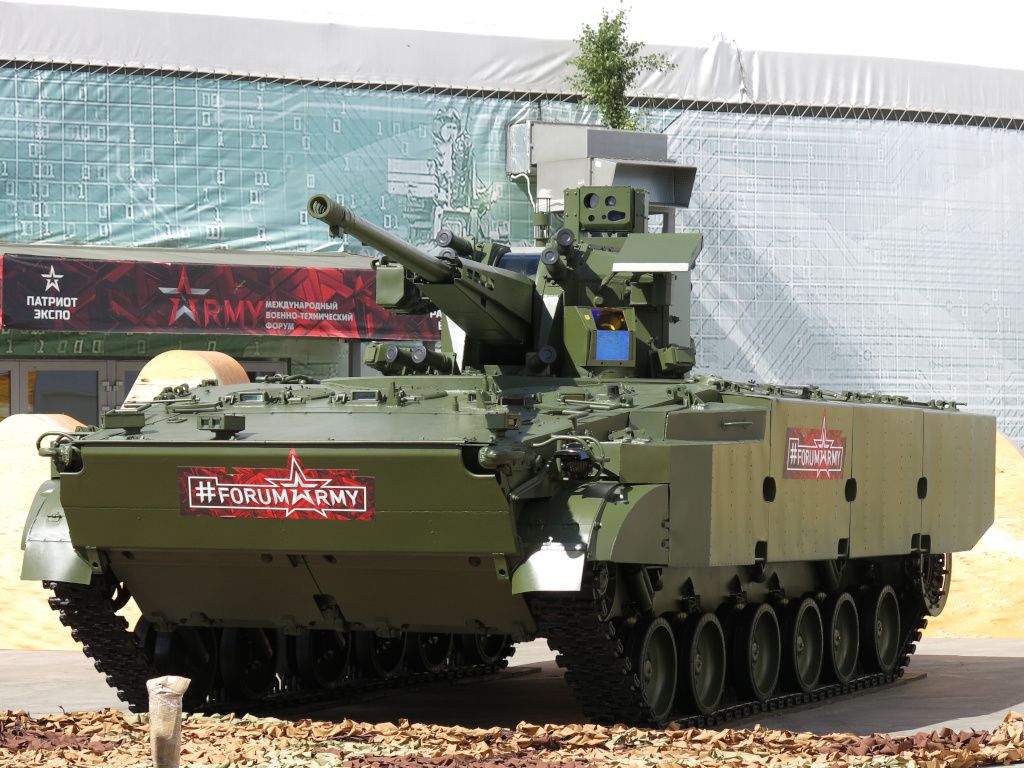
The 2S38 Derivatsiya-PVO first appeared publicly in presentation materials at the Army-2017 military exhibition, where the Main Rocket-Artillery Directorate of the Russian Ministry of Defense displayed a 2S38 combat vehicle with a 57-mm anti-aircraft artillery complex. The Burevestnik Central Research Institute, part of the Uralvagonzavod corporation, first publicly showed an actual prototype in January 2018, followed by its display at the Army-2018 forum in Kubinka in August of that year. The system was originally designed as a technology demonstrator and considered as a possible replacement for the 2S6 Tunguska adopted in the 1980s. It was presented again at the Army-2024 military-technical forum in August 2024, designated as part of the 1K150 “Derivatsiya” air defense system. In April 2024, Rostec weapons industrial director Bekhan Ozdoev stated that design work had been completed the previous year and that efforts were underway to accelerate deliveries to Russian forces. The vehicle was reportedly seen during the Center-2026 military exercise in October 2026, although independent verification of its exercise activities is lacking and the available material does not establish whether it conducted live firing or intercepted aerial targets. As of 2020, the vehicle was reported to be in very low numbers and slowly being adopted into the military.
Design
The 2S38 combines a BMP-3 tracked chassis with a remotely operated turret housing a crew of three in a single compartment. The primary weapon is a 57 mm 2A90 automatic cannon, described as a modernized version of the A-220 gun. The choice of 57 mm caliber provides a larger projectile with more space for explosive and fragmentation payloads compared to smaller-caliber anti-aircraft guns; Russian military assessments noted that medium-caliber guns can accommodate more powerful warheads, enabling “one-hit kill” capability against aircraft with defensive measures against small-caliber fire. Controlled-detonation ammunition with radio-command or remote laser-beam fuzes is intended to burst near aerial targets and distribute fragments along their flight path, reducing dependence on direct impact. The vehicle uses passive electro-optical equipment for surveillance and target tracking rather than an onboard search radar, reducing electromagnetic emissions. The OES OP optical-electronic system, developed by Minsk JSC “Peleng,” provides 360-degree panoramic observation with thermal-imaging and television channels. The turret is also fitted with a coaxial machine gun (listed as 7.62 mm in earlier references and 12.7 mm in the 2024 presentation) and a Kornet anti-tank guided missile system. An armor-piercing sub-caliber projectile with penetration of up to 95–100 mm at 1,000 m has been developed for the cannon.
Specifications
- Designer: Uralvagonzavod (Burevestnik Central Research Institute)
- Type: Self-propelled anti-aircraft gun
- Crew: 3
- Weight: 21.5 t
- Main armament: 57 mm 2A90 automatic cannon, 148 rounds
- Rate of fire: up to 120 rounds per minute
- Maximum engagement range: 6 km (air targets 200–6,000 m; ground targets 0–3,000 m)
- Maximum engagement altitude: 4.5 km (0–4,500 m)
- Maximum target speed: 500 m/s
- Maximum road speed: 70 km/h
- Autonomy: 600 km
- Elevation: −5° to +75°
- Azimuth: 360°
- Amphibious: Yes
These figures represent stated performance limits, not a demonstrated combat interception envelope against small drones.
Program Status
Russian officials stated in April 2024 that design work was complete and that efforts were underway to accelerate delivery of the 2S38 to Russian forces for deployment in Ukraine. The Russian side indicated that preliminary tests of the system’s vehicles had been completed, confirming its ability to combat various types of drones. The available material does not establish subsequent delivery quantities or widespread fielding. Within a layered air defense system, the 2S38 is intended to provide close-range engagement capability against drones, cruise missiles, and low-flying aircraft while conserving missile stocks.
Related Equipment
The 2S38’s development aligns with a broader international revival of mobile anti-aircraft artillery driven in part by the growing drone threat. Rheinmetall’s Skyranger 30 and Skyranger 35 combine 30 mm and 35 mm automatic cannons with programmable airburst ammunition and integrate search radar with electro-optical sensors for autonomous or networked operation. The U.S. Army’s SGT Stout, formerly Maneuver Short-Range Air Defense, mounts a 30 mm cannon, Stinger surface-to-air missiles, and onboard radar on a wheeled Stryker chassis, combining cannon fire and missile interception. These systems differ from the 2S38 in their weapon-and-sensor combinations: the 2S38 centers on a larger 57 mm projectile with passive electro-optical surveillance, while its Western counterparts pair smaller cannons with radar or combine guns with missiles.
 Argentina
 Armenia
 Australia
 Austria
 Austria-Hungary
 Belgium
 Brazil
 United Kingdom
 United States
 Brunei
 Bulgaria
 Canada
 Chile
 China
 Colonial America
 Colombia
 Confederate States
 Croatia
 Czech
 Denmark
 Egypt
 Finland
 France
 Georgia
 Germany
 German Imperial
 Greece
 Holland
 Hungary
 India
 Indonesia
 Iran
 Iraq
 Ireland
 Israel
 Italy
 Japan
 Japan (1940)
 Jordan
 Kingdom of Italy
 Malaysia
 Mexico
 Myanmar
 Nazi Germany
 Netherlands
 New Zealand
 North Korea
 Norway
 Pakistan
 Peru
 Philippines
 Poland
 Portugal
 Prussia
 Romania
 Saudi Arabia
 Serbia
 Singapore
 Slovakia
 Slovenia
 South Africa
 South Korea
 Soviet Union
 Spain
 Sweden
 Switzerland
 Syria
 Taiwan
 Thailand
 Turkey
 UAE
 Ukraine
 Vietnam
 Yugoslavia