
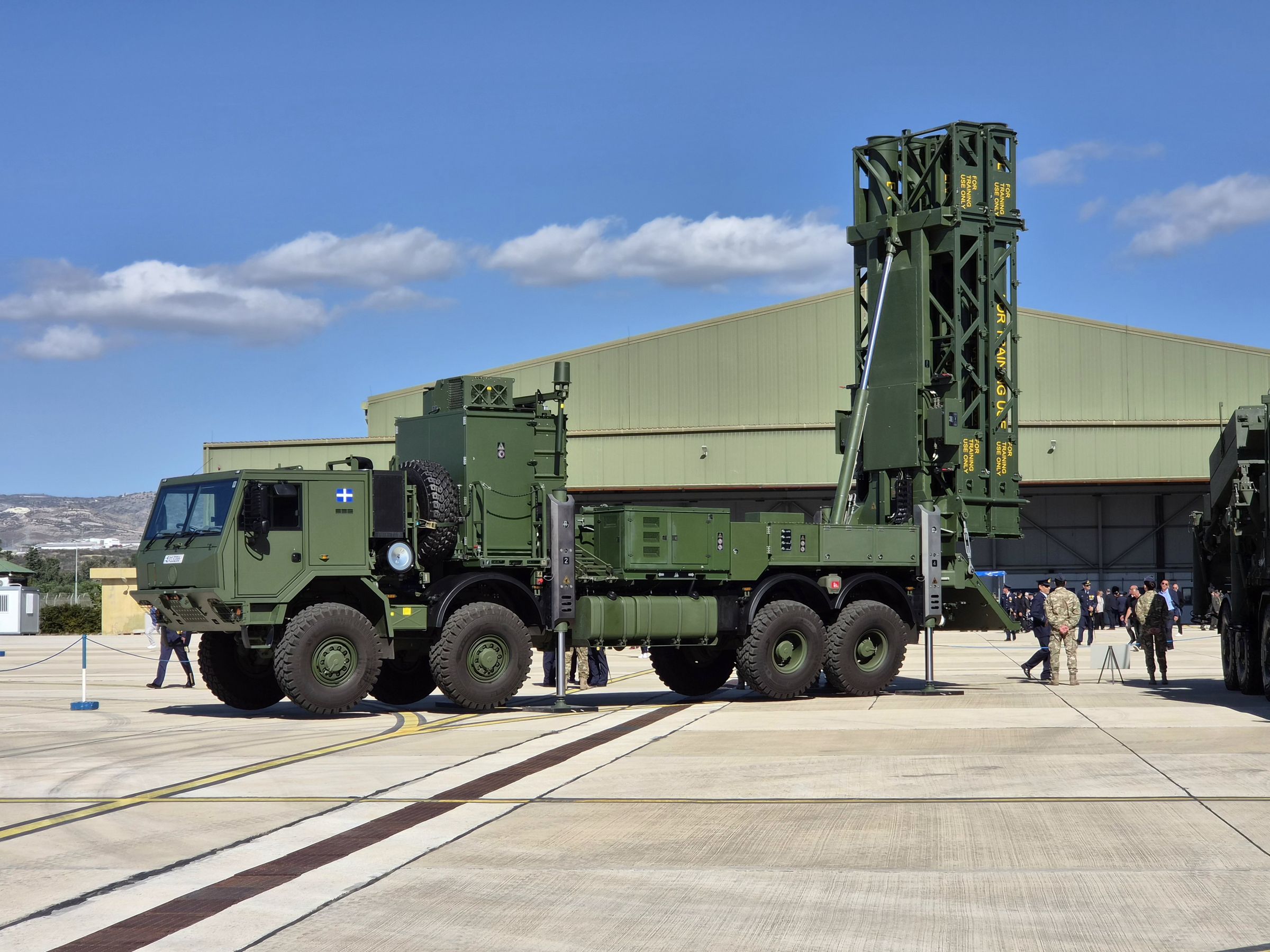
History
The Barak family of air defense systems originated in Israel in the 1980s, developed by Israel Aerospace Industries (IAI) in cooperation with Rafael. The initial Barak 1 was designed as a naval close-in defense system for protecting warships from anti-ship missiles. Over time the concept evolved into land-based variants, ultimately transforming into the modern modular Barak MX family. Unlike Barak 1 and Barak 8, which were developed jointly with Rafael and the Indian DRDO respectively, Barak MX is an exclusive IAI development built on the experience of those earlier programs.
The system achieved initial operational capability in 2020 for the Barak MR and Barak LR interceptors. The Barak ER completed a successful series of live-firing trials in March 2021 and achieved IOC in 2023. Further test milestones include a successful LR interceptor launch from a Sa'ar 6-class naval vessel in November 2022, which intercepted a target simulating an advanced cruise missile, and a successful LR test from the Sa'ar 6-class ship INS Atzmaut in August 2024.
Specifications
Barak MX is a modular, network-centric integrated air and missile defense system suitable for land and naval deployment. It uses an open, software-defined architecture that integrates sensors, battle management, vertical-launch units, and interceptors into a unified framework. Multiple fire units can be interconnected so that sensors and engagement assets are shared across the defended area, and land-based and naval elements can operate within the same multi-layered network. IAI describes three available interceptors for different ranges, all with active RF seekers, while the full documented family comprises four established types.
The interceptor family provides engagement ranges from 15 to 150 km:
- Barak SR – short-range interceptor, range up to 15 km, engagement altitude up to 9 km; carries up to 15 missiles per land launcher and 8 per naval launcher.
- Barak MR (formerly MRAD) – range up to 35 km, engagement altitude up to 20 km; single-pulse rocket motor; maneuverability up to 50 g; 8 missiles per launcher.
- Barak LR (formerly LRAD) – range up to 70 km, engagement altitude up to 20 km; dual-pulse rocket motor; maneuverability up to 50 g; 8 missiles per launcher.
- Barak ER – range up to 150 km, engagement altitude up to 30 km; dual-pulse rocket motor with additional booster; maneuverability up to 50 g; 8 missiles per launcher.
- Barak EA – newly disclosed variant with range of approximately 250 km and engagement altitude exceeding 35 km; detailed propulsion and operational status not yet publicly released by IAI.
All interceptors use vertical launch providing 360-degree engagement coverage and active radio-frequency seekers. The system operates with IAI/ELTA AESA radar families including MMR, MF-STAR, and ALPHA, and supports integration of customer-selected sensors. IAI identifies the intended target set as including fixed- and rotary-wing aircraft, helicopters, UAVs, UAV swarms, loitering munitions, sea-skimming missiles, cruise missiles, glide bombs, and tactical ballistic missiles. The system is capable of multiple simultaneous engagements and features high immunity to electronic countermeasures.
Operational history
Barak MX achieved its first operational use during the Twelve-Day War between Israel and Iran in June 2025. On 16 June 2025, the Israeli Navy's Barak Magen configuration aboard a Sa'ar 6-class vessel intercepted UAVs launched from Iran using the LR interceptor. The Israeli Air Force's land-based Barak system recorded its first operational interception on 19 June 2025 according to one account, or on 20 June 2025 according to another, when it destroyed a UAV that entered Israeli territory. IAI subsequently confirmed successful interceptions by both the Navy and Air Force and reported that the system intercepted dozens of threats during its initial operational deployment.
Operators
Israel operates Barak MX in both its naval configuration (designated Barak Magen on Sa'ar 6-class ships) and as a land-based system under the Air Force. Slovakia, Morocco, and Cyprus are confirmed operators. Thailand selected the system in December 2025. Additional procurement has been reported for Azerbaijan and Slovenia.
Program status
Slovakia ordered six Barak MX batteries under an intergovernmental agreement with IAI, including launchers, missiles, radar stations, command posts, logistics support, and operator training. The first battery was delivered in spring 2026; the second is scheduled for delivery by the end of 2026; the third is expected within the following year; and all six batteries are to be received by 2030. They will replace the country's former Soviet-era Kub air defense systems.
Switzerland's Federal Council announced in October 2026 that it had narrowed its choice of an additional long-range ground-based air defense system to Barak MX or the SAMP/T NG, pending a parliamentary decision. Greece selected Barak MX as a component of its Achilles Shield multi-layer air defense programme in August 2026.
 Argentina
 Armenia
 Australia
 Austria
 Austria-Hungary
 Belgium
 Brazil
 United Kingdom
 United States
 Brunei
 Bulgaria
 Canada
 Chile
 China
 Colonial America
 Colombia
 Confederate States
 Croatia
 Czech
 Denmark
 Egypt
 Finland
 France
 Georgia
 Germany
 German Imperial
 Greece
 Holland
 Hungary
 India
 Indonesia
 Iran
 Iraq
 Ireland
 Italy
 Japan
 Japan (1940)
 Jordan
 Kingdom of Italy
 Malaysia
 Mexico
 Myanmar
 Nazi Germany
 Netherlands
 New Zealand
 North Korea
 Norway
 Pakistan
 Peru
 Philippines
 Poland
 Portugal
 Prussia
 Romania

 Russia
 Saudi Arabia
 Serbia
 Singapore
 Slovakia
 Slovenia
 South Africa
 South Korea
 Soviet Union
 Spain
 Sweden
 Switzerland
 Syria
 Taiwan
 Thailand
 Turkey
 UAE
 Ukraine
 Vietnam
 Yugoslavia