
History
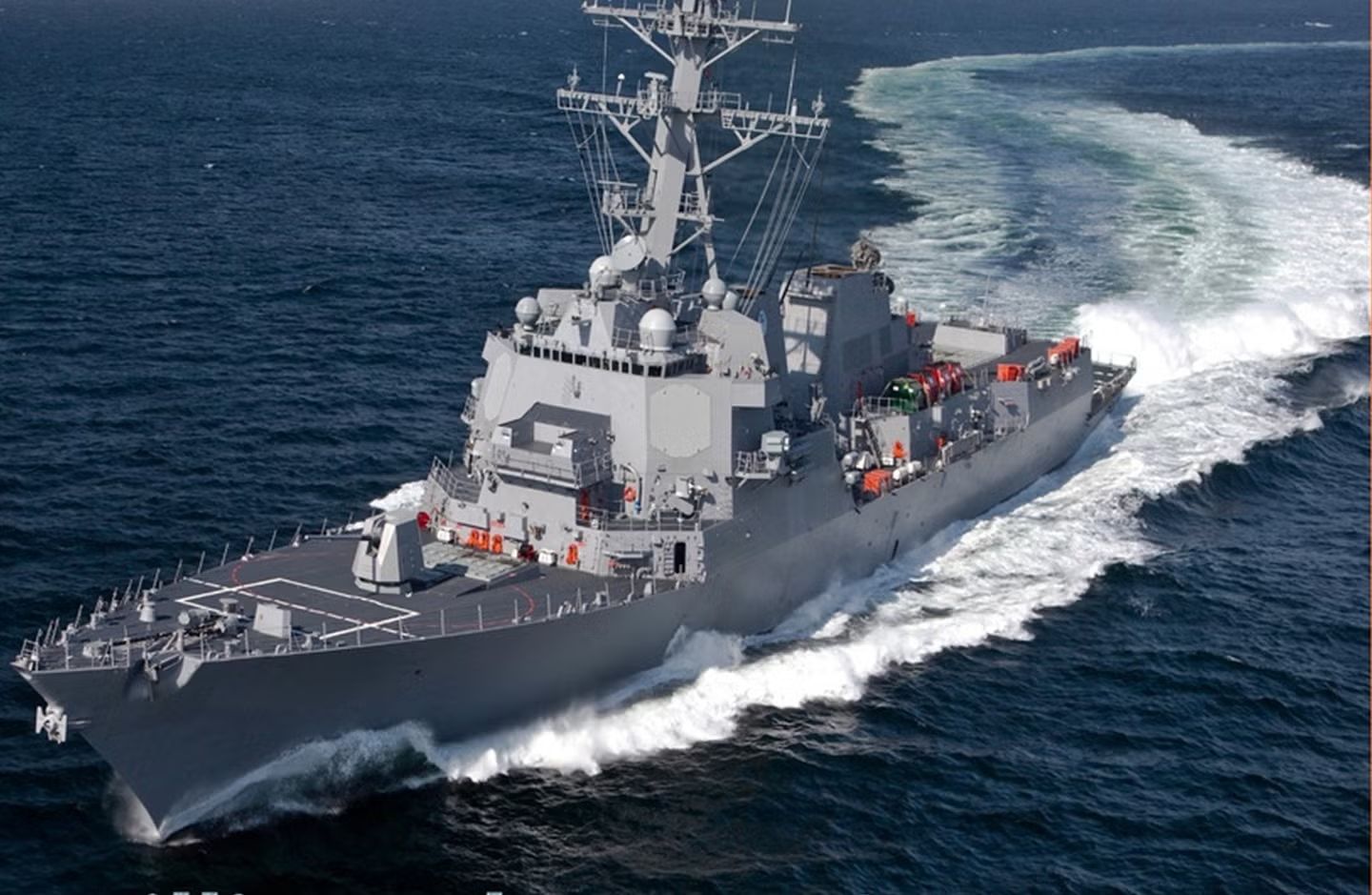
USS William Charette (DDG-130) is a Flight III Arleigh Burke-class guided-missile destroyer built by General Dynamics Bath Iron Works for the United States Navy. The ship is designed for air and missile defense, surface warfare, anti-submarine warfare, and land-attack missions.
DDG-130 is the fifth Flight III destroyer and the second Flight III ship built at Bath Iron Works. Its principal improvements over earlier Arleigh Burke variants include the AN/SPY-6(V)1 Air and Missile Defense Radar, Aegis Baseline 10, and increased electrical generation and cooling capacity.
The destroyer was christened on August 1, 2026, and launched into the Kennebec River several days later. It remained a future USS while outfitting, system activation, trials, delivery, and commissioning were still pending.
Construction
The United States Navy awarded the construction contract in September 2018. Bath Iron Works began fabrication in November 2020 and laid the keel on August 29, 2024. DDG-130 became the 43rd Arleigh Burke-class destroyer constructed at the Bath shipyard since work on the class began there in 1988.
The Navy christened the ship at Bath, Maine, on August 1, 2026. Kathryn Charette Donovan, a daughter of the namesake, served as principal sponsor on behalf of herself and her sisters. An official U.S. Navy announcement identified the vessel as an Arleigh Burke-class guided-missile destroyer.
Days after the ceremony, Bath Iron Works launched DDG-130 from its dry dock into the Kennebec River. The ship then moved to pierside outfitting. Work leading to Aegis Light Off includes installing and activating equipment before the combat system is powered and tested aboard the vessel. The launch and subsequent status were reported in the launch report.
Namesake
The ship is named for Master Chief Hospital Corpsman William Richard Charette. He received the Medal of Honor for treating and protecting wounded Marines under fire at Outpost Vegas during the Korean War on March 27, 1953. Charette later served in the United States Navy submarine force and retired in 1977 after 26 years of service. The ship carries the motto Valor in Service.
Design
Flight III retains the basic hull dimensions and external profile of the preceding Flight IIA design. Internal systems were extensively revised to supply the additional electrical power and cooling required by the new radar and combat system. DDG-130 has a reported full-load displacement of approximately 9,850 metric tonnes.
Propulsion and electrical power
Four General Electric LM2500 gas turbines drive two shafts and produce more than 100,000 shaft horsepower. The propulsion system gives the ship a maximum speed above 30 knots.
Three AG9160 generators each provide 4 MW, producing 12 MW of installed electrical power. This is about one-third more than the 9 MW generated by the three 3 MW units used in Flight IIA ships. The additional capacity supports the AN/SPY-6(V)1 radar, Aegis processing equipment, pumps, cooling systems, and other electronic loads.
Sensors and combat system
The AN/SPY-6(V)1 Air and Missile Defense Radar uses four fixed active electronically scanned arrays. Each array is assembled from 37 Radar Module Assemblies containing gallium-nitride transmit-and-receive components. The radar is intended to detect and track ballistic missiles, cruise missiles, aircraft, unmanned systems, and low-signature targets.
Aegis Baseline 10 integrates anti-air warfare and ballistic-missile defense functions within one combat architecture. Cooperative Engagement Capability and Link 16 allow DDG-130 to exchange tracks, identification information, and targeting data with other ships, aircraft, and allied forces.
The anti-submarine warfare installation belongs to the AN/SQQ-89 family. It combines shipboard sonar, a towed array, anti-submarine weapons, and information from embarked helicopters. Electronic defenses include the AN/SLQ-32 electronic-warfare suite, Mk 36 decoy launchers, Mk 53 Nulka active decoys, and the AN/SLQ-25 Nixie torpedo countermeasure.
Armament
DDG-130 has 96 Mk 41 vertical-launch cells, arranged as 32 cells forward and 64 aft. Depending on its assigned mission and load plan, the system can carry SM-2, SM-3, SM-6, Evolved Sea Sparrow Missile, Tomahawk, and RUM-139 Vertical Launch ASROC weapons.
A 127 mm Mk 45 Mod 4 gun provides surface engagement and naval gunfire support. Close defense includes a 20 mm Phalanx Close-In Weapon System. Two Mk 32 triple launchers can employ Mk 46, Mk 50, or Mk 54 lightweight torpedoes.
Aviation facilities
The ship has two hangars for MH-60R Seahawk helicopters. These aircraft can extend the ship's anti-submarine search and engagement area by using sonobuoys, dipping sonar, electro-optical sensors, and lightweight torpedoes.
Program status
Following its 2026 launch, USS William Charette remained under construction and was not yet a commissioned warship. Bath Iron Works was continuing pierside outfitting, combat-system activation, and preparations for harbor, builder's, and acceptance trials. Navy delivery and commissioning would follow successful completion of the required work and tests.
The United States Navy intends Flight III destroyers to perform integrated air and missile defense while retaining the Arleigh Burke class's surface, land-attack, and anti-submarine roles. The Flight III configuration improves sensor and combat-system capability but retains the 96-cell missile capacity of Flight IIA.
Operators
- United States Navy: DDG-130 was launched in 2026 and remained in the outfitting and trials phase before delivery and commissioning.
Specifications (Arleigh Burke Flight III, DDG-130)
General characteristics
- Type: Guided-missile destroyer
- Builder: General Dynamics Bath Iron Works, Bath, Maine
- Displacement: Approximately 9,850 metric tonnes (9,700 long tons) at full load
- Length: 155.3 m (509.5 ft)
- Beam: 20 m (66 ft)
- Crew: 359, including 41 officers, 27 chief petty officers, and 291 enlisted sailors
Performance
- Propulsion: Four General Electric LM2500 gas turbines driving two shafts
- Power: More than 100,000 shaft horsepower
- Maximum speed: More than 30 knots
- Electrical generation: Three 4 MW AG9160 generators, 12 MW total
Sensors and systems
- Combat system: Aegis Baseline 10
- Main radar: AN/SPY-6(V)1 Air and Missile Defense Radar
- Anti-submarine system: AN/SQQ-89 family combat system with hull-mounted and towed-array sonar
- Data links: Cooperative Engagement Capability and Link 16
- Electronic warfare: AN/SLQ-32 suite
Armament
- Vertical-launch system: 96 Mk 41 cells, with 32 forward and 64 aft
- Main gun: One 127 mm Mk 45 Mod 4 gun
- Close-in defense: One 20 mm Phalanx Close-In Weapon System
- Torpedoes: Two Mk 32 triple launchers for lightweight torpedoes
- Decoys and countermeasures: Mk 36 launchers, Mk 53 Nulka, and AN/SLQ-25 Nixie
- Aircraft: Two MH-60R Seahawk helicopters
 Argentina
 Armenia
 Australia
 Austria
 Austria-Hungary
 Belgium
 Brazil
 United Kingdom
 Brunei
 Bulgaria
 Canada
 Chile
Chile China
China Colonial America
 Colombia
 Confederate States
 Croatia
 Czech
Czech Denmark
 Egypt
Egypt Finland
 France
 Georgia
 Germany
 German Imperial
 Greece
 Holland
 Hungary
 India
India Indonesia
 Iran
Iran Iraq
Iraq Ireland
 Israel
 Italy
Italy Japan
Japan Japan (1940)
 Jordan
 Kingdom of Italy
 Malaysia
 Mexico
 Myanmar
 Nazi Germany
 Netherlands
 New Zealand
 North Korea
 Norway
 Pakistan
 Peru
Peru Philippines
 Poland
 Portugal
 Prussia
 Romania
 Russia
 Saudi Arabia
 Serbia
 Singapore
 Slovakia
 Slovenia
 South Africa
 South Korea
 Soviet Union
 Spain
Spain Sweden
 Switzerland
 Syria
Syria Taiwan
 Thailand
 Turkey
 UAE
UAE Ukraine
 Vietnam
 Yugoslavia