

History
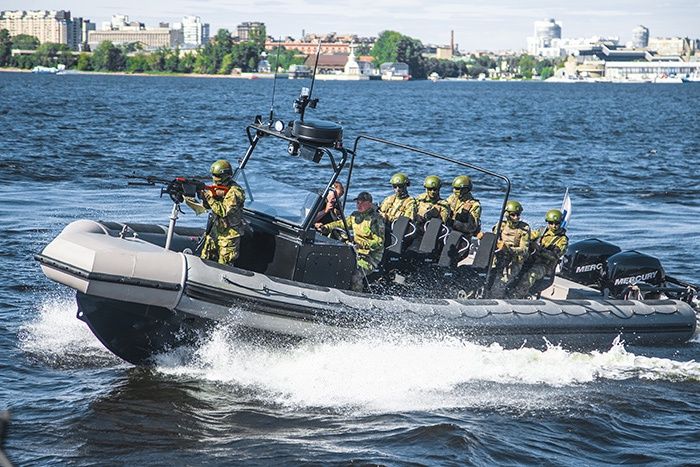
The Kalashnikov Concern BK-10, also designated Project 02450, is a Russian high-speed assault boat designed to transport troops, land personnel on prepared or unprepared shores, and provide fire support during disembarkation. The crewed boat can carry up to 10 troops in addition to its two-person crew.
The Russian military adopted the BK-10 in 2016, after which Kalashnikov supplied the type serially. Its combination of high speed, troop capacity, and optional armament has also made the platform a candidate for adaptation to unmanned maritime roles.
In August 2026, Kalashnikov head Alan Lushnikov said the concern was developing an unmanned surface vessel based on the BK-10. The announced version remained a planned development: no prototype, test schedule, production timeline, or service-entry date had been disclosed in the available reporting.
Service and development background
The BK-10 was created as a compact assault landing craft for coastal operations. Published descriptions identify troop transport, landing on prepared and unprepared shores, and direct fire support as its core missions. The boat's maximum reported speed is about 74 km/h (40 knots).
In August 2024, Semyon Danilin, chief executive of Rybinsk Shipyard, stated that BK-10 and BK-16 boats were being used in the Black Sea against unmanned surface vessels and sabotage groups. The statement, reported by Army Recognition, characterized the boats' speed and armament as useful for intercepting small maritime targets.
Unmanned conversion plan
On 10 August 2026, Lushnikov said Kalashnikov was working on an unmanned version of the BK-10. UNITED24 Media reported that the announcement included no prototype, testing schedule, production timetable, or planned service-entry date. Separate reports by Voennoe Delo and Oreanda-News likewise described the project as an unmanned surface vessel derived from the existing assault boat.
Lushnikov said the future unmanned boat's weapon fit would be determined by customer requirements. Reports also stated that specialists were already working on the new version, but they did not identify a completed unmanned prototype. The available evidence therefore supports treating the unmanned BK-10 as a proposed or developing variant rather than an operational system.
Design
The BK-10 is a high-speed assault craft with a two-person crew and space for up to 10 additional personnel. Its layout is intended to support rapid transport and landing of troops while retaining the ability to provide fire support during disembarkation.
Published performance figures consistently place maximum speed at about 40 knots, equivalent to roughly 74 km/h. Range figures differ between sources and appear to reflect different operating conditions. One report gives a range of about 248 km while carrying a payload of up to 3.5 tonnes, while another gives a range of 400 miles at a cruising speed of 22 knots. Because the source material does not reconcile these figures, they should not be treated as directly interchangeable.
Armament
The crewed BK-10 is reported with several weapon options. Sources describe fits including 7.62 mm machine guns, 12.7 mm machine guns, and a 40 mm grenade launcher. Another report gives a standard arrangement of two 7.62 mm machine guns or one automatic grenade launcher. The available reporting therefore indicates a configurable armament rather than one fixed weapon set.
For the planned unmanned version, Kalashnikov has not announced a standard armament. Lushnikov stated that the final weapon configuration would depend on the customer's requirements.
Operational history
The Russian military adopted the BK-10 in 2016, and the type has subsequently been supplied in series by Kalashnikov. By 2024, Russian industry representatives were publicly describing BK-10 boats as being used in the Black Sea for patrol and interception tasks against unmanned surface vessels and small hostile craft.
The August 2026 unmanned-conversion announcement did not establish that an unmanned BK-10 had entered testing or service. It represented a development direction for the existing platform rather than a confirmed operational variant.
Variants
- BK-10 / Project 02450: Crewed high-speed assault boat for transporting up to 10 troops, landing personnel, and providing fire support.
- Unmanned BK-10 variant: Planned unmanned surface vessel based on the BK-10. Kalashnikov announced the project in August 2026, with customer-defined armament proposed. No completed prototype, test schedule, production timeline, or service-entry date was disclosed in the available sources.
Operators
- Russia: The Russian military adopted the crewed BK-10 in 2016 and has received serially supplied boats.
Specifications (BK-10 crewed assault boat)
General characteristics
- Crew: 2
- Troop capacity: Up to 10 personnel
- Payload: Up to 3.5 tonnes in the cited 248 km range condition
Performance
- Maximum speed: About 74 km/h (40 knots)
- Reported range: About 248 km with payload up to 3.5 tonnes in one source; 400 miles at 22 knots in another source
Armament
- Machine guns: Reported options include 7.62 mm and 12.7 mm machine guns
- Grenade launcher: 40 mm grenade launcher reported as an alternative fit
 Argentina
 Armenia
 Australia
 Austria
 Austria-Hungary
 Belgium
 Brazil
 United Kingdom
 United States
 Brunei
 Bulgaria
 Canada
 Chile
Chile China
China Colonial America
 Colombia
 Confederate States
 Croatia
 Czech
Czech Denmark
 Egypt
Egypt Finland
 France
 Georgia
 Germany
 German Imperial
 Greece
 Holland
 Hungary
 India
India Indonesia
 Iran
Iran Iraq
Iraq Ireland
 Israel
 Italy
Italy Japan
Japan Japan (1940)
 Jordan
 Kingdom of Italy
 Malaysia
 Mexico
 Myanmar
 Nazi Germany
 Netherlands
 New Zealand
 North Korea
 Norway
 Pakistan
 Peru
Peru Philippines
 Poland
 Portugal
 Prussia
 Romania
 Saudi Arabia
 Serbia
 Singapore
 Slovakia
 Slovenia
 South Africa
 South Korea
 Soviet Union
 Spain
Spain Sweden
 Switzerland
 Syria
Syria Taiwan
 Thailand
 Turkey
 UAE
UAE Ukraine
 Vietnam
 Yugoslavia