
History
INS Drakon is the sixth and final submarine of Israel's Dolphin program and the third boat generally grouped with the Dolphin-II air-independent-propulsion generation. Built in Kiel, Germany, by Howaldtswerke-Deutsche Werft, later part of ThyssenKrupp Marine Systems (TKMS), it differs substantially from the preceding INS Tanin and INS Rahav through an extended hull, a much larger sail and additional mission volume.
The submarine was ordered in 2012 for the Israeli Navy. During construction, Israel approved a major configuration change that required structural alterations rather than a simple equipment update. The resulting design became an intermediate step between the established Dolphin-II configuration and the larger Dakar-class submarines intended to replace Israel's first-generation Dolphins in the 2030s.
Public reporting in 2026 stated that the Israeli Navy had taken custody of INS Drakon in Germany after prolonged testing. The exact handover date was reported inconsistently and the transfer was not accompanied by a widely publicized commissioning ceremony, so the safest description is that Drakon entered Israeli custody during 2026. Army Recognition described the delivery as reported rather than officially confirmed at the time of publication.
Development and redesign
Israel's first three Dolphin submarines entered service around the turn of the century. A second generation followed with INS Tanin and INS Rahav, which introduced a fuel-cell air-independent propulsion system and a longer hull. Israel then ordered a sixth boat in 2012. The initial expectation was that this submarine would broadly follow the 68.6 m Dolphin-II arrangement used by Tanin and Rahav.
That plan changed during construction. Israel selected additional capabilities that could not be accommodated by replacing existing equipment alone. The work required structural modification of the pressure-hull arrangement, extra internal volume, a redesigned sail, revised cable and pipe routing, and changes to machinery and accommodation layouts. These alterations separated Drakon from the preceding pair and contributed to a much longer completion schedule.
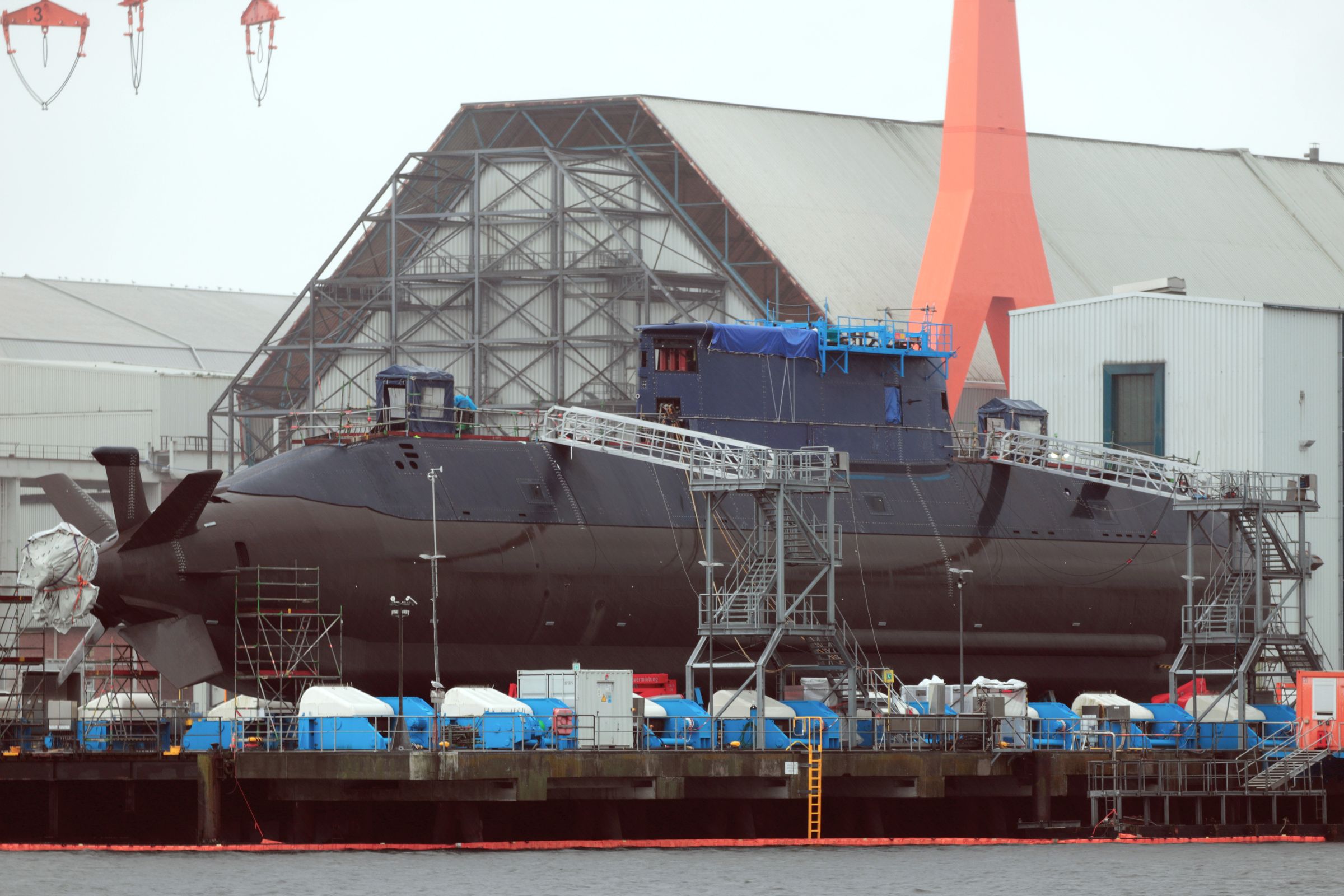
A secondary-source chronology reports an initial launch in 2017 before the redesign was completed. The submarine was later taken out of the water and was relaunched in August 2023 in its revised form. Photographs from that period showed the greatly enlarged sail and lengthened hull that distinguish the final configuration. Drakon was christened in Kiel on 12 November 2024, during a ceremony that also marked the start of construction activity for the future Dakar class.
Testing and delivery
Testing continued through 2025 and 2026. The program included harbor, propulsion, sensor and sea trials associated with the changed structure and systems. Public reports in 2025 described the submarine undergoing sea trials, while 2026 reporting placed it under Israeli control in Kiel during final acceptance activity.
Accounts of the formal transfer date differ. Reporting cited by Army Recognition referred to dates in June and July 2026, while other secondary material listed commissioning in August 2026. Because no consistent official public record is supplied in the available material, this article treats 2026 as the confirmed delivery year without assigning a definitive day. The completed boat brought Israel's Dolphin fleet to six submarines: three first-generation Dolphin-I boats and three AIP-equipped Dolphin-II boats. A broader overview of Israel's submarine force is available from the Nuclear Threat Initiative.
Design
INS Drakon retains the basic operating concept of a modern diesel-electric attack submarine but is physically distinct from earlier Dolphin-II boats. Its reported length is approximately 73 to 74 m, compared with 68.6 m for INS Tanin and INS Rahav. Beam remains about 6.8 m and draft about 6.2 m. Reported displacement is approximately 2,050 tonnes surfaced and 2,400 tonnes submerged.
Hull and mission volume
The most visible feature is the enlarged sail, which is longer, broader and taller than that of the preceding Dolphin-II submarines and extends farther aft. The redesign also added internal volume in or near the pressure-hull section. These changes created space for equipment and mission payloads that could not fit within the standard Dolphin-II arrangement.
The precise use of this extra volume has not been officially disclosed in the supplied sources. Analysts have suggested that it could support vertical launch tubes, unmanned underwater vehicles, reconnaissance equipment or special-operations facilities. These possibilities remain unconfirmed. No reliable public source in the supplied material establishes a specific number of vertical-launch cells or an assigned missile type, so such systems should not be treated as confirmed armament.
Propulsion and endurance
Drakon uses a diesel-electric propulsion arrangement supplemented by fuel-cell air-independent propulsion. The reported configuration combines three diesel engines, electric machinery, batteries and the fuel-cell AIP system driving a single shaft. The diesel engines are used when atmospheric oxygen is available, including for battery charging, while the fuel cells can generate electricity underwater without operating the diesels.
Air-independent propulsion reduces the frequency with which the submarine must approach the surface and snorkel. This is important for a conventional submarine because snorkeling exposes masts and requires diesel operation, increasing the chance of detection by radar, infrared, electronic-surveillance and airborne anti-submarine sensors. Public class data cited for the AIP Dolphins gives a submerged speed above 25 knots and a test depth of at least 350 m. The class is also reported to support extended patrols without resupply, although actual endurance depends strongly on speed and mission profile.
Crew, sensors and combat system
The normal crew is reported at about 35, with accommodation for roughly ten additional personnel. The extra berths can support specialists such as intelligence personnel, technicians, special-forces operators or unmanned-system crews, depending on mission requirements.
The submarine uses an Atlas Elektronik ISUS-series command and weapon-control architecture integrating sonar, navigation, electronic surveillance and fire-control data. Reported sensors include a hull-mounted active-passive sonar, passive ranging sonar, flank arrays, electronic-support equipment and a surface-search radar. During post-transfer activity, multiple retractable masts were reportedly visible simultaneously, consistent with a dense suite of optronic, communications, navigation and surveillance equipment housed in the enlarged sail.
Armament
INS Drakon retains the unusual ten-tube bow arrangement associated with the Dolphin family: six 533 mm torpedo tubes and four larger 650 mm tubes. The 533 mm tubes can employ heavyweight torpedoes, including the DM2A4 family cited in public reporting. The larger 650 mm tubes provide greater internal diameter for large weapons or specialized payloads and can also accept smaller weapons through liners.
The 650 mm tubes are reported as suitable for roles such as mine deployment, swimmer-delivery equipment and other large payloads. Open sources have long associated the Dolphin class with submarine-launched cruise-missile capability, but details of strategic weapons remain disputed or officially unconfirmed. Drakon's enlarged sail has intensified speculation about additional vertical-launch capacity, yet the supplied evidence does not confirm that such a system is operational.
Operational history
INS Drakon was reported to have entered Israeli Navy custody in 2026 after acceptance work in Germany. It is assigned to the Israeli submarine force, Shayetet 7, whose boats are based at Haifa. No combat deployment of Drakon is confirmed in the supplied material.
The broader Dolphin force has operated beyond the eastern Mediterranean. Israeli submarines have transited the Suez Canal and operated in the Red Sea, demonstrating an ability to reposition toward routes leading to the Arabian Sea and Indian Ocean. Drakon's likely mission set therefore includes anti-submarine warfare, anti-surface warfare, covert intelligence collection, electronic surveillance and support to special operations. Long-range land-attack capability is widely discussed in open sources, but the specific weapons carried by Drakon remain undisclosed.
The arrival of a third AIP-equipped boat gives the Israeli Navy more flexibility to rotate modern submarines among deployment, preparation, training and maintenance. Drakon also provides experience with a larger sail and expanded internal mission volume before the Dakar class enters service.
Operators
- Israeli Navy: One INS Drakon, operated within the Dolphin submarine force and reported delivered in 2026.
Specifications (INS Drakon)
General characteristics
- Type: Dolphin-II diesel-electric attack submarine with fuel-cell air-independent propulsion
- Builder: Howaldtswerke-Deutsche Werft / ThyssenKrupp Marine Systems, Kiel, Germany
- Length: approximately 73-74 m
- Beam: approximately 6.8 m
- Draft: approximately 6.2 m
- Displacement: approximately 2,050 tonnes surfaced; approximately 2,400 tonnes submerged
- Crew: about 35, with accommodation for roughly 10 additional personnel
Performance
- Propulsion: diesel-electric machinery, batteries and fuel-cell AIP driving a single shaft
- Diesel engines: three
- Maximum submerged speed: reported to exceed 25 knots
- Test depth: at least 350 m
Armament and systems
- Torpedo tubes: six 533 mm tubes and four 650 mm tubes
- Heavyweight torpedoes: DM2A4 family reported for the 533 mm tubes
- Combat system: Atlas Elektronik ISUS-series command and weapon-control architecture
- Sonar and surveillance: hull-mounted active-passive sonar, passive ranging sonar, flank arrays, electronic-support equipment and surface-search radar
Related equipment
- INS Tanin and INS Rahav: earlier Dolphin-II AIP submarines whose standard 68.6 m configuration preceded the enlarged Drakon.
- Dolphin-I class: the first three Israeli Dolphin submarines, shorter and without the fuel-cell AIP section of the later boats.
- Dakar class: planned successor class intended to replace the oldest Dolphin-I submarines; its design direction is associated with the increased volume and prominent sail first demonstrated on Drakon.
 Argentina
 Armenia
 Australia
 Austria
 Austria-Hungary
 Belgium
 Brazil
 United Kingdom
 United States
 Brunei
 Bulgaria
 Canada
 Chile
Chile China
China Colonial America
 Colombia
 Confederate States
 Croatia
 Czech
Czech Denmark
 Egypt
Egypt Finland
 France
 Georgia
 German Imperial
 Greece
 Holland
 Hungary
 India
India Indonesia
 Iran
Iran Iraq
Iraq Ireland
 Israel
 Italy
Italy Japan
Japan Japan (1940)
 Jordan
 Kingdom of Italy
 Malaysia
 Mexico
 Myanmar
 Nazi Germany
 Netherlands
 New Zealand
 North Korea
 Norway
 Pakistan
 Peru
Peru Philippines
 Poland
 Portugal
 Prussia
 Romania
 Russia
 Saudi Arabia
 Serbia
 Singapore
 Slovakia
 Slovenia
 South Africa
 South Korea
 Soviet Union
 Spain
Spain Sweden
 Switzerland
 Syria
Syria Taiwan
 Thailand
 Turkey
 UAE
UAE Ukraine
 Vietnam
 Yugoslavia