
History
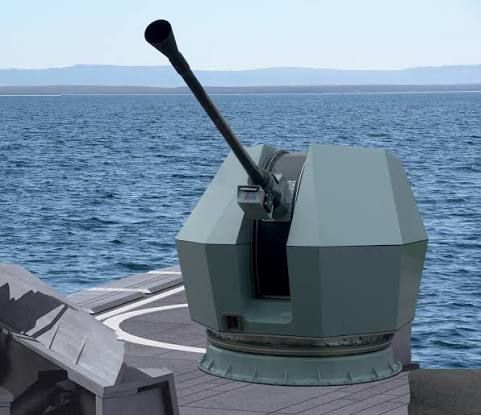
The Mk 45 is an American 127 mm automatic naval gun system developed to arm cruisers, destroyers, frigates, and amphibious ships. It was designed during the 1960s as a lighter and simpler replacement for the Mk 42 gun mount and entered United States Navy service in the early 1970s. The weapon is now manufactured and supported by BAE Systems and is operated by the United States and numerous allied navies.
The gun provides naval surface fire support, engagement of surface targets, and a limited capability against air threats. Its automatic loader permits the mount to fire without personnel inside the gunhouse, while sailors below deck replenish the ready-use ammunition for sustained operation.
Successive modifications introduced electronic fuze setting, revised barrels, new control equipment, and compatibility with different fire-control systems. The Mk 45 Mod 4 is the principal extended-length version. It combines a 62-calibre barrel with strengthened mount structures, a longer recoil stroke, an ammunition-recognition system, updated controls, and a redesigned low-signature gun shield.
Development
The original Mod 0 used a 54-calibre barrel and mechanical fuze setting. Mod 1 introduced electronic fuze setting and a unitary barrel with longer service life. Mod 2 became the principal export configuration and was also widely used by the United States Navy. A proposed Mod 3 with a revised control system did not enter production.
Mod 4 was developed to exploit higher-energy ammunition and provide greater naval gunfire range. The longer barrel allows propellant gases to act on the projectile for more time, increasing muzzle velocity. Structural changes accommodate greater firing energy, while digital interfaces connect the mount with modern gun-computing equipment.
USS Winston S. Churchill, DDG-81, became the first Arleigh Burke-class destroyer built with Mod 4. The configuration was subsequently selected for additional American and allied ships, while some older mounts could be upgraded.
Ammunition development
The Mk 45 family fires separate-loading 127 mm ammunition selected for surface, shore, air, illumination, and training tasks. Development programs have repeatedly sought guided or extended-range projectiles. Some earlier American projects, including the Extended Range Guided Munition, were cancelled after technical and cost problems.
In August 2026, Diehl Defence and BAE Systems announced cooperation to integrate a German high-precision, long-range 127 mm ammunition family with Mk 45 Mod 4. The work was intended for German and international customers. No ammunition designation, guidance method, warhead, maximum range, qualification schedule, or customer order was disclosed.
The memorandum established an integration objective rather than an operational capability. Compatibility work would need to address loading, chamber pressure, ballistics, fuze or guidance programming, gun-control software, and ship fire-control interfaces before the ammunition could enter service.
Design
The Mk 45 consists of a 127 mm gun, unmanned above-deck mount, automatic loader, ready-use magazine, below-deck ammunition handling spaces, and control interfaces. The weapon is remotely aimed and fired through the ship's combat and gun fire-control systems.
Gun mount
The mount can train and elevate the barrel automatically in response to fire-control commands. Mod 4 uses a 62-calibre Mk 36 barrel, approximately 7.87 m long, compared with the shorter 54-calibre barrel of earlier versions. The gun shield was designed to reduce radar signature and maintenance requirements.
A ready-use loader holds 20 rounds. This magazine supports immediate automatic fire, but a below-deck team must continue supplying projectiles and propelling charges during prolonged engagements. Maximum cyclic rate is commonly stated as approximately 16 to 20 rounds per minute, while sustained rate depends on ammunition handling and firing restrictions.
Fire control
United States installations have used systems such as the Mk 86 Gun Fire Control System and Mk 160 Gun Computing System. Sensors and combat-system software determine target position and motion, calculate a firing solution, select ammunition settings, and command the mount.
Accuracy depends on target data, ship motion, projectile ballistics, weather, barrel condition, and ammunition. Guided projectiles may add their own navigation and control, but they still require compatible programming and fire-control support.
Roles
Against surface targets, Mk 45 can engage small craft and larger vessels within gun range. For shore bombardment, it can support forces ashore and attack exposed positions, vehicles, buildings, or other suitable targets. The weapon can also fire at air targets, although modern naval air defence relies primarily on missiles and close-in systems for the most demanding threats.
Operational history
Mk 45 guns have served in combat and routine operations aboard American and allied warships since the 1970s. The system has been used for warning shots, surface engagements, shore bombardment, exercises, and naval gunfire support. Its broad adoption created an international support and ammunition base.
The Mod 4 configuration expanded the potential range and growth capacity of the system. Actual combat performance varies with ammunition and ship integration, so the maximum range of one projectile should not be applied to every Mk 45 load.
Variants
- Mk 45 Mod 0 — initial 127 mm/54-calibre mount with mechanical fuze setter.
- Mk 45 Mod 1 — introduced electronic fuze setting and a unitary barrel.
- Mk 45 Mod 2 — export-oriented Mod 1 development later widely used by the United States Navy.
- Mk 45 Mod 3 — proposed version with a new control system that did not enter production.
- Mk 45 Mod 4 — 127 mm/62-calibre version with strengthened structure, updated controls, and provisions for advanced ammunition.
Operators
The Mk 45 family is used by the United States Navy and by allied fleets including Australia, Denmark, Greece, Japan, New Zealand, South Korea, Spain, Taiwan, Thailand, and Turkey. Mod and ship configuration differ among users, and later orders have expanded the customer base.
Specifications (Mk 45 Mod 4)
General characteristics
- Calibre: 127 mm (5 in).
- Barrel length: 62 calibres, approximately 7.87 m (25 ft 10 in).
- Operation: Remotely controlled automatic naval gun.
- Ready-use capacity: 20 rounds.
- Projectile mass: Approximately 31.75 kg (70 lb) for a typical conventional projectile.
- Elevation: Approximately −15 to +65 degrees.
Performance
- Rate of fire: Approximately 16–20 rounds per minute maximum.
- Range: More than 37 km (20 nmi) with a compatible extended-range cargo projectile and improved propelling charge.
Related equipment
- Mk 42 naval gun — heavier 127 mm system that Mk 45 was developed to replace.
- Mk 160 Gun Computing System — fire-control computer used with modern Mk 45 installations.
- Diehl 127 mm long-range ammunition — proposed precision ammunition family undergoing compatibility work for Mod 4 as of 2026.
 Argentina
 Armenia
 Australia
 Austria
 Austria-Hungary
 Belgium
 Brazil
 United Kingdom
 Brunei
 Bulgaria
 Canada
 Chile
Chile China
China Colonial America
 Colombia
 Confederate States
 Croatia
 Czech
Czech Denmark
 Egypt
Egypt Finland
 France
 Georgia
 Germany
 German Imperial
 Greece
 Holland
 Hungary
 India
India Indonesia
 Iran
Iran Iraq
Iraq Ireland
 Israel
 Italy
Italy Japan
Japan Japan (1940)
 Jordan
 Kingdom of Italy
 Malaysia
 Mexico
 Myanmar
 Nazi Germany
 Netherlands
 New Zealand
 North Korea
 Norway
 Pakistan
 Peru
Peru Philippines
 Poland
 Portugal
 Prussia
 Romania
 Russia
 Saudi Arabia
 Serbia
 Singapore
 Slovakia
 Slovenia
 South Africa
 South Korea
 Soviet Union
 Spain
Spain Sweden
 Switzerland
 Syria
Syria Taiwan
 Thailand
 Turkey
 UAE
UAE Ukraine
 Vietnam
 Yugoslavia