
History
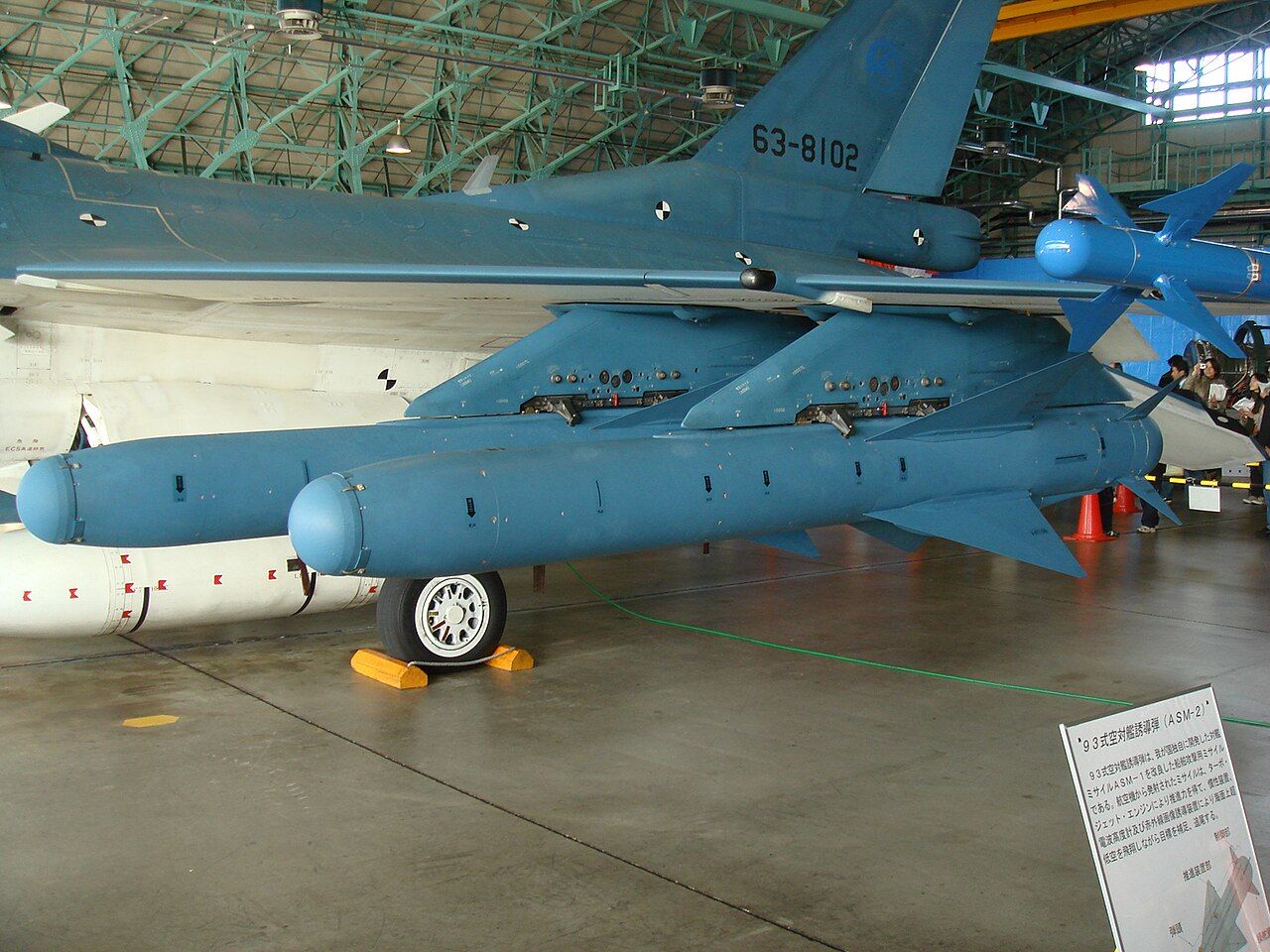
ASM-2, officially designated Type 93 Air-to-Ship Missile, is a Japanese air-launched anti-ship cruise missile developed for the Japan Air Self-Defense Force. Mitsubishi Heavy Industries produced the weapon as a successor to the Type 80 ASM-1, combining an indigenous airframe and propulsion system with an imaging infrared terminal seeker.
The developmental XASM-2 underwent operational testing between June and December 1992. The missile entered service in 1995 and became a principal maritime-strike weapon for Japanese combat aircraft. It was integrated with the Mitsubishi F-2 and was also associated with upgraded F-4EJ Kai aircraft before their retirement.
Japan developed ASM-2 to attack surface ships at stand-off range while keeping the launch aircraft outside the immediate reach of many shipboard defensive weapons. The missile follows a low-altitude sea-skimming profile during the final approach and uses passive infrared imaging rather than an active radar seeker to identify and home on its target.
Development
ASM-2 drew on experience from the ASM-1 air-launched missile and the related Type 88 ground-launched anti-ship system. The new design introduced a turbojet engine for sustained cruise and an imaging infrared seeker intended to improve terminal target discrimination.
Development reflected Japan's geography and the requirement to defend long maritime approaches around the home islands. Air-launched missiles allow fighter units to shift rapidly between sectors and attack from different bearings. Their effectiveness nevertheless depends on surveillance, target identification, communications, aircraft availability, and a reliable targeting chain.
Service development
An improved ASM-2B configuration added satellite-navigation support and expanded the weapon's ability to attack fixed land targets. Public images and reports also show external differences among rounds described as belonging to the ASM-2 series, although imagery alone does not reliably identify every subvariant or test configuration.
Japan later developed the faster ASM-3 and longer-range derivatives of the Type 12 missile family. These weapons supplement or are intended to replace parts of the older maritime-strike inventory, but ASM-2 remained active in training and operational planning into the 2020s.
Design
ASM-2 is a conventionally arranged cruise missile with a cylindrical fuselage, cruciform wings, and tail control surfaces. It weighs approximately 530 kg and is about 4 m long. A turbojet provides subsonic cruise propulsion after launch from the carrier aircraft.
Guidance
The missile uses an inertial navigation system during the mid-course phase. Before launch, the aircraft and supporting command network provide target information used to plan the flight. The baseline weapon transitions to an imaging infrared seeker for terminal homing.
An infrared seeker detects heat and image contrast without transmitting radar energy. This can reduce warning from radar-warning equipment, but performance remains dependent on weather, sea background, target aspect, countermeasures, and the quality of the stored or observed target signature.
ASM-2B adds satellite navigation for improved route accuracy and land-attack capability. Public sources do not fully describe its navigation redundancy, resistance to jamming, data-link capability, or target-recognition algorithms.
Flight profile
Following release, the missile descends toward a low cruise altitude and approaches the target close to the sea surface. Open sources commonly state a terminal altitude of approximately 5 to 6 m. Sea-skimming reduces the distance at which a ship can detect the missile because the radar horizon masks a low target until it is relatively close.
The missile is subsonic, with open-source estimates near Mach 0.9. A low flight path complicates detection but does not make the weapon invulnerable. Modern warships can combine airborne sensors, ship radars, electronic warfare, decoys, surface-to-air missiles, and close-in weapons to disrupt or intercept an attack.
Warhead
ASM-2 carries a high-explosive warhead commonly reported at approximately 100 kg. Its effect depends on impact location, fuze operation, remaining fuel, and target construction. A successful hit can damage sensors, weapons, machinery, or the hull even when it does not sink a large warship.
Operational history
Japan has used ASM-2 for maritime-strike training and multinational exercises. During Exercise Valiant Shield 2026, a Japan Air Self-Defense Force F-2A launched two ASM-2-series missiles against the decommissioned amphibious transport dock USS Juneau in the Philippine Sea. The sinking exercise combined weapons from Japanese, American, and New Zealand aircraft and other forces.
The event demonstrated live weapon handling, launch procedures, coordination, and impact against a ship-sized target. It did not reproduce the manoeuvring, electronic warfare, decoys, or layered defences of an operational surface combatant and therefore cannot by itself establish the missile's effectiveness against a defended naval group.
F-2 aircraft carrying ASM-2 contribute to Japanese sea-denial operations around the home islands, Ryukyu chain, and western Pacific approaches. Their mobility permits dispersal and attacks from changing directions, while reliance on airfields, maintenance, fuel, secure communications, and offboard targeting creates operational vulnerabilities.
Variants
- XASM-2 — developmental and test designation used during trials in 1992.
- ASM-2 Type 93 — baseline operational air-to-ship missile with inertial mid-course navigation and imaging infrared terminal guidance.
- ASM-2B — improved variant with satellite-navigation support and a reported land-attack capability.
Operators
- Japan — Japan Air Self-Defense Force; carried primarily by Mitsubishi F-2 maritime-strike aircraft.
Specifications (ASM-2 Type 93)
General characteristics
- Type: Air-launched anti-ship cruise missile.
- Length: Approximately 4.0 m (13 ft 1 in).
- Diameter: Approximately 0.35 m (13.8 in).
- Wingspan: Approximately 1.2 m (3 ft 11 in).
- Launch weight: Approximately 530 kg (1,168 lb).
- Warhead: Approximately 100 kg (220 lb) high explosive.
- Powerplant: Turbojet engine.
- Guidance: Inertial mid-course navigation and imaging infrared terminal homing.
Performance
- Maximum speed: Approximately Mach 0.9.
- Range: Approximately 170 km (106 mi) in commonly published open-source estimates; actual range varies with launch and flight profile.
- Terminal altitude: Approximately 5–6 m (16–20 ft) above the sea in the reported sea-skimming profile.
Related equipment
- Type 80 ASM-1 — earlier Japanese air-launched anti-ship missile replaced by ASM-2.
- Type 88 Surface-to-Ship Missile — related Japanese ground-launched anti-ship weapon whose technology contributed to development.
- ASM-3 — later high-speed Japanese air-launched anti-ship missile.
- Mitsubishi F-2 — principal launch aircraft for ASM-2 in Japan Air Self-Defense Force service.
 Argentina
 Armenia
 Australia
 Austria
 Austria-Hungary
 Belgium
 Brazil
 United Kingdom
 United States
 Brunei
 Bulgaria
 Canada
 Chile
Chile China
China Colonial America
 Colombia
 Confederate States
 Croatia
 Czech
Czech Denmark
 Egypt
Egypt Finland
 France
 Georgia
 Germany
 German Imperial
 Greece
 Holland
 Hungary
 India
India Indonesia
 Iran
Iran Iraq
Iraq Ireland
 Israel
 Italy
Italy Japan (1940)
 Jordan
 Kingdom of Italy
 Malaysia
 Mexico
 Myanmar
 Nazi Germany
 Netherlands
 New Zealand
 North Korea
 Norway
 Pakistan
 Peru
Peru Philippines
 Poland
 Portugal
 Prussia
 Romania
 Russia
 Saudi Arabia
 Serbia
 Singapore
 Slovakia
 Slovenia
 South Africa
 South Korea
 Soviet Union
 Spain
Spain Sweden
 Switzerland
 Syria
Syria Taiwan
 Thailand
 Turkey
 UAE
UAE Ukraine
 Vietnam
 Yugoslavia