
History
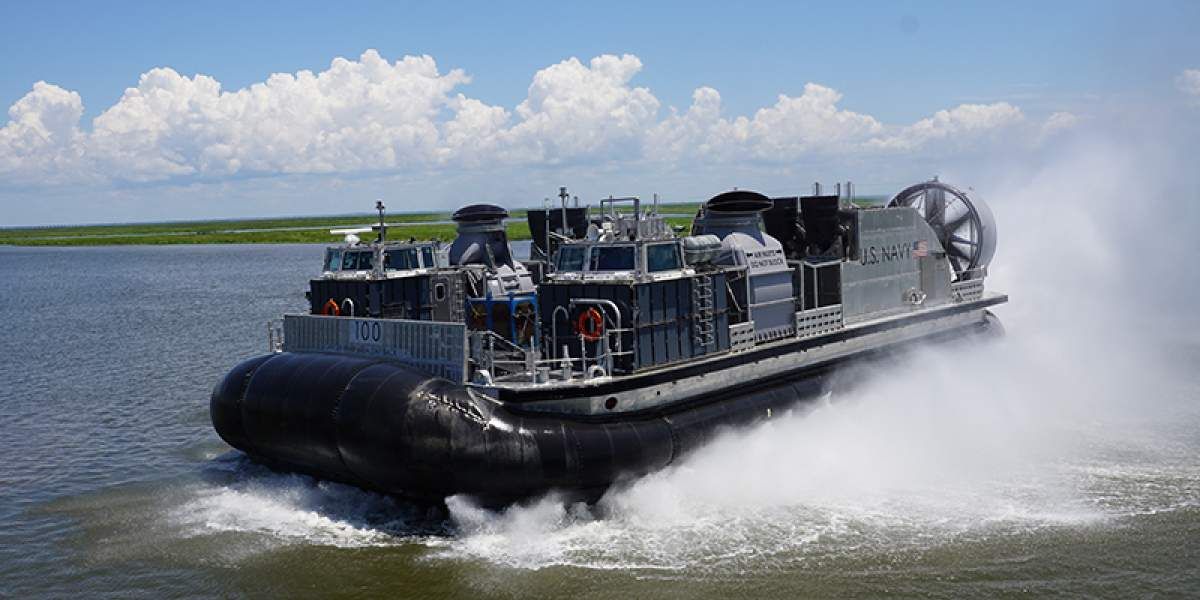
The Textron Systems LCAC-100-class Ship to Shore Connector, commonly abbreviated SSC, is a U.S. Navy air-cushioned landing craft developed to replace the service's earlier Landing Craft Air Cushion fleet. It is designed to transport personnel, vehicles, heavy equipment, and cargo between amphibious ships and shore areas without depending on prepared ports or conventional landing sites.
The SSC retains dimensions and clearances intended for compatibility with existing well-deck-equipped amphibious ships while providing greater payload capacity, improved reliability, and reduced maintenance requirements. Its air-cushion configuration allows it to cross shallow water, mud flats, marshes, beaches, and other coastal terrain that can restrict conventional displacement landing craft.
The program progressed from replacement studies during the 2000s to a competitive procurement, prototype and test-craft construction, serial production, and operational introduction. Initial Operational Capability was declared in 2023, and U.S. Navy procurement plans published in 2026 called for continued production into the following decade.
Development
The U.S. Navy considered several concepts for replacing its existing LCAC fleet. A 2003 Navy Transformation Roadmap discussed research and development for a Heavy Lift LCAC, while a later LCAC(X) concept evolved into the Ship to Shore Connector requirement.
In August 2010, the Navy issued a request for proposals covering the design and construction of SSC craft. Competing proposals included teams led by Marinette Marine, Textron Marine & Land Systems, and VT Halter. The Navy selected Textron, and on 6 July 2012 awarded the company a $212.7 million fixed-price incentive-fee contract for detailed design and construction of the first test and training craft. Options for eight additional craft could raise the contract value to $570.4 million.
Textron began fabrication of the first nine SSCs in November 2014. This production start is the earliest supported physical milestone for the LCAC-100-class program. Development and early production testing subsequently encountered gearbox reliability problems, blade micro-cracking, and integration delays. These issues contributed to schedule disruption before being progressively addressed during the test program.
The first Ship to Shore Connector was delivered on 6 February 2020. The program subsequently moved through additional post-delivery testing, ship well-deck interface evaluations, operational certification, and serial production.
Production and procurement
The Navy declared Initial Operational Capability in July 2023 after LCAC 107 was assigned to Assault Craft Unit 4 at Joint Expeditionary Base Little Creek in Virginia following completion of required testing and certification activities. LCAC 110 was delivered on 6 September 2024 after acceptance trials conducted by the Navy's Board of Inspection and Survey. Baird Maritime reported the delivery as the eleventh SSC landing craft.
Production continued during 2025 and 2026. A June 2026 report identified LCAC 116 as the latest SSC delivered and stated that LCAC 117 through LCAC 126 were under construction. WorkBoat described the continuing serial-production program.
In May 2026, the Navy's FY2027 shipbuilding plan called for procurement of four SSCs annually from fiscal 2027 through fiscal 2031. The corresponding production schedule extended deliveries through September 2036 and supported an overall objective of 72 operational SSCs plus one test and training vehicle. The FY2027 request allocated $733.895 million for four LCAC-100-class craft. The procurement sequence described in the plan extended through LCAC 158. Army Recognition published details of the FY2027 procurement schedule.
In August 2026, the U.S. Navy awarded Textron Systems a $231.5 million contract modification for two additional LCAC-100-class Ship to Shore Connectors. The modification was funded through fiscal 2026 Navy shipbuilding and conversion funds and added the two craft to an existing contract.
Design
The LCAC-100-class SSC follows the general configuration of the earlier U.S. Navy LCAC while incorporating substantial changes to propulsion, controls, materials, skirt design, and maintenance arrangements. The craft was deliberately sized to remain compatible with existing Navy amphibious ships equipped with well decks. It is also compatible with Military Sealift Command Expeditionary Transfer Docks.
Structure and cargo arrangement
The SSC uses corrosion-resistant aluminum construction together with composite propulsion structures. Its redesigned air-cushion skirt is intended to reduce drag and craft weight compared with the deep-skirt arrangement associated with the earlier LCAC design.
The craft has an open cargo deck measuring approximately 149 square metres (1,608 square feet). Program-level specifications give a payload capacity of 74 tonnes. A 2024 report for LCAC 110 listed a maximum load of 67 tonnes, while other program descriptions consistently state a 74-tonne SSC payload requirement. The higher figure is therefore used here as the class-level design specification.
The cargo deck can carry vehicles, heavy equipment, and other military loads. An enclosed personnel transport module can accommodate up to 145 combat-equipped personnel or 108 casualty personnel. The craft normally has a four-person crew consisting of a pilot, co-pilot, loadmaster, and deck engineer.
Controls and propulsion
The SSC incorporates fly-by-wire integrated controls. The cockpit is arranged for two operators and uses joystick controls, replacing some of the more mechanically intensive control arrangements of the earlier LCAC.
Propulsion is provided by four Rolls-Royce MT7 marine gas turbines. The MT7 is derived from the propulsion family used for the Bell Boeing V-22 Osprey, with a core related to the T406 and AE1107. This common engineering lineage was intended to provide logistical advantages for forces supporting both aircraft and hovercraft powered by related engine families.
The drivetrain was simplified compared with the legacy LCAC arrangement, using one gearbox on each side of the craft. The reduction in drivetrain components was intended to improve reliability and reduce maintenance requirements. Published specifications state a speed of 35 knots in Sea State 3, while the air-cushion system allows operation across shallow coastal waters and terrain where a conventional landing craft would be constrained by water depth.
Service-life features
The SSC was designed for a 30-year operational life. Corrosion-resistant materials, composite components, redesigned propulsion systems, and the simplified drivetrain were selected in part to increase availability and reduce life-cycle maintenance demands.
A capability to launch vehicles directly into the water rather than requiring the craft to reach a beach was planned for the tenth SSC delivered. The same capability was intended to be retrofitted to the previous nine craft.
Operational history
The U.S. Navy declared the Ship to Shore Connector operationally capable in July 2023. The craft are intended primarily to move U.S. Marine Corps personnel, combat vehicles, equipment, and supplies between larger amphibious ships and shore objectives. Their ability to operate over an air cushion permits movement across beaches, mud flats, shallow water, and other littoral terrain without relying on fixed port infrastructure.
The SSC also supports secondary missions including humanitarian assistance and disaster response. Navy planning described in 2026 increasingly associated the craft with distributed expeditionary logistics, tactical sustainment, and movement between dispersed coastal positions as well as traditional amphibious assault missions.
The class retains compatibility with existing LHD, LHA, LSD, and LPD well-deck ships. This allows the Navy to introduce the new hovercraft without requiring major structural alterations to the amphibious ships that previously operated the legacy LCAC fleet.
Operators
- United States Navy: The sole confirmed operator. The program is replacing the Navy's legacy LCAC fleet. Current acquisition planning calls for 72 operational SSCs plus one test and training craft, with serial production continuing and deliveries planned into 2036.
Specifications (LCAC-100-class Ship to Shore Connector)
General characteristics
- Type: Air-cushioned landing craft
- Crew: 4: pilot, co-pilot, loadmaster, and deck engineer
- Length: approximately 28 m (92 ft)
- Beam: approximately 15 m (48 ft)
- Overall height: approximately 7.9 m (26 ft)
- Displacement: 180.57 tonnes
- Cargo deck area: approximately 149 m² (1,608 sq ft)
- Payload: 74 tonnes
- Personnel capacity: up to 145 combat-equipped personnel
- Casualty transport capacity: up to 108 personnel
- Designed service life: 30 years
Performance
- Propulsion: 4 Rolls-Royce MT7 marine gas turbine engines
- Speed: 35 kn in Sea State 3
Related equipment
- Landing Craft Air Cushion: The earlier U.S. Navy air-cushion landing craft fleet that the Ship to Shore Connector is designed to replace.
 Argentina
 Armenia
 Australia
 Austria
 Austria-Hungary
 Belgium
 Brazil
 United Kingdom
 Brunei
 Bulgaria
 Canada
 Chile
Chile China
China Colonial America
 Colombia
 Confederate States
 Croatia
 Czech
Czech Denmark
 Egypt
Egypt Finland
 France
 Georgia
 Germany
 German Imperial
 Greece
 Holland
 Hungary
 India
India Indonesia
 Iran
Iran Iraq
Iraq Ireland
 Israel
 Italy
Italy Japan
Japan Japan (1940)
 Jordan
 Kingdom of Italy
 Malaysia
 Mexico
 Myanmar
 Nazi Germany
 Netherlands
 New Zealand
 North Korea
 Norway
 Pakistan
 Peru
Peru Philippines
 Poland
 Portugal
 Prussia
 Romania
 Russia
 Saudi Arabia
 Serbia
 Singapore
 Slovakia
 Slovenia
 South Africa
 South Korea
 Soviet Union
 Spain
Spain Sweden
 Switzerland
 Syria
Syria Taiwan
 Thailand
 Turkey
 UAE
UAE Ukraine
 Vietnam
 Yugoslavia