
History
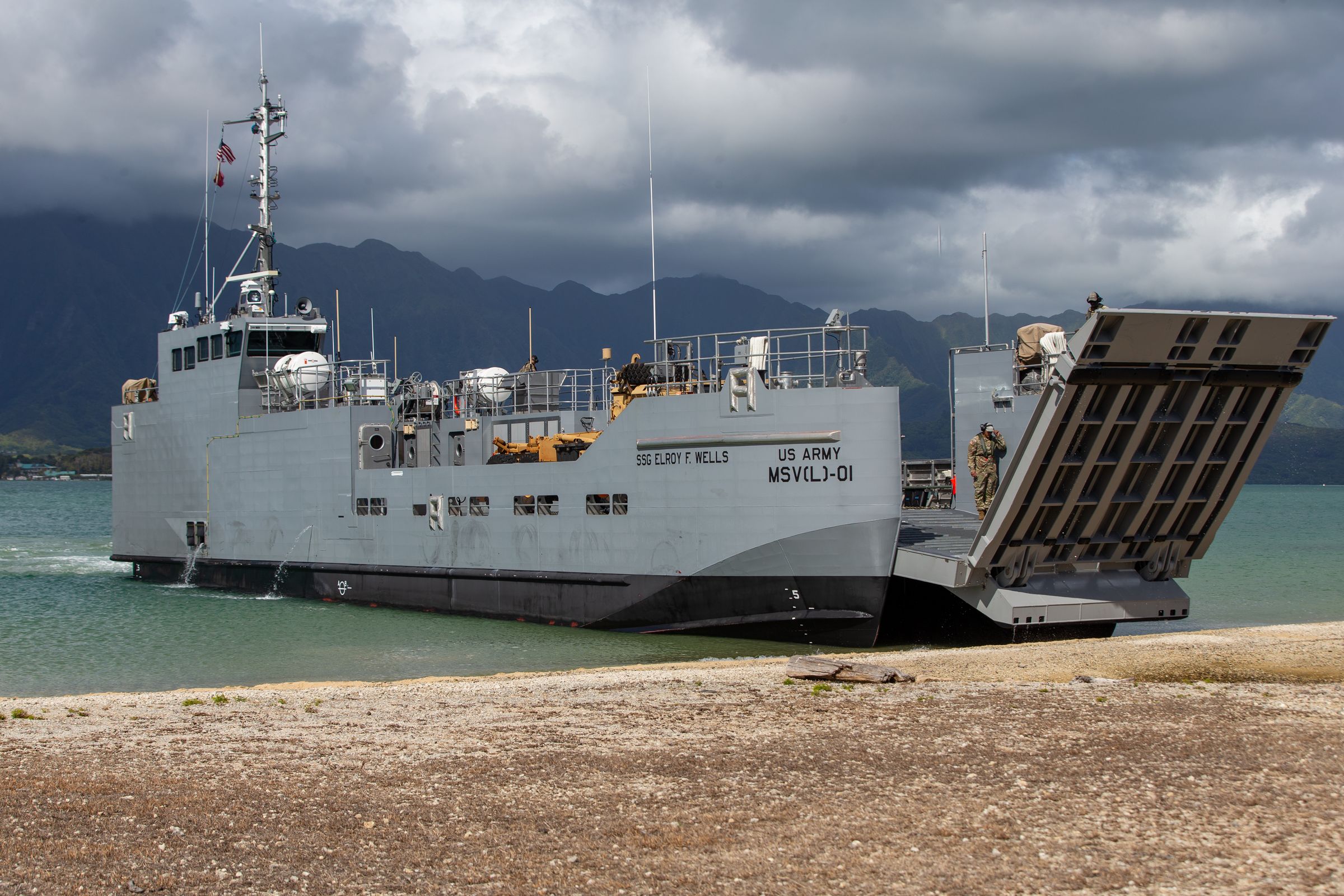
The Vigor Maneuver Support Vessel (Light), or MSV(L), is a high-speed landing craft developed for the U.S. Army. It transports personnel, armored vehicles, artillery systems, and other equipment through coastal waters and inland waterways to remote beaches or degraded ports.
The MSV(L) is intended to replace the Landing Craft Mechanized Mark 8, commonly known as the LCM-8. Its greater payload, speed, range, and shallow-water capability allow it to carry modern combat vehicles that exceed the capacity of the older craft.
The first prototype was launched in 2022. It subsequently supported Army trials and operational demonstrations, while Vigor prepared production vessels for delivery.
Development and production
The U.S. Army selected the Vigor design in September 2017. Vigor developed the vessel with BMT after studying the Army's transport requirements and available design options. The resulting craft evolved from the BMT Caimen-90 design. The contract covered one prototype, four low-rate production vessels, and options for as many as 32 additional vessels over ten years. The Vigor MSV(L) project page describes the design and contract structure.
Construction of the prototype began in 2019. Supply-chain and workforce problems associated with the COVID-19 pandemic delayed the work. Development was also affected by the bankruptcy of a BMT subcontractor in 2022. Despite these difficulties, the Army continued the program because no existing platform met its MSV(L) requirements. Contemporary details were reported by Naval News.
Vigor launched the prototype in Vancouver, Washington, in October 2022. Low-rate initial production work began in June 2024. On 11 August 2026, Vigor reported that the first production-ready vessel would undergo testing before its planned delivery to the Army in fall 2026. Three additional vessels were then under construction. Army budget documents warned that a lack of fiscal year 2027 funding could interrupt production and increase unit costs.
Design
The MSV(L) has an aluminum tribow monohull. This hull form is designed to improve maneuverability, stability while beached, and seakeeping in coastal waters. The vessel can operate through littoral areas, inland waterways, shallow approaches, and unimproved landing sites.
A raised central waterjet contributes to a fully laden draft of approximately 1.2 m. Three waterjets provide propulsion and reduce the need for exposed propellers in shallow water. Three main engines, each rated at 2,600 hp, power the propulsion system.
The cargo deck provides drive-through access and a grid of payload tie-down points. A bi-fold bow ramp supports rapid loading and unloading on beaches. A kedge anchor system helps control the vessel during beaching and withdrawal. The open deck imposes no fixed height limit on suitable payloads.
The vessel can carry up to 82 tons. Anticipated loads include one main battle tank or two armored vehicles. Other demonstrated loads include a High Mobility Artillery Rocket System launcher. The craft operates with a crew of eight and can carry two CROWS II remote weapon stations.
Operational history
On 24 and 25 February 2026, the prototype USAV Staff Sgt. Elroy F. Wells, identified as MSV-L 01, participated in a littoral rapid infiltration exercise in Hawaii. The vessel inserted and extracted a HIMARS launcher at an unimproved beach. This was the first reported use of an MSV(L) to transport HIMARS.
The exercise tested loading, maritime movement, beach landing, establishment of a simulated firing position, and rapid extraction. Army personnel reported that the shallow draft and waterjet propulsion helped the vessel cross reef-lined approaches and land in less than four feet of water. The U.S. Army account described the mission as a demonstration of dispersed long-range fire support in an island environment.
Operators
- United States Army: Development, testing, and initial production operator. The prototype supported Army exercises, and delivery of the first production-ready vessel was planned for fall 2026.
Specifications (MSV(L))
General characteristics
- Type: Landing craft
- Hull configuration: Tribow monohull
- Construction: Aluminum
- Length: 35.6 m (117 ft)
- Beam: 8.6 m (28 ft 2 in)
- Fully laden draft: 1.2 m (4 ft)
- Crew: 8
- Deck area: 157.7 m² (1,697 sq ft)
- Maximum payload: 82 tons
- Engines: Three engines rated at 2,600 hp each
- Propulsors: Three waterjets
Performance
- Maximum speed, laden: 21 knots
- Maximum speed, unladen: More than 30 knots
- Range: More than 360 nautical miles (667 km)
Payload and armament
- Vehicle capacity: One main battle tank or two armored vehicles
- Weapon mounts: Two CROWS II remote weapon-station mounts
- Loading system: Bi-fold bow ramp with drive-through deck access
Published dimensions and performance figures are also summarized by Naval Technology and the MSV(L) reference overview.
Related equipment
- Landing Craft Mechanized Mark 8: The older U.S. Army landing craft that the MSV(L) is intended to replace.
- BMT Caimen-90: The tested landing-craft design from which the MSV(L) hull concept evolved.
 Argentina
 Armenia
 Australia
 Austria
 Austria-Hungary
 Belgium
 Brazil
 United Kingdom
 Brunei
 Bulgaria
 Canada
 Chile
Chile China
China Colonial America
 Colombia
 Confederate States
 Croatia
 Czech
Czech Denmark
 Egypt
Egypt Finland
 France
 Georgia
 Germany
 German Imperial
 Greece
 Holland
 Hungary
 India
India Indonesia
 Iran
Iran Iraq
Iraq Ireland
 Israel
 Italy
Italy Japan
Japan Japan (1940)
 Jordan
 Kingdom of Italy
 Malaysia
 Mexico
 Myanmar
 Nazi Germany
 Netherlands
 New Zealand
 North Korea
 Norway
 Pakistan
 Peru
Peru Philippines
 Poland
 Portugal
 Prussia
 Romania
 Russia
 Saudi Arabia
 Serbia
 Singapore
 Slovakia
 Slovenia
 South Africa
 South Korea
 Soviet Union
 Spain
Spain Sweden
 Switzerland
 Syria
Syria Taiwan
 Thailand
 Turkey
 UAE
UAE Ukraine
 Vietnam
 Yugoslavia