
History
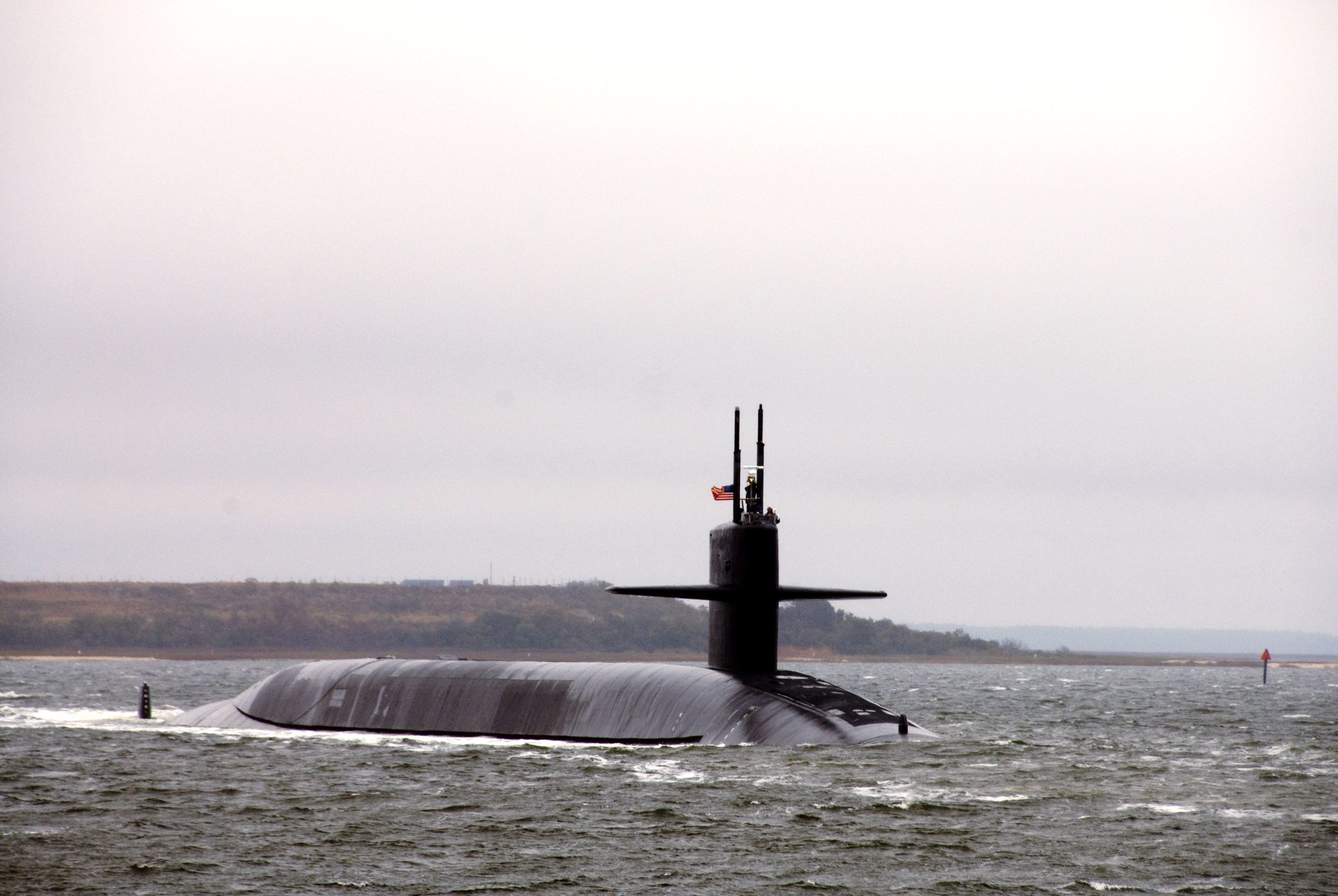
USS West Virginia (SSBN-736) is a United States Navy Ohio-class nuclear-powered ballistic missile submarine built by General Dynamics Electric Boat. It is the eleventh of 18 Ohio-class submarines and was constructed as a strategic deterrent platform for the Trident ballistic missile system.
West Virginia was launched in 1989 and commissioned on 20 October 1990. The submarine is based at Naval Submarine Base Kings Bay, Georgia, and uses separate Blue and Gold crews that alternate responsibility for patrols and other assignments.
The submarine remains associated with the United States sea-based nuclear deterrent mission. Its principal strategic armament is the Trident II D5 ballistic missile, while four torpedo tubes provide the ability to employ Mk 48 torpedoes.
Construction and commissioning
The contract for West Virginia was awarded to the Electric Boat Division of General Dynamics in Groton, Connecticut, on 21 November 1983. The keel was laid on 24 December 1987. The submarine was launched and christened on 14 October 1989, with Erma O. Byrd as sponsor, and was commissioned on 20 October 1990. Contemporary material identifies West Virginia as the eleventh Ohio-class submarine and the third submarine of the class fitted with the Trident II D5 missile system. Construction dates and original characteristics are documented in a USS West Virginia ship booklet.
West Virginia is the third U.S. Navy ship named for the state of West Virginia and the first submarine to carry the name. Its predecessors were the armored cruiser later renamed USS Huntington and the battleship USS West Virginia (BB-48).
Overhaul and later service
In 2010, personnel from the submarine's two alternating crews were combined into a smaller single crew in preparation for an overhaul and refueling period at Norfolk Naval Shipyard in Portsmouth, Virginia. The shipyard period began in 2011. West Virginia departed the yard on 24 October 2013 after a 30-month refueling and overhaul and returned to Kings Bay on 3 November 2013.
On 25 October 2022, West Virginia became the first U.S. Navy ballistic missile submarine reported to have docked at Diego Garcia.
2026 Blue Crew command change
Cmdr. Joseph Sammur assumed command of West Virginia's Blue Crew on 14 August 2025, succeeding Cmdr. James Kepper IV. On 30 July 2026, the commander of Submarine Squadron 20 relieved Sammur because of a loss of confidence in his ability to command. The Navy did not publicly specify the underlying reason in the announcement described by the source article. Sammur was temporarily reassigned to Submarine Group 10, and Cmdr. Luke Kelvington, then the squadron's Deputy for Training, became interim commander of the Blue Crew.
At the time of the command change, West Virginia was in port for maintenance. The Navy stated that the leadership change would not affect operations. A separate 2026 report connected the decision with an investigation into a maintenance issue, but the Navy account described in the principal source did not publicly identify a specific cause. The maintenance explanation therefore should not be treated as a confirmed official reason for Sammur's removal.
Design
West Virginia follows the Ohio-class configuration developed for long-duration strategic deterrent patrols. The class was designed with emphasis on quiet operation, extended periods between major overhauls, long submerged endurance, and the ability to carry more ballistic missiles than earlier U.S. fleet ballistic missile submarines.
Hull and internal arrangement
The submarine is approximately 170.7 m (560 ft) long with a hull diameter of about 12.8 m (42 ft). An original ship booklet gives a draft of about 11.0 m (36 ft). The layout includes command and control spaces, navigation and sonar areas, crew accommodation, machinery spaces, a large missile compartment, and a torpedo room.
Navigation and combat systems
The navigation subsystem provides an accurate geographic position for the submarine and supplies position information to the missile fire-control system for launch calculations. Maintaining an accurate position while submerged also supports extended operations without routinely exposing the submarine to obtain an external position fix.
The torpedo room contains four torpedo tubes arranged with two tubes on each side. West Virginia is capable of employing the Mk 48 torpedo.
Propulsion
West Virginia uses nuclear propulsion. Published Ohio-class data for the submarine identify an S8G pressurized-water reactor, geared turbines, one propulsion shaft, and an auxiliary propulsion motor. Nuclear propulsion supports extended submerged operations without the routine fuel limitations associated with conventionally powered submarines.
Strategic armament
The submarine was built with 24 ballistic-missile tubes and was equipped for Trident II D5 missiles. The long range of the Trident system allows Ohio-class submarines to conduct strategic deterrent patrols across large ocean areas while remaining based in the United States.
Operational history
West Virginia has served with the U.S. Navy's ballistic missile submarine force from Naval Submarine Base Kings Bay, Georgia. Its Blue and Gold crews alternate staffing and operating the submarine, an arrangement intended to support sustained strategic patrol availability.
Publicly available material documents periodic maintenance, refueling and overhaul work, crew changes, and port visits rather than the detailed movements of strategic deterrent patrols. As of the 2026 source material, the submarine remained in U.S. Navy service and was in port for maintenance when its Blue Crew commander was relieved.
Operators
- United States Navy: Operates USS West Virginia (SSBN-736) as an Ohio-class ballistic missile submarine from Kings Bay, Georgia, with alternating Blue and Gold crews.
Specifications (USS West Virginia SSBN-736)
General characteristics
- Type: Ohio-class nuclear-powered ballistic missile submarine
- Length: 170.7 m (560 ft)
- Hull diameter: 12.8 m (42 ft)
- Draft: approximately 11.0 m (36 ft) in the original ship booklet
- Surface displacement: approximately 17,033 t (16,764 long tons)
- Submerged displacement: approximately 19,050 t (18,750 long tons)
- Propulsion: one S8G pressurized-water nuclear reactor, geared turbines, one propulsion shaft, and auxiliary propulsion motor
- Original complement: 15 officers and 145 enlisted personnel in the original ship booklet
Performance
- Speed: reported as greater than 46 km/h (25 knots)
- Test depth: reported as greater than 240 m (800 ft)
Armament
- Ballistic missiles: originally 24 missile tubes for Trident II D5 missiles
- Torpedo tubes: four
- Torpedoes: Mk 48
Related equipment
- Ohio class: The U.S. Navy ballistic missile submarine class to which USS West Virginia belongs.
- Trident II D5: The submarine-launched ballistic missile system carried by West Virginia for its strategic deterrent mission.
 Argentina
 Armenia
 Australia
 Austria
 Austria-Hungary
 Belgium
 Brazil
 United Kingdom
 Brunei
 Bulgaria
 Canada
 Chile
Chile China
China Colonial America
 Colombia
 Confederate States
 Croatia
 Czech
Czech Denmark
 Egypt
Egypt Finland
 France
 Georgia
 Germany
 German Imperial
 Greece
 Holland
 Hungary
 India
India Indonesia
 Iran
Iran Iraq
Iraq Ireland
 Israel
 Italy
Italy Japan
Japan Japan (1940)
 Jordan
 Kingdom of Italy
 Malaysia
 Mexico
 Myanmar
 Nazi Germany
 Netherlands
 New Zealand
 North Korea
 Norway
 Pakistan
 Peru
Peru Philippines
 Poland
 Portugal
 Prussia
 Romania
 Russia
 Saudi Arabia
 Serbia
 Singapore
 Slovakia
 Slovenia
 South Africa
 South Korea
 Soviet Union
 Spain
Spain Sweden
 Switzerland
 Syria
Syria Taiwan
 Thailand
 Turkey
 UAE
UAE Ukraine
 Vietnam
 Yugoslavia