
History
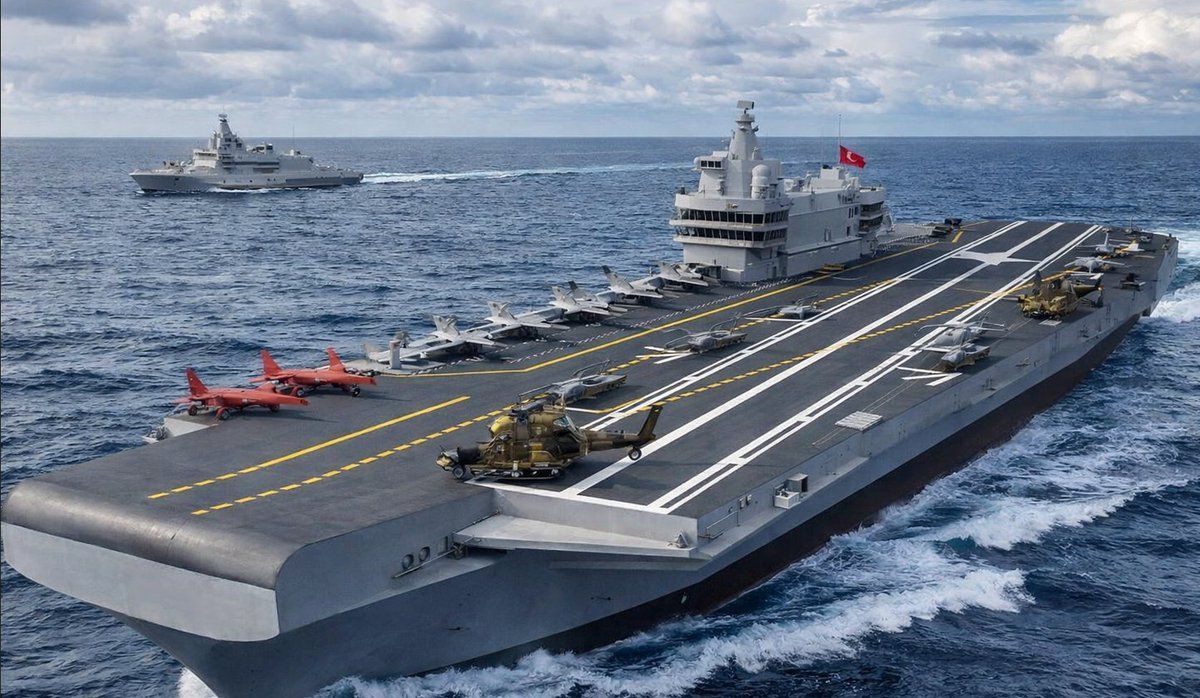
MUGEM, short for Milli Uçak Gemisi or National Aircraft Carrier, is Turkey’s indigenous aircraft carrier project. The conventionally powered ship is being developed for fixed-wing naval aviation and a large mixed force of manned and unmanned aircraft.
The current publicly disclosed configuration has a displacement of approximately 60,000 tonnes, an overall length of 285 m, a STOBAR flight deck, and capacity for 52 aircraft. The design also includes facilities for unmanned surface and underwater vehicles, creating what the Turkish Navy describes as a multi-domain carrier concept.
Construction of the first ship began at Istanbul Naval Shipyard on January 2, 2025. The Turkish Naval Forces announced a planned launch date of September 27, 2027, followed by outfitting, integration, testing, and verification before planned delivery in 2032.
Development
The MUGEM program began in 2023 with concept-of-operations development, feasibility studies, and analysis of alternatives. The project then advanced through concept and preliminary design work before entering detailed and contract design activities. Contrary to early assumptions that Turkey might enlarge the TCG Anadolu concept, the carrier developed into a purpose-designed ship with substantially greater dimensions and a dedicated fixed-wing aviation arrangement.
Construction started in January 2025 at Istanbul Naval Shipyard. By 2026, the design presented by the Turkish Navy specified a 285 m hull, 72 m maximum beam, 10.1 m draught, and displacement of about 60,000 tonnes. A Turkish Navy presentation at the 2026 Combined Naval Event also described a maximum speed above 26 knots, a cruising speed of approximately 14 knots, and a range of about 10,000 nautical miles at cruising speed. These specifications are also summarized in the MUGEM-class overview.
The Turkish Naval Forces Commander confirmed in August 2026 that the first MUGEM is planned to be launched on September 27, 2027. The launch will be a major structural milestone rather than completion of the carrier. Delivery remains planned for 2032, leaving several years for outfitting, installation of combat and aviation systems, harbor tests, sea trials, and verification. A detailed MUGEM technical profile describes the same 2027 launch and 2032 delivery targets.
Secondary reporting has not always used identical technical figures. A June 2026 program report discussed possible later increases to displacement and length and listed several propulsion concepts, while identifying some of those figures as reported or unconfirmed. The 285 m, approximately 60,000-tonne configuration presented by the Turkish Navy in 2026 is therefore used here as the current baseline.
Design
Hull and flight deck
MUGEM is designed as a conventionally powered aircraft carrier measuring approximately 285 m in overall length, 72 m in maximum beam, and 10.1 m in draught. Displacement is approximately 60,000 tonnes. Hydrodynamic development has included computational fluid dynamics analysis, towing-tank trials, bow optimization, propeller development, and seakeeping studies.
The ship is initially configured for STOBAR, or Short Take-Off But Arrested Recovery, operations. Aircraft will launch using their own engine power and a 12-degree ski-jump at the bow, while fixed-wing aircraft returning to the carrier will use arresting equipment. The 2026 flight-deck arrangement includes three take-off lanes and a dedicated landing area. The ski-jump is described as modular, allowing its removal if a future indigenous catapult system enables conversion toward CATOBAR operations.
Air-wake simulations and wind-tunnel testing have been conducted to study airflow over the flight deck and around the island. Seakeeping work is intended to permit unrestricted flight operations through Sea State 6. The carrier is also designed with stern and starboard-side ramps for logistics, vehicles, and equipment.
Air wing
The updated 2026 configuration provides capacity for 52 aircraft. Earlier information described a minimum capacity of 50 aircraft, including approximately 30 in the hangar and 20 on the flight deck. The planned air group combines manned and unmanned fixed-wing aircraft.
Aircraft publicly associated with MUGEM include a naval version of the TUSAŞ HÜRJET, the Baykar KIZILELMA unmanned combat aircraft, the TUSAŞ ANKA-3 flying-wing unmanned combat aircraft, and the Bayraktar TB3 unmanned aircraft. Turkish Navy statements have also described the possibility of carrying as many as 52 KIZILELMA aircraft in a single-type configuration. A navalized KAAN fighter has been discussed as a potential future possibility, but it is not a confirmed operational component of the carrier air wing.
The carrier concept also extends beyond aircraft. MUGEM is being designed with facilities for deploying and recovering unmanned surface vehicles and unmanned underwater vehicles. These systems are intended to operate through a network-centric command architecture together with the carrier’s aircraft and other naval platforms.
Propulsion
The detailed propulsion configuration has remained subject to refinement. A CODLAG arrangement presented in 2026 comprised two gas turbines, four electric motors, two shafts, and two controllable-pitch propellers. Separate reporting has also described an earlier or alternative plan using four GE LM2500 gas turbines. Because both configurations have appeared during the design process, the final installed arrangement should not be treated as confirmed until the program publishes a definitive configuration.
The current performance target is a maximum speed exceeding 26 knots. Cruising speed is approximately 14 knots, with a planned range of about 10,000 nautical miles at that speed. Propeller design and hydrodynamic optimization are being developed domestically, with testing intended to improve efficiency and reduce acoustic signature.
Combat systems and sensors
MUGEM is planned to use the indigenous ADVENT combat management system as the principal command-and-control architecture. The system is intended to integrate the carrier’s sensors, weapons, manned aircraft, unmanned aircraft, surface vehicles, and underwater vehicles within a network-centric operating environment.
The disclosed defensive armament includes two 16-cell MİDLAS vertical launch system modules for a total of 32 cells, three close-in weapon systems, four remotely controlled weapon stations, and two point-defense missile systems. These weapons are intended to provide local defense while the carrier operates as part of a larger naval task group.
Planned sensors include ÇAFRAD multifunction and long-range radar elements, low-probability-of-intercept radar, infrared tracking systems, electro-optical directors, identification friend-or-foe equipment, and electronic-support and electronic-attack systems. Satellite communications are planned in X-, Ku-, and Ka-bands. The design also includes laser electronic-attack capability.
Accommodation, medical and logistics facilities
The 2026 configuration provides accommodation for as many as 2,500 people. This total includes the ship’s company together with aviation personnel, maintainers, command staff, medical personnel, and other embarked elements and should not be interpreted as the basic ship crew alone.
Medical facilities are planned to meet Role 2 Enhanced standards. Disclosed facilities include operating rooms, dental clinics, intensive care, burn treatment, radiology, isolation spaces, inpatient wards, a laboratory, and a pharmacy. These facilities are intended to support surgery, trauma stabilization, and inpatient treatment at sea.
Program status
The first MUGEM is under construction at Istanbul Naval Shipyard. The ship is scheduled for launch on September 27, 2027. Delivery to the Turkish Naval Forces is planned for 2032 after completion of outfitting, combat-system integration, aviation-system installation, harbor testing, sea trials, and verification.
The carrier remains a development program and is not operational. Its planned aircraft, propulsion arrangement, combat systems, and detailed internal configuration may continue to change before completion.
Specifications (MUGEM 2026 configuration)
General characteristics
- Type: Conventionally powered STOBAR aircraft carrier
- Length: 285 m
- Maximum beam: 72 m
- Draught: 10.1 m
- Displacement: Approximately 60,000 tonnes
- Accommodation: Up to 2,500 personnel
- Aircraft capacity: 52 aircraft in the updated 2026 configuration
- Flight deck: Three take-off lanes, arrested landing area, and 12-degree ski-jump
Performance
- Maximum speed: More than 26 knots
- Cruising speed: Approximately 14 knots
- Range: Approximately 10,000 nautical miles at 14 knots
Aviation
- Planned manned aircraft: Naval variant of TUSAŞ HÜRJET
- Planned unmanned aircraft: Baykar KIZILELMA, TUSAŞ ANKA-3, and Bayraktar TB3
- Launch and recovery: STOBAR with 12-degree ski-jump and arresting equipment
Armament
- Vertical launch system: 32 MİDLAS cells in two 16-cell modules
- Close-in defense: Three close-in weapon systems
- Remote weapon stations: Four
- Point-defense missile systems: Two
 Argentina
 Armenia
 Australia
 Austria
 Austria-Hungary
 Belgium
 Brazil
 United Kingdom
 United States
 Brunei
 Bulgaria
 Canada
 Chile
Chile China
China Colonial America
 Colombia
 Confederate States
 Croatia
 Czech
Czech Denmark
 Egypt
Egypt Finland
 France
 Georgia
 Germany
 German Imperial
 Greece
 Holland
 Hungary
 India
India Indonesia
 Iran
Iran Iraq
Iraq Ireland
 Israel
 Italy
Italy Japan
Japan Japan (1940)
 Jordan
 Kingdom of Italy
 Malaysia
 Mexico
 Myanmar
 Nazi Germany
 Netherlands
 New Zealand
 North Korea
 Norway
 Pakistan
 Peru
Peru Philippines
 Poland
 Portugal
 Prussia
 Romania
 Russia
 Saudi Arabia
 Serbia
 Singapore
 Slovakia
 Slovenia
 South Africa
 South Korea
 Soviet Union
 Spain
Spain Sweden
 Switzerland
 Syria
Syria Taiwan
 Thailand
 UAE
UAE Ukraine
 Vietnam
 Yugoslavia