
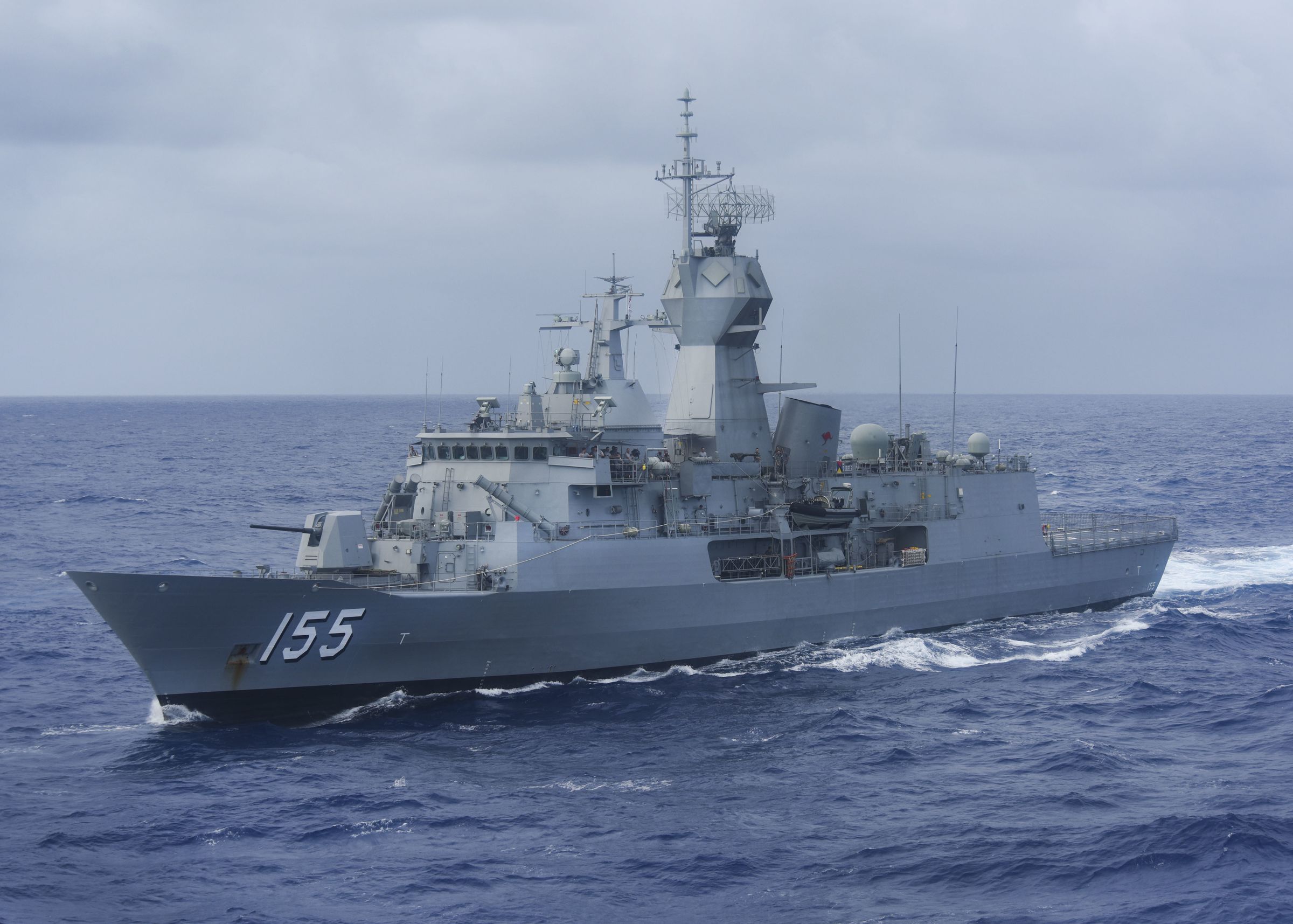
History
The Anzac class is a group of long-range frigates developed jointly for Australia and New Zealand from the German Blohm + Voss MEKO 200 design. Eight ships were built for the Royal Australian Navy and two for the Royal New Zealand Navy. The Australian ships became a core surface-combatant capability for surveillance, patrol, protection of shipping, naval gunfire support and other maritime missions.
The program began in the mid-1980s when Australia sought a replacement for its River-class destroyer escorts while New Zealand was considering replacements for its Leander-class frigates. The two countries signed a memorandum of understanding on 6 March 1987 and combined their requirements under the Anzac Ship Project.
The design was deliberately based on an established foreign frigate rather than a completely new Australian design. The selected MEKO 200 derivative combined a 3,600-tonne class hull, CODOG propulsion, helicopter facilities and provision for progressive installation of weapons and sensors throughout the ships' service lives.
Selection and construction
Tenders were requested in 1986. Competing proposals included versions of the Dutch M class, British Type 23, German MEKO 200 and several other frigate designs. The competition was eventually narrowed to the MEKO proposal offered by Blohm + Voss with AMECON and the M-class proposal offered by Royal Schelde with Australian Warship Systems.
On 14 August 1989, the Australian government selected the modified MEKO 200 proposal for construction by AMECON. The design is also identified as the MEKO 200 ANZ. The ships were assembled at Williamstown, Victoria, while the modular construction method allowed hull and superstructure sections for later vessels to be produced at other Australian and New Zealand facilities. More background on the acquisition is available from the Royal Australian Navy history.
Steel cutting for the lead ship, HMAS Anzac, began on 27 March 1992. HMAS Anzac entered Royal Australian Navy service in May 1996. The first New Zealand ship, HMNZS Te Kaha, entered service in July 1997. The final Australian ship, HMAS Perth, was commissioned in August 2006.
Australian government audit material identifies eight Anzac-class frigates in Royal Australian Navy service during the class's mature operational period, while the New Zealand program produced two ships. This ten-ship total is also consistent with the individual ship records and the wider program history.
Capability upgrades
The ships entered service with a deliberately limited baseline armament and with space or provisions for additional systems. Australia and New Zealand subsequently pursued national upgrade programs rather than maintaining a single identical configuration across the class.
For the Australian ships, plans for a Warfighting Improvement Program were followed by the Anti-Ship Missile Defence program. The Australian upgrade introduced CEA Technologies CEAFAR phased-array radar, CEAMOUNT illuminators and associated combat-system improvements. HMAS Perth entered the upgrade process in January 2010 and was used for trials after completion of the work. Trials were completed in 2011, and upgrades of the remaining Australian ships continued through 2017.
The Royal Australian Navy later implemented the Anzac Mid-Life Capability Assurance Program. This work addressed obsolescence and included improvements to long-range air-search radar, identification systems, communications, platform reliability, maintainability and crew habitability. The HMAS Warramunga profile describes the upgraded Australian configuration and its principal systems.
Design
Hull and layout
The Anzac class is derived from the Blohm + Voss MEKO 200 family and was adapted for Australian and New Zealand requirements. The ships use all-steel hull and superstructure construction and are fitted with fin stabilisers. The modular MEKO concept also supported distributed construction of hull and superstructure modules before final assembly.
The baseline design has an overall length of 118 m, a beam of 14.8 m and a full-load displacement of approximately 3,600 tonnes. Published draught figures for Australian ships are approximately 4.35 to 4.5 m depending on the source and configuration. Later equipment additions increased displacement on some upgraded ships.
Propulsion
The frigates use combined diesel or gas propulsion. The machinery arrangement consists of one General Electric LM2500-series gas turbine and two MTU 12V1163 diesels driving two controllable-pitch propellers. The arrangement permits economical cruising on diesel power and higher sprint speed using the gas turbine.
The class was designed for a maximum speed of about 27 knots and a range exceeding 6,000 nautical miles at 18 knots. Royal Australian Navy material describes sprint speed as greater than 27 knots.
Combat system and sensors
Australian Anzac-class frigates were progressively equipped with a Saab 9LV-series combat-management system and upgraded radar and electro-optical sensors. The Anti-Ship Missile Defence upgrade introduced the Australian-developed CEAFAR active phased-array radar and CEAMOUNT target illuminators, together with combat-system changes intended to improve defence against air and missile threats.
Systems listed for upgraded Australian ships also include long-range air-search radar, navigation radar, hull-mounted sonar, mine and obstacle avoidance sonar, electronic-support equipment and infrared search-and-track equipment. Exact fits vary according to ship and upgrade state.
Armament and aviation
Australian ships are armed with a 127 mm Mark 45 naval gun and a Mark 41 vertical launching system for Evolved Sea Sparrow Missiles. The ESSM can be quad-packed in the launcher, increasing missile capacity compared with the earlier Sea Sparrow arrangement. Australian ships also received Harpoon anti-ship missiles.
Torpedo armament is carried in two triple Mark 32 launchers. Australian ships originally used Mark 46 torpedoes and later adopted the MU90 Impact torpedo. Additional defensive equipment includes decoy systems and heavy machine guns on upgraded ships.
The class has a flight deck and hangar for a single helicopter. Australian ships can operate the MH-60R Seahawk, extending anti-submarine, anti-surface and search-and-rescue capability beyond the range of shipboard sensors and weapons.
Operational history
Anzac-class frigates have deployed extensively outside their home waters. Australian audit records describe repeated operations in Australian, Middle Eastern and Asia-Pacific waters. New Zealand ships have also conducted long-range deployments.
In 1999, HMNZS Te Kaha participated in activities that included operations associated with the multinational deployment to East Timor and service with the Multinational Interception Force in the Persian Gulf. New Zealand Anzac-class frigates also served around the Solomon Islands and later returned to the Persian Gulf.
In March 2003, HMAS Anzac provided naval gunfire support to Royal Marines during the Battle of Al Faw in the Iraq War. The class has also supported surveillance, maritime patrol, shipping protection, disaster relief and search-and-rescue missions.
Sustainment and service life
The high operational use of the Australian Anzac fleet created increasing maintenance and sustainment demands. An Australian National Audit Office sustainment audit found that operational use had exceeded assumptions in earlier sustainment planning and that obsolescence, maintenance deferrals and shortages of some parts contributed to support difficulties.
The audit recorded that the Australian government had extended the planned life-of-type of the class to support the transition to replacement frigates. It also warned that the material condition of hulls and subsystems and the cost of maintaining older ships would need continuing attention.
HMAS Anzac, the first ship of the class, was decommissioned in 2024. By September 2026, Australia operated seven Anzac-class frigates. The Royal Australian Navy was transitioning toward replacement surface combatants, including the Hunter-class program and planned general-purpose frigates.
On 2 September 2026, Australia's Department of Defence announced a new long-term sustainment arrangement appointing Babcock Australia as capability life-cycle manager for the seven remaining Australian ships. Babcock is to work with Saab Australia on engineering support, spare parts, asset management and coordination with Australian industry suppliers.
Variants
- Royal Australian Navy configuration — Eight ships were built for Australia. The ships received national upgrades including ESSM, Harpoon, the Anti-Ship Missile Defence program with CEAFAR and CEAMOUNT, and the Mid-Life Capability Assurance Program.
- Royal New Zealand Navy configuration — Two ships were built for New Zealand. The RNZN pursued its own national upgrade path after the ships entered service.
Operators
- Australia — Eight ships were built for the Royal Australian Navy. Seven remained in Australian service in September 2026 following the decommissioning of HMAS Anzac in 2024.
- New Zealand — Two ships were acquired for the Royal New Zealand Navy. New Zealand planning has called for their eventual replacement by new surface combatants.
Specifications (HMAS Warramunga, upgraded RAN configuration)
General characteristics
- Type: helicopter frigate
- Displacement: approximately 3,600 tonnes
- Length: 118 m
- Beam: 14.8 m
- Draught: 4.5 m
- Crew: 177
- Propulsion: CODOG with one General Electric LM2500 gas turbine and two MTU 12V1163 diesel engines driving two controllable-pitch propellers
- Aircraft: one MH-60R Seahawk helicopter
Performance
- Maximum speed: approximately 27 knots, with Royal Australian Navy material describing sprint speed as greater than 27 knots
- Range: more than 6,000 nautical miles at 18 knots
Armament
- Main gun: one 127 mm Mark 45 Mod 2 naval gun
- Surface-to-air missiles: Evolved Sea Sparrow Missiles in a Mark 41 vertical launching system
- Anti-ship missiles: Harpoon missiles
- Torpedoes: two Mark 32 Mod 5 triple torpedo-tube mounts
- Machine guns: four 12.7 mm machine guns listed for HMAS Warramunga
Sensors and defensive systems
- Air and surface surveillance: long-range air-search radar and CEAFAR active phased-array radar
- Target illumination: CEAMOUNT illuminators and Saab Ceros 200 director
- Sonar: Thomson Sintra Spherion hull-mounted sonar and Thales UMS 5424 Petrel mine and obstacle avoidance sonar
- Combat data system: Saab Systems 9LV453 Mk3E
- Countermeasures: SRBOC decoy launchers, Nulka active missile decoys and SLQ-25-series torpedo countermeasures
Related equipment
- MEKO 200 — German modular frigate design family from which the Anzac class was developed.
- Hunter class — Australian replacement frigate program intended to take over part of the Anzac class's surface-combatant role.
 Argentina
 Armenia
 Austria
 Austria-Hungary
 Belgium
 Brazil
 United Kingdom
 United States
 Brunei
 Bulgaria
 Canada
 Chile
Chile China
China Colonial America
 Colombia
 Confederate States
 Croatia
 Czech
Czech Denmark
 Egypt
Egypt Finland
 France
 Georgia
 Germany
 German Imperial
 Greece
 Holland
 Hungary
 India
India Indonesia
 Iran
Iran Iraq
Iraq Ireland
 Israel
 Italy
Italy Japan
Japan Japan (1940)
 Jordan
 Kingdom of Italy
 Malaysia
 Mexico
 Myanmar
 Nazi Germany
 Netherlands
 New Zealand
 North Korea
 Norway
 Pakistan
 Peru
Peru Philippines
 Poland
 Portugal
 Prussia
 Romania
 Russia
 Saudi Arabia
 Serbia
 Singapore
 Slovakia
 Slovenia
 South Africa
 South Korea
 Soviet Union
 Spain
Spain Sweden
 Switzerland
 Syria
Syria Taiwan
 Thailand
 Turkey
 UAE
UAE Ukraine
 Vietnam
 Yugoslavia