
History
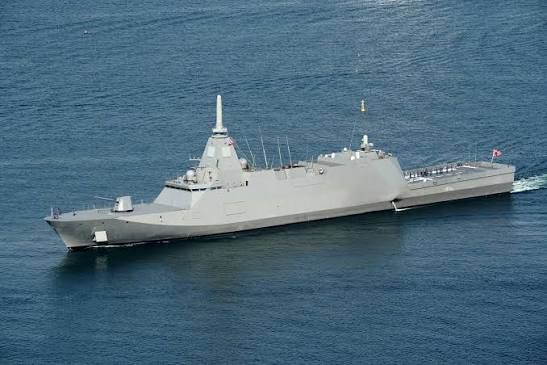
The Mogami-class frigate, also known as 30FFM or 30DX, is a Japanese multi-mission surface combatant developed for the Japan Maritime Self-Defense Force. Mitsubishi Heavy Industries serves as the prime contractor, with Mitsui Engineering and Shipbuilding selected as a subcontractor. The design combines reduced signatures, extensive automation, anti-submarine warfare, mine countermeasures, surface warfare, and air-defense functions.
The class was developed to replace older Asagiri-class destroyers and Abukuma-class destroyer escorts while reducing personnel requirements. A crew of about 90 is enabled by centralized ship control, integrated combat and engineering functions, and a highly automated combat information center.
Japan originally planned to acquire 22 Mogami-class frigates, but in 2023 the Ministry of Defense reduced the baseline program to 12 ships and shifted subsequent procurement toward a larger New FFM, also promoted as the Upgraded Mogami.
Japan funded studies in 2015 for a compact surface combatant with additional multi-function capabilities and a new radar system. Mitsubishi Heavy Industries also displayed its own 30FF concept that year. In August 2017, the Acquisition, Technology and Logistics Agency selected Mitsubishi Heavy Industries as prime contractor and Mitsui Engineering and Shipbuilding as subcontractor for a new design identified as 30DX.
A December 2018 plan called for 22 frigates, with construction proceeding at approximately two ships per year. Construction of the class began in 2019. JS Mogami, FFM-1, was launched in March 2021 and commissioned in April 2022. JS Kumano, the second ship of the class, entered service in March 2022 and therefore became operational before the nominal lead ship.
The program subsequently expanded through successive ships. By June 29, 2026, the JMSDF had commissioned JS Nagara, FFM-10. The source material states that Nagara was laid down on July 6, 2023, launched on December 19, 2024, and delivered on June 29, 2026.
In August 2023, Japan announced that the original Mogami-class program would stop after 12 ships. The following group would use a larger New FFM design. Mitsubishi Heavy Industries publicly presented the Upgraded Mogami configuration in 2024. This derivative increases displacement, hull dimensions, missile capacity, and growth margins while retaining the basic concept of a highly automated multi-mission frigate.
Design
Hull and automation
The baseline Mogami-class has a standard displacement of approximately 3,900 tonnes and a full-load displacement of about 5,500 tonnes. It is approximately 133 m long, 16.3 m wide, and has a draught of about 4.5 m. Sloped surfaces, an integrated mast, and enclosed external features are used to reduce the ship's radar signature.
A major design objective is reduced crewing. The class normally operates with approximately 90 personnel. The Advanced Integrated Combat Information Center consolidates tactical, navigation, engineering, damage-control, and ship-management functions. Available descriptions identify a circular panoramic display arrangement and centralized multifunction consoles intended to reduce the number of separate watch stations.
Propulsion
The frigates use combined diesel and gas propulsion. The machinery consists of one Rolls-Royce MT30 gas turbine and two MAN 12V28/33D STC diesel engines driving two shafts with controllable-pitch propellers. Maximum speed exceeds 30 knots.
Sensors and combat systems
The main radar is the OPY-2 X-band active electronically scanned array multifunction radar. The sensor suite also includes the OAX-3 electro-optical and infrared system. The OYQ-1 combat management system and OYX-1 series operator consoles integrate tactical information and ship functions. Electronic warfare equipment includes the NOLQ-3E system and associated countermeasure equipment.
For anti-submarine warfare, the class uses the OQQ-25 variable-depth sonar and towed-array sonar system. Mine warfare equipment includes the OQQ-11 mine-hunting sonar. The stern mission area allows the deployment and recovery of unmanned underwater vehicles, unmanned surface vehicles, and other mission equipment. The ships can also support mine-laying and mine-countermeasure tasks.
Armament
The main gun is a 127 mm Mk 45 Mod 4 naval gun. Close-range defense is provided by SeaRAM, while two remotely operated 12.7 mm weapon stations provide additional protection against nearby threats.
The baseline design incorporates provision for a 16-cell Mk 41 vertical launching system. Early ships entered service without the launcher, and Japanese funding subsequently provided for installation on the class. The supplied sources identify Type 03 family surface-to-air missiles and Type 07 vertical-launch anti-submarine rockets as intended weapons for the VLS.
Eight canister-launched anti-ship missiles are carried in two four-round launchers. Several supplied sources identify the weapon as the Type 17 SSM-2, while another describes it as a ship-launched Type 12 derivative. The available material therefore does not provide fully consistent naming for this missile installation.
Lightweight torpedoes are carried in two triple 324 mm launchers. A hangar and flight deck support one maritime helicopter, with supplied descriptions identifying SH-60K or SH-60L aircraft depending on the period and configuration described.
Operational history
The Mogami-class entered JMSDF service in 2022. JS Kumano was commissioned in March 2022, followed by JS Mogami in April. Additional ships entered service as construction continued. The class is intended for anti-submarine warfare, anti-surface warfare, limited air defense, surveillance, mine warfare, maritime security, patrol, and other general-purpose naval missions.
The ships have also been used in Japanese defense engagement with prospective foreign customers. JS Kumano visited Indonesia in 2023, and JS Yahagi visited in 2025. Indonesian officials also inspected Mogami-class ships in Japan. These contacts formed part of discussions concerning possible Indonesian acquisition, but Indonesia had not signed a procurement contract in the supplied August 2026 material.
Variants
- Mogami-class 30FFM / 30DX: Baseline JMSDF frigate with approximately 3,900 tonnes standard displacement, a crew of about 90, CODAG propulsion, multi-mission sensors, mine-warfare equipment, and provision for a 16-cell Mk 41 VLS.
- New FFM / Upgraded Mogami: Enlarged derivative developed after Japan reduced the baseline program to 12 ships. The design is approximately 142 m long and 17 m wide, with standard displacement of about 4,800-4,880 tonnes and full-load displacement around 6,200 tonnes. It uses a 32-cell Mk 41 VLS and retains a crew requirement close to that of the smaller baseline design.
- Australian 06FFM configuration: Australia selected an Upgraded Mogami derivative for its future general-purpose frigate program. The Royal Australian Navy lists a 142 m hull, 4,800-tonne standard displacement, 32-cell VLS, SeaRAM, a 5-inch gun, towed-array sonar, AESA radar, approximately 92 crew, and accommodation for 127. The first three ships are planned to be built in Japan by Mitsubishi Heavy Industries, with later construction planned in Australia subject to program conditions. The first ship is planned for delivery at the end of 2029.
Operators
- Japan: Japan Maritime Self-Defense Force. Twelve baseline Mogami-class frigates are planned, with ten reported commissioned by June 29, 2026 in the supplied material.
Export and program developments
Australia selected the Upgraded Mogami design in August 2025 for its future general-purpose frigate program. The Royal Australian Navy describes the ships as replacements for the Anzac class and lists anti-submarine warfare, limited air defense, maritime and land strike, and force protection among their intended roles. The first three ships are to be constructed in Japan, while later vessels are planned for construction at Henderson in Western Australia subject to the required conditions.
Indonesia has also considered the Mogami family. An earlier 2021 concept involved eight frigates, with four to be built in Japan and four at PT PAL in Surabaya. The proposal later lost momentum. Indonesian interest was renewed, and on August 26, 2026, Japan, Indonesia, and Australia held trilateral defense discussions during which the Upgraded Mogami was again considered. The supplied source describes the prospective requirement as eight ships but states that Indonesia had not yet entered contract negotiations.
Specifications (Mogami-class 30FFM)
General characteristics
- Type: Multi-mission frigate
- Standard displacement: Approximately 3,900 tonnes
- Full-load displacement: Approximately 5,500 tonnes
- Length: Approximately 133 m
- Beam: 16.3 m
- Draught: Approximately 4.5 m
- Crew: Approximately 90
- Propulsion: CODAG with one Rolls-Royce MT30 gas turbine and two MAN 12V28/33D STC diesel engines
- Drive: Two shafts with controllable-pitch propellers
- Aviation facilities: Flight deck and hangar for one maritime helicopter
Performance
- Maximum speed: More than 30 knots
Armament
- Main gun: One 127 mm Mk 45 Mod 4 naval gun
- Vertical launch system: Provision for 16 Mk 41 cells, with installation funded progressively for the class
- Anti-ship missiles: Eight missiles in two four-round launchers; supplied sources differ between the Type 17 SSM-2 designation and descriptions as a ship-launched Type 12 derivative
- Close-in defense: One SeaRAM system
- Torpedoes: Two triple 324 mm lightweight torpedo launchers
- Remote weapons: Two 12.7 mm remote weapon stations
Sensors and systems
- Radar: OPY-2 X-band AESA multifunction radar
- Electro-optical system: OAX-3 EO/IR system
- Anti-submarine sonar: OQQ-25 variable-depth sonar and towed-array sonar system
- Mine-hunting sonar: OQQ-11
- Combat management system: OYQ-1
- Electronic warfare: NOLQ-3E
 Argentina
 Armenia
 Australia
 Austria
 Austria-Hungary
 Belgium
 Brazil
 United Kingdom
 United States
 Brunei
 Bulgaria
 Canada
 Chile
Chile China
China Colonial America
 Colombia
 Confederate States
 Croatia
 Czech
Czech Denmark
 Egypt
Egypt Finland
 France
 Georgia
 Germany
 German Imperial
 Greece
 Holland
 Hungary
 India
India Indonesia
 Iran
Iran Iraq
Iraq Ireland
 Israel
 Italy
Italy Japan (1940)
 Jordan
 Kingdom of Italy
 Malaysia
 Mexico
 Myanmar
 Nazi Germany
 Netherlands
 New Zealand
 North Korea
 Norway
 Pakistan
 Peru
Peru Philippines
 Poland
 Portugal
 Prussia
 Romania
 Russia
 Saudi Arabia
 Serbia
 Singapore
 Slovakia
 Slovenia
 South Africa
 South Korea
 Soviet Union
 Spain
Spain Sweden
 Switzerland
 Syria
Syria Taiwan
 Thailand
 Turkey
 UAE
UAE Ukraine
 Vietnam
 Yugoslavia