
History
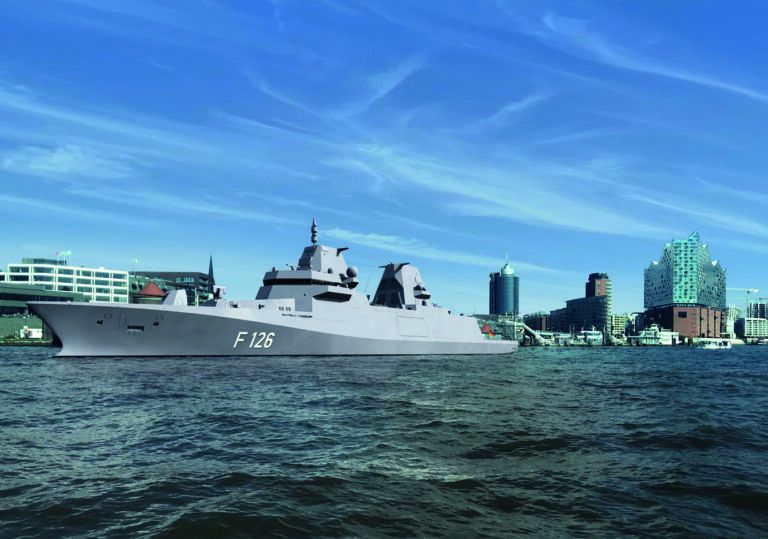
The F126 and MEKO A-200 DEU programs represent successive German efforts to provide the German Navy with modern frigates able to perform anti-submarine warfare and other maritime missions. The F126 program was developed as a large, mission-modular replacement for the Brandenburg-class frigates, while the MEKO A-200 DEU was selected in 2026 as a faster alternative after the F126 procurement encountered major delays and rising costs.
Germany formally canceled the F126 program on 24 June 2026. The Defense Ministry stated that the original contractor could no longer guarantee completion within the agreed schedule and financial framework. The government subsequently pursued procurement of eight MEKO A-200 DEU frigates from ThyssenKrupp Marine Systems, subject to parliamentary budget approval.
The replacement decision retained anti-submarine warfare as the central requirement. The Inspector of the German Navy concluded that the MEKO A-200 DEU could perform the Navy's core submarine-hunting mission and meet Germany's related NATO commitments.
Development of F126
Early studies that eventually led to F126 began in 2009. The concept evolved from a replacement for German fast attack craft into a larger multi-role combat ship intended for lengthy deployments and configurable missions. Detailed requirements were formally established in 2013, and a fully compliant design concept was selected in 2015. The project later became the planned replacement for the four Brandenburg-class frigates, which represented an important part of the German Navy's anti-submarine warfare capability. A detailed history of the program is summarized by SeaForces.
The program was initially known as MKS 180, or Mehrzweckkampfschiff 180. The designation was changed to F126 from 1 January 2021. The design emphasized mission modularity, allowing specialized equipment, sensors, spaces, and weapons associated with particular tasks to be installed as mission modules.
After a competitive procurement process, the Damen Group won the tender in January 2020. The contract was signed on 17 June 2020. German parliamentary approval initially covered four ships and options for two more, while construction and integration work involved German shipyards and subcontractors.
The F126 ships were planned to assume the anti-submarine role of the Brandenburg class through an anti-submarine warfare module incorporating a towed-array sonar. Other mission concepts included detention facilities, while earlier planning also considered mine-countermeasure and diving-related modules. The program also emphasized long deployments, with rotating crews intended to reduce the amount of time individual hulls spent returning to Germany.
Schedule and contractor problems
By the later stages of the program, Germany planned six F126 frigates. Reporting in 2026 described the ships as approximately 10,550-ton vessels and placed the total program value at roughly €10 billion. The first ship had been expected to achieve initial capability in 2028, with all six planned for availability by 2033. The 2028 date was therefore a planned milestone and was not achieved before the program was canceled.
Damen Schelde Naval Shipbuilding informed the German government that the vessels could not be completed within the contracted schedule and budget. Germany began examining a transfer of the general-contractor role to Naval Vessels Lürssen in 2025. According to the Defense Ministry figures reported by Defense News, a negotiated continuation under the new contractor would have cost approximately €15.2 billion for six ships. Including work already performed and necessary supply and support contracts, the total requirement would have exceeded €18 billion.
A contractor change would also have required the German government to waive possible damage claims against Damen. The ministry rejected that condition and stated that the possible claims remained under legal review. Breaking Defense likewise reported that the combination of delays, additional costs, and the legal consequences of changing contractors contributed to the decision to terminate F126.
Cancellation and MEKO replacement
On 24 June 2026, the German Defense Ministry announced the cancellation of the F126 construction program. Germany instead moved toward procurement of eight MEKO A-200 DEU frigates from ThyssenKrupp Marine Systems. The new ships are intended primarily for anti-submarine warfare and for fulfilling German commitments to NATO.
The replacement concept had been under consideration before the final F126 cancellation. Germany had examined an initial acquisition of four MEKO A-200 DEU ships as a bridge solution while discussions about the future of F126 continued. The June decision converted the MEKO concept into the planned replacement program.
Subject to approval by the Bundestag Budget Committee, the first four MEKO A-200 DEU frigates were priced at approximately €6.3 billion. Germany also planned an option for four additional ships, valued at approximately €5.3 billion and exercisable through the end of 2026. The potential total for eight ships was therefore approximately €11.6 billion.
The Defense Ministry attributed the increase over earlier MEKO budget estimates mainly to the conversion of an industry cost estimate into a binding TKMS offer. Navy-requested additions were reported to account for only about five percent of the overall cost increase.
Naval News reported that the new MEKO frigates are expected to use the same Atlas Elektronik towed sonar system intended for F126. The publication also reported an expected arrival of the lead MEKO A-200 DEU toward the end of 2029, followed by additional ships at approximately nine-month intervals. These dates remained planned schedules rather than completed deliveries.
Design
F126
F126 was conceived as a large mission-modular frigate. Its modular architecture was intended to allow specialized equipment and mission-specific spaces to be maintained separately from the ship and exchanged between vessels. This approach was intended to permit the same hull to support different mission sets without permanently installing every specialized system.
Anti-submarine warfare was one of the principal planned roles. When equipped with its ASW mission module, F126 was intended to use a modular towed-array sonar and replace the Brandenburg-class frigates in the submarine-hunting role.
The design also emphasized sustained overseas deployment. Planning called for ships to remain deployed for extended periods while crews rotated approximately every four months, reducing the need for the vessel itself to return to Germany solely for crew changes.
MEKO A-200 DEU
The MEKO A-200 DEU is a German adaptation of the established MEKO A-200 frigate design offered by TKMS. Germany selected it as an alternative to completing the much larger F126 design. The German Navy's assessment concluded that the ship could satisfy the required anti-submarine warfare mission and associated NATO commitments.
Available reporting describes the MEKO A-200 as approximately 121 m long, displacing slightly under 4,000 tonnes, and capable of more than 29 knots. The German configuration is planned around anti-submarine warfare and is reported to include an Atlas Elektronik towed sonar.
Program status
The F126 program was canceled by Germany on 24 June 2026 before the planned ships entered German Navy service. The government continued examining possible contractual damage claims associated with the terminated procurement.
The MEKO A-200 DEU acquisition was announced as the replacement path. Procurement of the first four ships and the option for four more remained subject to approval by the Bundestag Budget Committee at the time of the announcement. The lead ship was reported as expected toward the end of 2029.
Variants
- F126: Planned German mission-modular frigate developed from the MKS 180 program. Six ships were planned before cancellation in June 2026.
- MEKO A-200 DEU: German Navy configuration of the TKMS MEKO A-200 selected as the planned replacement for F126, with four ships proposed initially and an option for four additional vessels.
Operators
- Germany: The German Navy was the intended operator of F126. After cancellation of that program, Germany moved toward procurement of up to eight MEKO A-200 DEU frigates, subject to parliamentary budget approval.
Specifications (F126)
General characteristics
- Type: Mission-modular frigate
- Displacement: Approximately 10,550 tonnes
- Planned primary replacement role: Replacement of the Brandenburg-class frigates
Mission systems
- Anti-submarine warfare: Planned modular ASW package with towed-array sonar
- Mission architecture: Exchangeable mission modules
Specifications (MEKO A-200 DEU)
General characteristics
- Type: Frigate
- Length: Approximately 121 m
- Displacement: Slightly under 4,000 tonnes
Performance
- Maximum speed: More than 29 knots
Mission systems
- Primary German role: Anti-submarine warfare
- Sonar: Atlas Elektronik towed sonar system reported as planned
 Argentina
 Armenia
 Australia
 Austria
 Austria-Hungary
 Belgium
 Brazil
 United Kingdom
 United States
 Brunei
 Bulgaria
 Canada
 Chile
Chile China
China Colonial America
 Colombia
 Confederate States
 Croatia
 Czech
Czech Denmark
 Egypt
Egypt Finland
 France
 Georgia
 German Imperial
 Greece
 Holland
 Hungary
 India
India Indonesia
 Iran
Iran Iraq
Iraq Ireland
 Israel
 Italy
Italy Japan
Japan Japan (1940)
 Jordan
 Kingdom of Italy
 Malaysia
 Mexico
 Myanmar
 Nazi Germany
 Netherlands
 New Zealand
 North Korea
 Norway
 Pakistan
 Peru
Peru Philippines
 Poland
 Portugal
 Prussia
 Romania
 Russia
 Saudi Arabia
 Serbia
 Singapore
 Slovakia
 Slovenia
 South Africa
 South Korea
 Soviet Union
 Spain
Spain Sweden
 Switzerland
 Syria
Syria Taiwan
 Thailand
 Turkey
 UAE
UAE Ukraine
 Vietnam
 Yugoslavia